215 posters, 5 topics, 22 sessions, 596 authors, 283 institutions
ePostersLive by SciGen Technologies S.A. All rights reserved.
Obstetric Anaesthesia Annual Scientific Meeting 2025
May 15 - 16, 2025 | ICC, 2 Lanyon Place, Belfast BT1 3WH

6781269
Battle of the cannulations: Midwives v anaesthetists
Poster Presenter
Authors
Affiliations
Part of Topic
Service Evaluation
Battle of the Cannulas Midwives V Anaesthetists
OUR MATERNITY UNIT: Royal Preston Hospital, LTHTR,
Maternal Medicine Centre., Average 4,125 deliveries per year.
The unit is composed of, two maternity wards (ante and post natal), 12 bed obstetric led delivery suite, 4 bed midwifery led birth centre, gynaecology ward, antenatal clinic and maternity assessment suite.
BACKGROUND: Large bore cannulation for labouring women is common practice. Proficiency in this skill can vary, as can patient experience. Difficult or multiple cannulation can be a significant contributing factor to birth related trauma. Needle phobia is also a growing issue that can significantly hinder safe obstetric care.
Midwives are generally trained in cannulation and phlebotomy and regularly undertake this role on labour ward. Outside of labour ward these skills are more traditionally performed by the doctors responsible for care, with difficult cases being escalated within that team. More recently however it is our experience that this route of escalation has been lost, and anaesthetists are now the first point of call in difficult cases, over and above other doctors.
AIMS: To gain an understanding of the experiences of women on labour and maternity wards in relation to cannulation and identify factors to improve patient experience. To investigate the staff groups performing this skill, success rates and documentation.
METHOD: Data collection by anaesthetic doctors based for each patient cannulated on delivery suite and maternity ward over Oct- Nov 2024. Proforma used collecting objective and subjective data on patient experience, details and documentation of each cannulation.
Pain was assessed retrospectively on a self-reported scale of 0 (no pain) to 10 (worst pain ever).
Results were analysed using Excel. Hospital audit department approval obtained
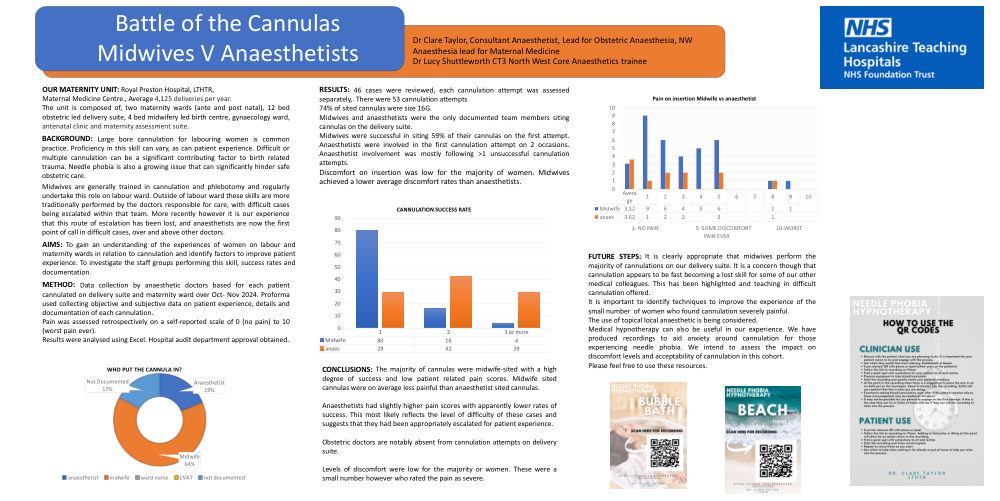
RESULTS: 46 cases were reviewed, each cannulation attempt was assessed separately,. There were 53 cannulation attempts
74% of sited cannulas were size 16G.
Midwives and anaesthetists were the only documented team members siting cannulas on the delivery suite.
Midwives were successful in siting 59% of their cannulas on the first attempt. Anaesthetists were involved in the first cannulation attempt on 2 occasions. Anaesthetist involvement was mostly following >1 unsuccessful cannulation attempts.
Discomfort on insertion was low for the majority of women. Midwives achieved a lower average discomfort rates than anaesthetists.
CONCLUSIONS: The majority of cannulas were midwife-sited with a high degree of success and low patient related pain scores. Midwife sited cannulas were on average less painful than anaesthetist sited cannulas.
Anaesthetists had slightly higher pain scores with apparently lower rates of success. This most likely reflects the level of difficulty of these cases and suggests that they had been appropriately escalated for patient experience.
Obstetric doctors are notably absent from cannulation attempts on delivery suite.
Levels of discomfort were low for the majority or women. These were a small number however who rated the pain as severe.
FUTURE STEPS:: It is clearly appropriate that midwives perform the majority of cannulations on our delivery suite. It is a concern though that cannulation appears to be fast becoming a lost skill for some of our other medical colleagues. This has been highlighted and teaching in difficult cannulation offered.
It is important to identify techniques to improve the experience of the small number of women who found cannulation severely painful.
The use of topical local anaesthetic is being considered.
Medical hypnotherapy can also be useful in our experience. We have produced recordings to aid anxiety around cannulation for those experiencing needle phobia. We intend to assess the impact on discomfort levels and acceptability of cannulation in this cohort.
Please feel free to use these resources.