215 posters, 5 topics, 22 sessions, 596 authors, 283 institutions
ePostersLive by SciGen Technologies S.A. All rights reserved.
Obstetric Anaesthesia Annual Scientific Meeting 2025
May 15 - 16, 2025 | ICC, 2 Lanyon Place, Belfast BT1 3WH

6781152
The changing role of Interventional Radiology (IR) in our placenta accreta spectrum (PAS) caesarean sections aiming to minimise blood loss
Poster Presenter
Part of Topic
Service Evaluation
The changing role of Interventional Radiology (IR) in our placenta accreta spectrum (PAS) caesarean sections aiming to minimise blood loss
Introduction
Our PAS caesarean section service is increasingly busy with cases increasing 43% in the last year. A key haemorrhage control technique in some cases has been prophylactic internal iliac balloon occlusion (PIIBO). While balloons are in situ the patient’s legs cannot be put in lithotomy position, lower limb perfusion monitoring is required, and some patients have had complications requiring intervention. [1] Historically, this has had a significant impact on the anaesthesia planned as balloon insertion was performed remote to the obstetric theatre and dislodgement was a risk of transfer, as well as additional hours of procedural time.
Methods
We retrospectively reviewed the last four years of patients having caesarean section for suspected PAS in our service. This project has been peer-reviewed and approved locally.
Results
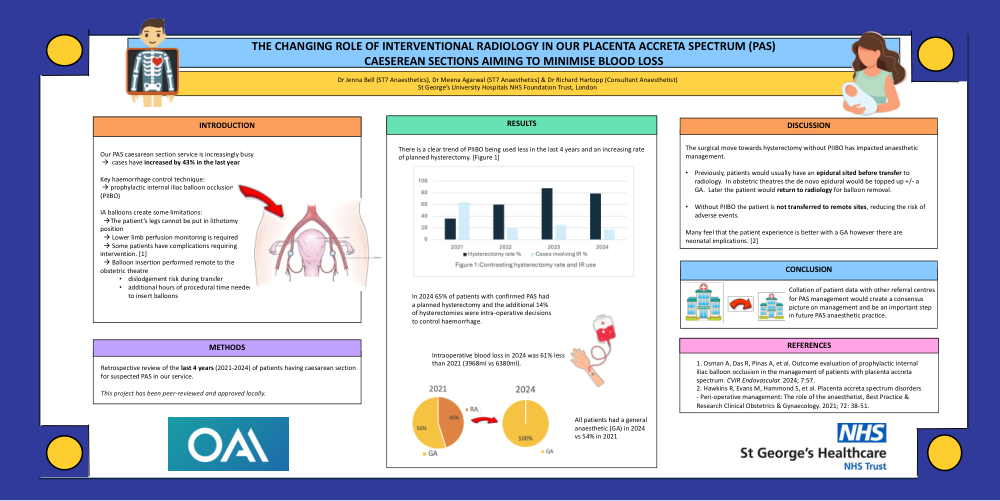
The is a clear trend of PIIBO being used less in the last four years and an increasing rate of planned hysterectomy. [Figure 1] In 2024 65% of patients with confirmed PAS had a planned hysterectomy and the additional 14% of hysterectomies were intra-operative decisions to control haemorrhage. Intraoperative blood loss in 2024 was 61% less than 2021 (3968ml vs 6380ml). All patients had a general anaesthetic (GA) in 2024 vs 54% in 2021.
Discussion
The surgical move towards hysterectomy without PIIBO has impacted anaesthetic management. Previously, patients would usually have an epidural sited before transfer to radiology. In obstetric theatres the de novo epidural would be topped up +/- a GA. Later the patient would return to radiology for balloon removal. Without PIIBO the patient is not transferred to remote sites, reducing the risk of adverse events. Many feel that the patient experience is better with a GA however there are neonatal implications. [2] Collation of patient data with other referral centres for PAS management would create a consensus picture on management and be an important step in future PAS anaesthetic practice.