215 posters, 5 topics, 22 sessions, 596 authors, 283 institutions
ePostersLive by SciGen Technologies S.A. All rights reserved.
Obstetric Anaesthesia Annual Scientific Meeting 2025
May 15 - 16, 2025 | ICC, 2 Lanyon Place, Belfast BT1 3WH

6780850
Intrauterine fetal resuscitation and the role of the anaesthetist
Poster Presenter
Part of Topic
Quality Improvement
Intrauterine fetal resuscitation and the role of the anaesthetist
Introduction
Fetal distress refers to progressive fetal asphyxia,
which can lead to permanent neurological damage or
death (1). When fetal distress is detected, conservative
interventions can be considered to reduce fetal
hypoxia. While these measures are typically
associated with obstetricians and midwives,
anaesthetists also play an important role. Early
intervention may improve fetal condition, potentially
avoiding operative delivery or allowing for alternative
anaesthetic techniques. This project aims to explore
anaesthetic trainees’ responses to fetal distress and
develop a practical learning tool to guide anaesthetists
in remembering key interventions for intrauterine
resuscitation.
Methods
Anaesthetic trainees were surveyed on their responses
to fetal distress in theatre. The voluntary survey
included questions on the frequency of intervention
and the specific actions taken. A literature review was
conducted to assess guidelines on intrauterine
resuscitation and evaluate existing aide-memoires,
which informed the creation of a focused aide-memoire
for obstetric anaesthetists.
Results
Six anaesthetic trainees responded to the voluntary survey.
66.7%reported taking measures only sometimes to improve
fetal distress. The most commonly described interventions
were changing maternal position and improving blood
pressure. Thurlow & Kinsella proposed the SPOILT
mnemonic for intrauterine fetal resuscitation, which stands
for: Syntocinon off; Position the mother; Oxygen; IV Fluid;
Low BP; and Tocolysis. (1) Although these measures remain
relevant, recent NICE guidelines emphasise conservative
management tailored to the cause of distress and notably,
state that oxygen should only begiven if the mother is
hypoxic. (2) Based on this updated guidance, we developed
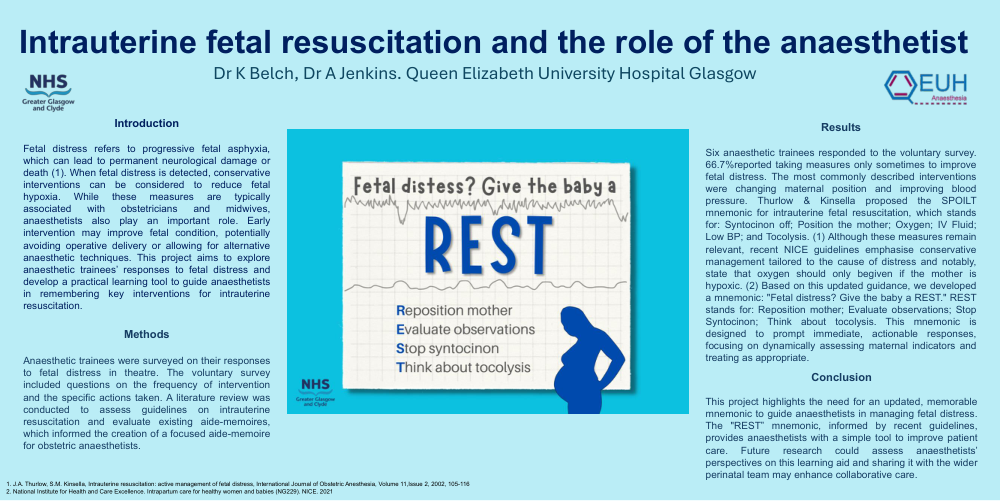
a mnemonic: "Fetal distress? Give the baby a REST." REST
stands for: Reposition mother; Evaluate observations; Stop
Syntocinon; Think about tocolysis. This mnemonic is
designed to prompt immediate, actionable responses,
focusing on dynamically assessing maternal indicators and
treating as appropriate.
Conclusion
This project highlights the need for an updated, memorable
mnemonic to guide anaesthetists in managing fetal distress.
The "REST” mnemonic, informed by recent guidelines,
provides anaesthetists with a simple tool to improve patient
care. Future research could assess anaesthetists’
perspectives on this learning aid and sharing it with the wider
perinatal team may enhance collaborative care.