215 posters, 5 topics, 22 sessions, 596 authors, 283 institutions
ePostersLive by SciGen Technologies S.A. All rights reserved.
Obstetric Anaesthesia Annual Scientific Meeting 2025
May 15 - 16, 2025 | ICC, 2 Lanyon Place, Belfast BT1 3WH

6780778
Addressing barriers to the use of remifentanil patient-controlled analgesia (PCA) during labour - a quality improvement project
Poster Presenter
Authors
Andreia Rodrigues Batista, Jonathan Robinson, Beddoes Penelope, Palin Robert, Fozia Hayat
Affiliations
Part of Topic
Quality Improvement
Addressing barriers to the use of remifentanil patient-controlled analgesia (PCA) during labour - a quality improvement project
Andreia Batista1 , Jonathan Robinson1 , Penelope Beddoes1 , Robert Palin1 and Fozia Hayat1
1Bradford Teaching Hospitals NHS Foundation Trust
Introduction
Pain during labour is a major concern for many pregnant women for whom effective pain relief is an important element of a positive maternal experience.
Though lumbar epidural remains the gold standard for labour analgesia some women can not have or do not want an epidural.
Remifentanil (PCA) has been shown to be the most effective non-neuraxial analgesia method. It is associated with high levels of maternal satisfaction, has a good safety profile, and may reduce rates of instrumental delivery(1,2). Despite this, its use is still limited in our unit.
This quality improvement project aimed to explore and address barriers to the use of remifentanil PCA at the Bradford Royal Infirmary, which has a busy maternity unit with over 6000 deliveries annually.
Methods
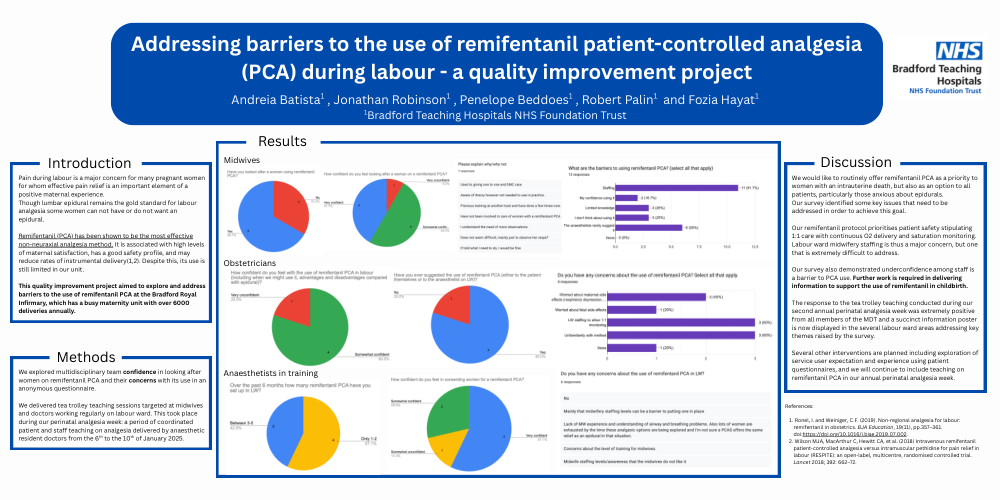
We explored multidisciplinary team confidence in looking after women on remifentanil PCA and their concerns with its use in an anonymous questionnaire.
We delivered tea trolley teaching sessions targeted at midwives and doctors working regularly on labour ward. This took place during our perinatal analgesia week: a period of coordinated patient and staff teaching on analgesia delivered by anaesthetic resident doctors from the 6th to the 10th of January 2025.
Discussion
We would like to routinely offer remifentanil PCA as a priority to women with an intrauterine death, but also as an option to all patients, particularly those anxious about epidurals. Our survey identified some key issues that need to be addressed in order to achieve this goal.
Our remifentanil protocol prioritises patient safety stipulating 1:1 care with continuous O2 delivery and saturation monitoring. Labour ward midwife staffing is thus a major concern, but one that is extremely difficult to address.
Our survey also demonstrated underconfidence among staff is a barrier to PCA use. Further work is required in delivering information to support the use of remifentanil in childbirth.
The response to the tea trolley teaching conducted during our second annual perinatal analgesia week was extremely positive from all members of the MDT and a succinct information poster is now displayed in the several labourward areas addressing key themes raised by the survey.
Several other interventions are planned including exploration of service user expectation and experience using patient questionnaires, and we will continue to include teaching on remifentanil PCA in our annual perinatal analgesia week.