215 posters, 5 topics, 22 sessions, 596 authors, 283 institutions
ePostersLive by SciGen Technologies S.A. All rights reserved.
Obstetric Anaesthesia Annual Scientific Meeting 2025
May 15 - 16, 2025 | ICC, 2 Lanyon Place, Belfast BT1 3WH

6780722
Constipation in emergency caesarean section patients; a service evaluation
Poster Presenter
Authors
Affiliations
Part of Topic
Service Evaluation
Constipation after Emergency Caesarean Section
Dr Emily Leadbeater, Dr Richard Skelly, Dr Suni Halder
Oxford University Hospitals NHS Foundation Trust
Introduction
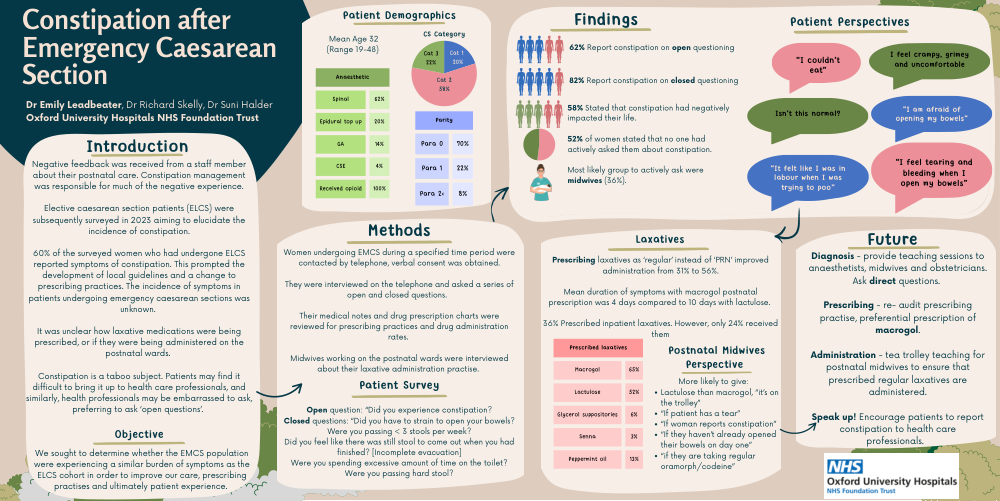
Negative feedback was received from a staff member about their postnatal care. Constipation management was responsible for much of the negative experience.
Elective caesarean section patients (ELCS) were subsequently surveyed in 2023 aiming to elucidate the incidence of constipation.
60% of the surveyed women who had undergone ELCS reported symptoms of constipation. This prompted the development of local guidelines and a change to prescribing practices. The incidence of symptoms in patients undergoing emergency caesarean sections was unknown.
It was unclear how laxative medications were being prescribed, or if they were being administered on the postnatal wards.
Constipation is a taboo subject. Patients may find it difficult to bring it up to health care professionals, and similarly, health professionals may be embarrassed to ask, preferring to ask ‘open questions’.
Objective
We sought to determine whether the EMCS population were experiencing a similar burden of symptoms as the ELCS cohort in order to improve our care, prescribing practises and ultimately patient experience.
Methods
Women undergoing EMCS during a specified time period were contacted by telephone, verbal consent was obtained.
They were interviewed on the telephone and asked a series of open and closed questions.
Their medical notes and drug prescription charts were reviewed for prescribing practices and drug administration rates.
Midwives working on the postnatal wards were interviewed about their laxative administration practise.
Patient survey
Open question: “Did you experience constipation?
Closed questions: “Did you have to strain to open your bowels?
Were you passing < 3 stools per week?
Did you feel like there was still stool to come out when you had finished? [Incomplete evacuation]
Were you spending excessive amount of time on the toilet?
Were you passing hard stool?
Findings
62% Report constipation on open questioning
82% Report constipation on closed questioning
58% Stated that constipation had negatively impacted their life.
52% of women stated that no one had actively asked them about constipation.
Most likely group to actively ask were midwives (36%).
Laxatives
Prescribing laxatives as ‘regular’ instead of ‘PRN’ improved administration from 31% to 56%.
Mean duration of symptoms with macrogol postnatal prescription was 4 days compared to 10 days with lactulose.
36% Prescribed inpatient laxatives. However, only 24% received them.
Postnatal midwives perspective
More likely to give:
- Lactulose than macrogol, “it’s on the trolley”
- “If patient has a tear”
- “If woman reports constipation”
- “If they haven’t already opened their bowels on day one”
- “if they are taking regular oramorph/codeine”
Future
Diagnosis - provide teaching sessions to anaesthetists, midwives and obstetricians. Ask direct questions.
Prescribing - re- audit prescribing practise, preferential prescription of macrogol.
Administration - tea trolley teaching for postnatal midwives to ensure that prescribed regular laxatives are administered.
Speak up! Encourage patients to report constipation to health care professionals.