215 posters, 5 topics, 22 sessions, 596 authors, 283 institutions
ePostersLive by SciGen Technologies S.A. All rights reserved.
Obstetric Anaesthesia Annual Scientific Meeting 2025
May 15 - 16, 2025 | ICC, 2 Lanyon Place, Belfast BT1 3WH

6767750
Audit of blood pressure cuff size use in obstetric patients
Poster Presenter
Part of Topic
Quality Improvement
INTRODUCTION
Hypertensive disorders occur in 8-10% of all pregnancies, and blood pressure (BP) management is a key part of antenatal and intrapartum care1. Hypertension in pregnancy could be due to chronic hypertension, gestational hypertension or pre-eclampsia. Careful control of BP during labour and delivery is important for minimising risk of complications from these conditions. The NICE guidelines on Hypertension in pregnancy recommend a target BP of 135/851. The size of cuff used to measure BP can have a significant effect on the accuracy of the reading. BP cuffs that are too small will overestimate the BP, whilst cuffs that are too large will underestimate the BP. A recent randomised control trial found that measuring the BP with a regular sized cuff on a patient who should have a large cuff resulted in an increase in the systolic BP by 4.8mmHg. When a regular sized cuff was used on a patient who should have had an extra-large cuff the systolic BP increased by 19.5mmHg2. Data from the 7th National Audit Project (NAP7) showed that 28% of obstetric patients were overweight; 18% were obese class 1; 8% were obese class 2; and 5% were obese class 33. We hypothesised that on our labour ward there were a significant number of patients that were having their BP measured with an incorrect cuff size, leading to either possible delay in diagnosing a raised BP or to misdiagnosis of hypertension and unnecessary medication.
METHODS
The middle upper arm circumference and the BP cuff size being used were collected for 100 obstetric patients on labour ward and those having elective caesarean sections. We also collected data on whether the patient had been diagnosed with hypertension, and if so whether they were medicated for it. The data was collected over an eight-month period from March to June 2024, across a range of shifts including day, night and weekend shifts. This was with the aim to partially blind midwives to the study so as not to influence a change in their practice.
RESULTS
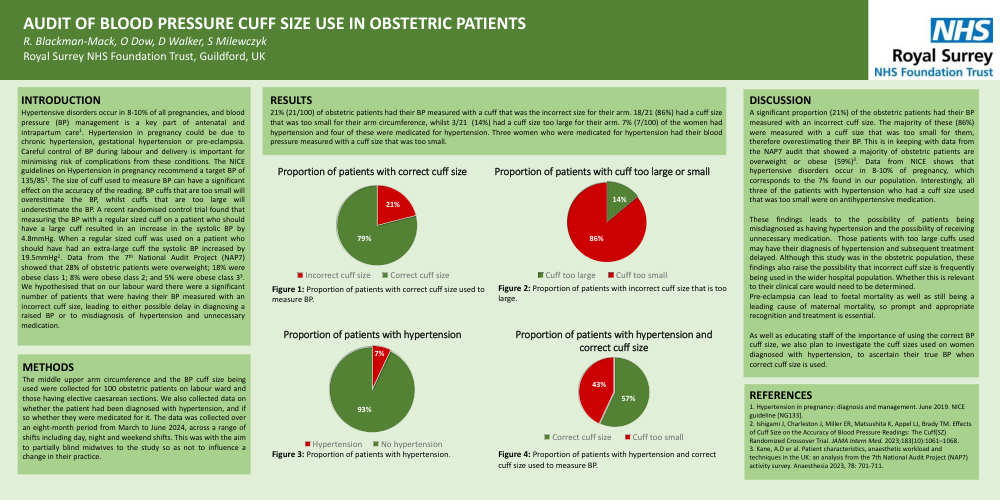
21% (21/100) of obstetric patients had their BP measured with a cuff that was the incorrect size for their arm. 18/21 (86%) had a cuff size that was too small for their arm circumference, whilst 3/21 (14%) had a cuff size too large for their arm. 7% (7/100) of the women had hypertension and four of these were medicated for hypertension. Three women who were medicated for hypertension had their blood pressure measured with a cuff size that was too small.
DISCUSSION
A significant proportion (21%) of the obstetric patients had their BP measured with an incorrect cuff size. The majority of these (86%) were measured with a cuff size that was too small for them, therefore overestimating their BP. This is in keeping with data from the NAP7 audit that showed a majority of obstetric patients are overweight or obese (59%)3. Data from NICE shows that hypertensive disorders occur in 8-10% of pregnancy, which corresponds to the 7% found in our population. Interestingly, all three of the patients with hypertension who had a cuff size used that was too small were on antihypertensive medication.
These findings leads to the possibility of patients being misdiagnosed as having hypertension and the possibility of receiving unnecessary medication. Those patients with too large cuffs used may have their diagnosis of hypertension and subsequent treatment delayed. Although this study was in the obstetric population, these findings also raise the possibility that incorrect cuff size is frequently being used in the wider hospital population. Whether this is relevant to their clinical care would need to be determined.
Pre-eclampsia can lead to foetal mortality as well as still being a leading cause of maternal mortality, so prompt and appropriate recognition and treatment is essential.
As well as educating staff of the importance of using the correct BP cuff size, we also plan to investigate the cuff sizes used on women diagnosed with hypertension, to ascertain their true BP when correct cuff size is used.
REFERENCES
1. Hypertension in pregnancy: diagnosis and management. June 2019. NICE guideline [NG133].
2. Ishigami J, Charleston J, Miller ER, Matsushita K, Appel LJ, Brady TM. Effects of Cuff Size on the Accuracy of Blood Pressure Readings: The Cuff(SZ) Randomized Crossover Trial. JAMA Intern Med. 2023;183(10):1061–1068.
3. Kane, A.D er al. Patient characteristics, anaesthetic workload and techniques in the UK: an analysis from the 7th National Audit Project (NAP7) activity survey. Anaesthesia 2023, 78: 701-711.