215 posters, 5 topics, 22 sessions, 596 authors, 283 institutions
ePostersLive by SciGen Technologies S.A. All rights reserved.
Obstetric Anaesthesia Annual Scientific Meeting 2025
May 15 - 16, 2025 | ICC, 2 Lanyon Place, Belfast BT1 3WH

6780644
An 11 Year Review of Maternity Admissions to the Intensive Care Unit, Ulster Hospital, Northern Ireland
Poster Presenter
Part of Topic
Service Evaluation
An 11 Year Review of Maternity Admissions to the Intensive Care Unit, Ulster Hospital, Northern Ireland
Dr Hannah Houston (CT3 Anaesthetics), Dr Leanne Laverty (Consultant Anaesthetist), Dr Claire Jamison (Consultant ICM & Anaesthetics)
Introduction
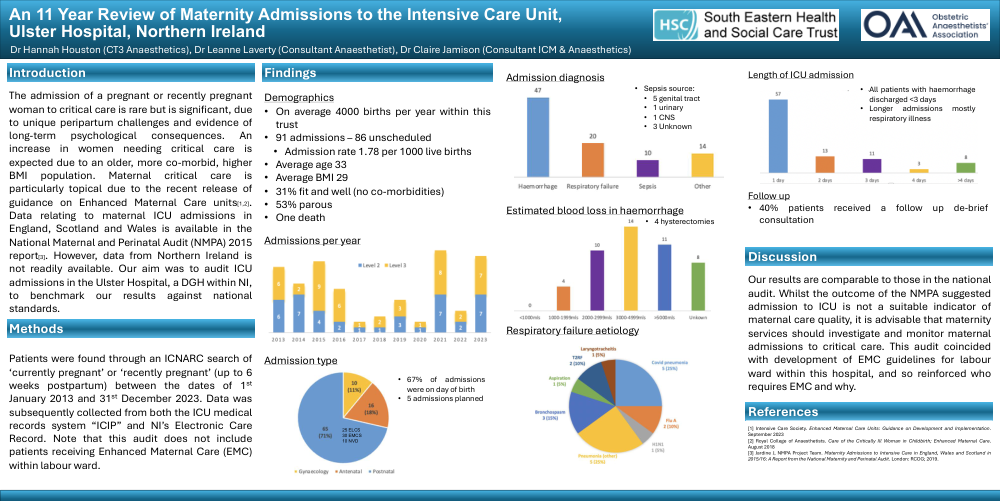
The admission of a pregnant or recently pregnant woman to critical care is rare but is significant, due to unique peripartum challenges and evidence of long-term psychological consequences. An increase in women needing critical care is expected due to an older, more co-morbid, higher BMI population. Maternal critical care is particularly topical due to the recent release of guidance on Enhanced Maternal Care units[1,2]. Data relating to maternal ICU admissions in England, Scotland and Wales is available in the National Maternal and Perinatal Audit (NMPA) 2015 report[3]. However, data from Northern Ireland is not readily available. Our aim was to audit ICU admissions in the Ulster Hospital, a DGH within NI, to benchmark our results against national standards.
Methods
Patients were found through an ICNARC search of ‘currently pregnant’ or ‘recently pregnant’ (up to 6 weeks postpartum) between the dates of 1st January 2013 and 31st December 2023. Data was subsequently collected from both the ICU medical records system “ICIP” and NI’s Electronic Care Record. Note that this audit does not include patients receiving Enhanced Maternal Care (EMC) within labour ward.
Findings
Demographics
Admissions per year
Admission type
Admission diagnosis
Estimated blood loss
Respiratory failure aetiology
Length of ICU admission
Follow up
Our results are comparable to those in the national audit. Whilst the outcome of the NMPA suggested admission to ICU is not a suitable indicator of maternal care quality, it is advisable that maternity services should investigate and monitor maternal admissions to critical care. This audit coincided with development of EMC guidelines for labour ward within this hospital, and so reinforced who requires EMC and why.
References
[1] Intensive Care Society. Enhanced Maternal Care Units: Guidance on Development and Implementation. September 2023
[2] Royal College of Anaesthetists. Care of the Critically Ill Woman in Childbirth; Enhanced Maternal Care. August 2018
[3] Jardine J, NMPA Project Team. Maternity Admissions to Intensive Care in England, Wales and Scotland in 2015/16: A Report from the National Maternity and Perinatal Audit. London: RCOG; 2019.