215 posters, 5 topics, 22 sessions, 596 authors, 283 institutions
ePostersLive by SciGen Technologies S.A. All rights reserved.
Obstetric Anaesthesia Annual Scientific Meeting 2025
May 15 - 16, 2025 | ICC, 2 Lanyon Place, Belfast BT1 3WH

6780435
Improving the peripartum pathway for obstetric Jehovah's Witness patients
Poster Presenter
Authors
Affiliations
Part of Topic
Service Evaluation
Abstract ID: 6780435
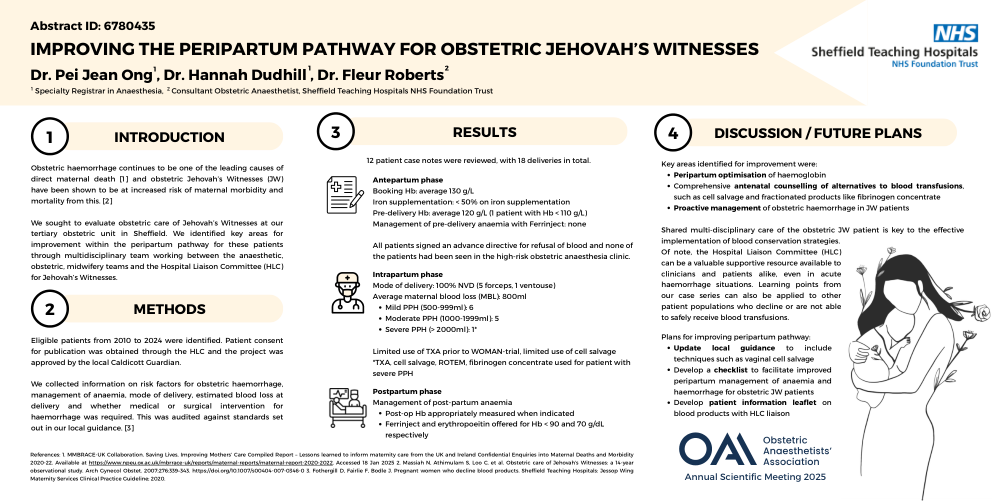
Improving the peripartum pathway for obstetric Jehovah’s Witnesses
Introduction
Obstetric haemorrhage continues to be one of the leading causes of direct maternal death [1] and obstetric Jehovah’s Witnesses (JW) have been shown to be at increased risk of maternal morbidity and mortality from this. [2]
We sought to evaluate obstetric care of Jehovah’s Witnesses at our tertiary obstetric unit in Sheffield. We identified key areas for improvement within the peripartum pathway for these patients through multidisciplinary team working between the anaesthetic, obstetric, midwifery teams and the Hospital Liaison Committee (HLC) for Jehovah’s Witnesses.
Methods
Eligible patients from 2010 to 2024 were identified. Patient consent for publication was obtained through the HLC and the project was approved by the local Caldicott Guardian.
We collected information on risk factors for obstetric haemorrhage, management of anaemia, mode of delivery, estimated blood loss at delivery and whether medical or surgical intervention for haemorrhage was required. This was audited against standards set out in our local guidance. [3]
Results
12 patient case notes were reviewed, with 18 deliveries in total.
Antepartum phase
Booking Hb: average 130 g/L
Iron supplementation: < 50% on iron supplementation
Pre-delivery Hb: average 120 g/L (1 patient with Hb < 110 g/L)
Management of pre-delivery anaemia with Ferrinject: none
All patients signed an advance directive for refusal of blood and none of the patients had been seen in the high-risk obstetric anaesthesia clinic.
Intrapartum phase
Mode of delivery: 100% NVD (5 forceps, 1 ventouse)
Average maternal blood loss (MBL): 800ml
- Mild PPH (500-999ml): 6
- Moderate PPH (1000-1999ml): 5
- Severe PPH (> 2000ml): 1*
Limited use of TXA prior to WOMAN-trial, limited use of cell salvage
*TXA, cell salvage, ROTEM, fibrinogen concentrate used for patient with severe PPH
Postpartum phase
Management of post-partum anaemia
- Post-op Hb appropriately measured when indicated
- Ferrinject and erythropoeitin offered for Hb < 90 and 70 g/dL respectively
Discussion
Key areas identified for improvement were:
- Peripartum optimisation of haemoglobin
- Comprehensive antenatal counselling of alternatives to blood transfusions, such as cell salvage and fractionated products like fibrinogen concentrate
- Proactive management of obstetric haemorrhage in JW patients
Shared multi-disciplinary care of the obstetric JW patient is key to the effective implementation of blood conservation strategies. Of note, the Hospital Liaison Committee (HLC) can be a valuable supportive resource available to clinicians and patients alike, even in acute haemorrhage situations. Learning points from our case series can also be applied to other patient populations who decline or are not able to safely receive blood transfusions.
Future Plans
Plans for improving peripartum pathway:
- Update local guidance to include techniques such as vaginal cell salvage
- Develop a checklist to facilitate improved peripartum management of anaemia and haemorrhage for obstetric JW patients
- Develop patient information leaflet on blood products with HLC liaison
References
1. MMBRACE-UK Collaboration. Saving Lives, Improving Mothers’ Care Compiled Report – Lessons learned to inform maternity care from the UK and Ireland Confidential Enquiries into Maternal Deaths and Morbidity 2020-22. Available at https://www.npeu.ox.ac.uk/mbrrace-uk/reports/maternal-reports/maternal-report-2020-2022. Accessed 18 Jan 2025
2. Massiah N, Athimulam S, Loo C, et al. Obstetric care of Jehovah’s Witnesses: a 14-year observational study. Arch Gynecol Obstet. 2007;276:339–343. https://doi.org/10.1007/s00404-007-0346-0
3. Fothergill D, Fairlie F, Bodle J. Pregnant women who decline blood products. Sheffield Teaching Hospitals: Jessop Wing Maternity Services Clinical Practice Guideline; 2020.