215 posters, 5 topics, 22 sessions, 596 authors, 283 institutions
ePostersLive by SciGen Technologies S.A. All rights reserved.
Obstetric Anaesthesia Annual Scientific Meeting 2025
May 15 - 16, 2025 | ICC, 2 Lanyon Place, Belfast BT1 3WH

6780389
Analgesia after delivery in Placenta Accreta Spectrum disorder
Poster Presenter
Part of Topic
Service Evaluation
Introduction
Placenta Accreta Spectrum (PAS) disorder mandates operative delivery. At the more severe end of the spectrum, midline laparotomy and hysterectomy are required, and analgesia requirements are higher than following a standard caesarean delivery. As a regional tertiary centre, Princess Royal Maternity Hospital undertakes regular deliveries of women with severe PAS disorder. A standardised approach to anaesthetic
management is desirable [1], however, the optimum analgesic approach is unclear, and will vary between individuals, due to the extent of disease, and the nature of
the delivery. We aimed to evaluate current approaches to postoperative analgesic management in PAS patients.
Methods
A retrospective review of electronic and paper case notes was undertaken for all PAS patients who delivered at Princess Royal Maternity Hospital, Glasgow, during 2023.
Data on postoperative analgesia for days zero to three was collected.
Results:
Twelve charts were reviewed. All patients had a midline laparotomy and 10 had hysterectomy. Anaesthetic management was: five spinals, with planned GA
conversion, six CSEs (two GA conversions), and one GA. All neuraxial techniques included opioids (diamorphine or morphine 300mcg). Intraoperative analgesia was
variable between cases, with a minority receiving paracetamol, NSAID, or clonidine as part of multimodal analgesia in theatre. Opioids used included remifentanil,
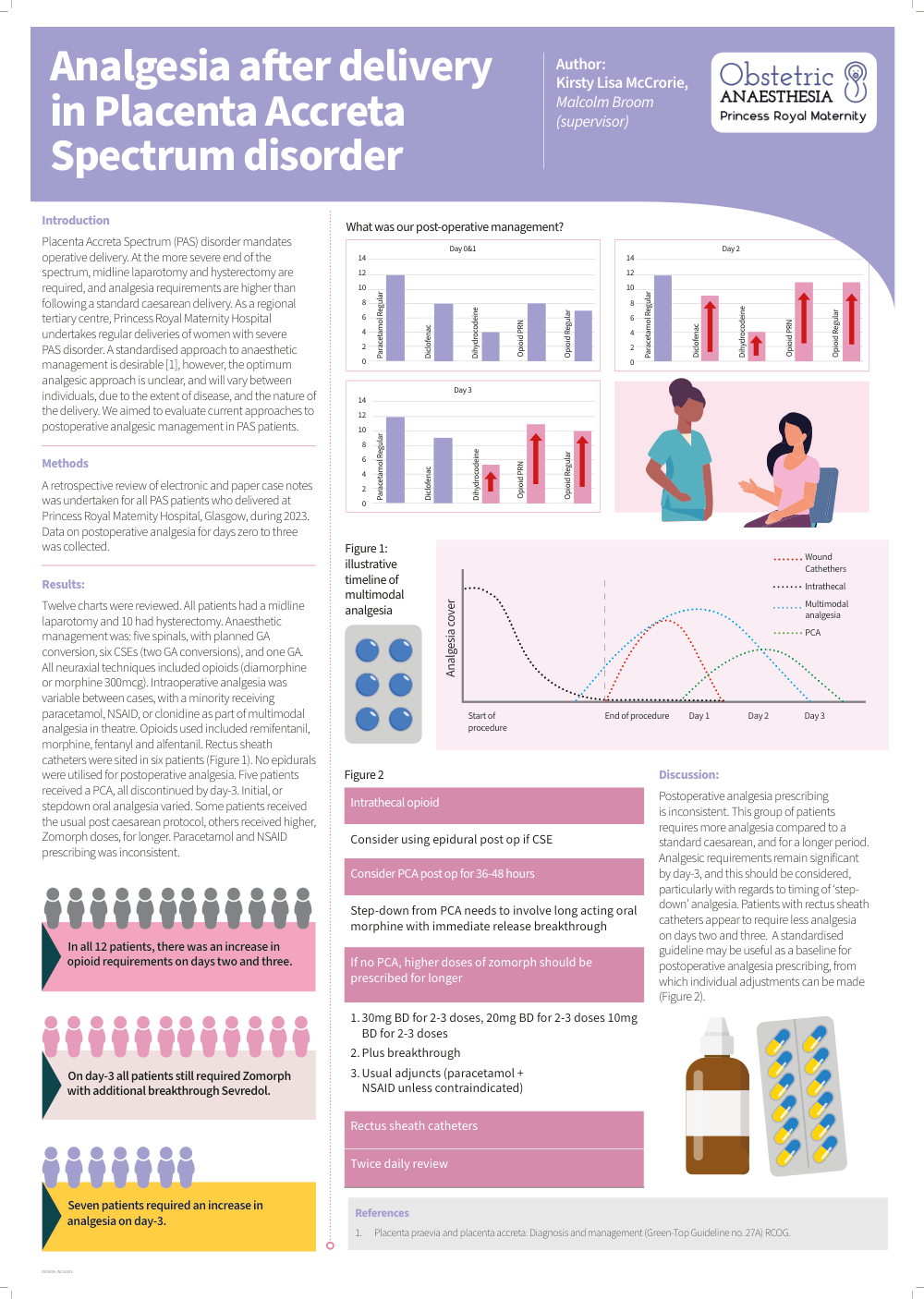
morphine, fentanyl and alfentanil. Rectus sheath catheters were sited in six patients (Figure 1). No epidurals were utilised for postoperative analgesia. Five patients
received a PCA, all discontinued by day-3. Initial, or stepdown oral analgesia varied. Some patients received the usual post caesarean protocol, others received higher,
Zomorph doses, for longer. Paracetamol and NSAID prescribing was inconsistent.
Discussion:
Postoperative analgesia prescribing is inconsistent. This group of patients requires more analgesia compared to a standard caesarean, and for a longer period.
Analgesic requirements remain significant by day-3, and this should be considered, particularly with regards to timing of ‘stepdown’ analgesia. Patients with rectus sheath catheters appear to require less analgesia on days two and three. A standardised guideline may be useful as a baseline for postoperative analgesia prescribing, from which individual adjustments can be made (Figure 2).