215 posters, 5 topics, 22 sessions, 596 authors, 283 institutions
ePostersLive by SciGen Technologies S.A. All rights reserved.
Obstetric Anaesthesia Annual Scientific Meeting 2025
May 15 - 16, 2025 | ICC, 2 Lanyon Place, Belfast BT1 3WH

6780043
Optimising Postpartum Haemorrhage (PPH) Management at a High Risk Obstetric Centre: A Multidisciplinary Approach to embed OBSCymru principles
Poster Presenter
Authors
Zahra Rajput, Kelly Feane, Uprichard James, Hughes Polly, Meenakshi Agarwal, Catherine Lloyd
Affiliations
Part of Topic
Quality Improvement
Optimising Postpartum Haemorrhage (PPH) Management at a High Risk Obstetric Centre: A multidisciplinary approach to embed OBSCymruprinciples
Authors: Dr Zahra Rajput1, Kelly Feane2, Dr James Uprichard3, Miss Polly Hughes4, Dr Meenakshi Agarwal5, Dr Catherine Lloyd6
Anaesthetic Registrar1,5, Lead Transfusion Practitioner2, Consultant Haematologist3, Consultant Obstetrician4, Consultant Anaesthetist6.
St George’s University Hospitals NHS Trust, London, UK
INTRODUCTION
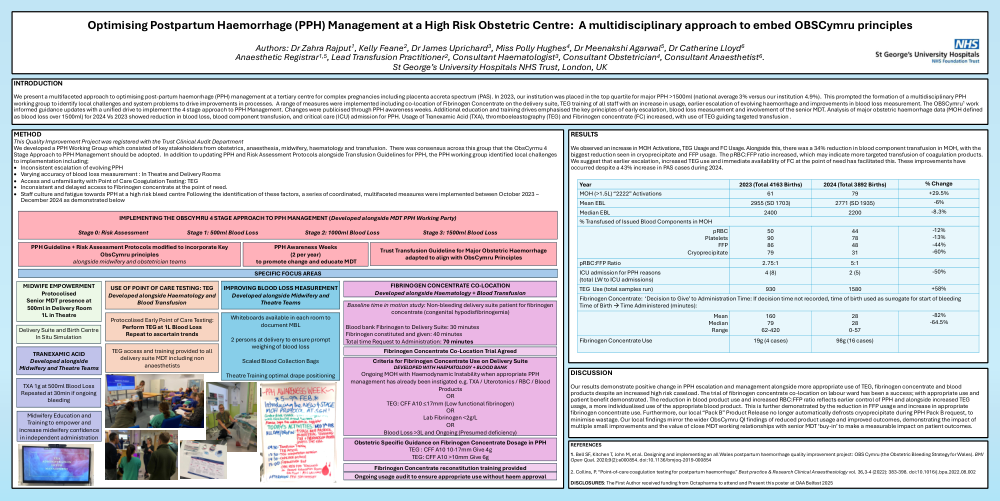
We present a multifaceted approach to optimising post-partum haemorrhage (PPH) management at a tertiary centre for complex pregnancies including placenta accreta spectrum (PAS). In 2023, our institution was placed in the top quartile for major PPH >1500ml (national average 3% versus our institution 4.9%). This prompted the formation of a multidisciplinary PPH working group to identify local challenges and system problems to drive improvements in processes. A range of measures were implemented including co-location of Fibrinogen Concentrate on the delivery suite, TEG training of all staff with an increase in usage, earlier escalation of evolving haemorrhage and improvements in blood loss measurement. The OBSCymru1 work informed guidance updates with a unified drive to implement the 4 stage approach to PPH Management. Changes were publicised through PPH awareness weeks. Additional education and training drives emphasised the key principles of early escalation, blood loss measurement and involvement of the senior MDT. Analysis of major obstetric haemorrhage data (MOH defined as blood loss over 1500ml) for 2024 Vs 2023 showed reduction in blood loss, blood component transfusion, and critical care (ICU) admission for PPH. Usage of Tranexamic Acid (TXA), thromboeleastography(TEG) and Fibrinogen concentrate (FC) increased, with use of TEG guiding targeted transfusion.