215 posters, 5 topics, 22 sessions, 596 authors, 283 institutions
ePostersLive by SciGen Technologies S.A. All rights reserved.
Obstetric Anaesthesia Annual Scientific Meeting 2025
May 15 - 16, 2025 | ICC, 2 Lanyon Place, Belfast BT1 3WH

6779923
Documentation of compassionate patient interactions in obstetric anaesthetic care
Poster Presenter
Authors
Affiliations
Part of Topic
Service Evaluation
Introduction
Uncompassionate maternity care can be a major contributor to psychological harm, poor birth experience, complaints and litigation. Conversely, compassionate care can significantly improve maternal well being and birth experience. It fosters trust, reduces fear and anxiety and can positively influence the postpartum recovery and mother-baby bond.
The Kirkup Report1 states that "every interaction must be based on kindness and respect" and that those responsible "be commissioned to report on how compassionate care .. be embedded into practice.“ As compassion is cornerstone to maternity care and complaints and claims rise, we aimed to assess if/how compassionate interactions/care are documented.
There is no universal definition of compassion in healthcare. The following attributes occur repeatedly in literature2: recognition of suffering, emotional connection to the person suffering and motivation to act/help
When reviewing events, what is written contemporaneously is essential. Good Medical Practice3 recommends that “concerns or preferences expressed by the patient that might be relevant to their ongoing care, and whether these were addressed”, should be included in the patient’s medical record.
Method
Obstetric antenatal clinic records were interrogated from November to December 2024. This clinic was chosen as there is perceived to be more time compared to labour ward interactions and more free text opportunities on our institution’s electronic patient record.
Documentation was reviewed for evidence of compassion. As there is no standard definition to compare/audit against, author discretion was used to determine if evidence of compassion was present.
Results
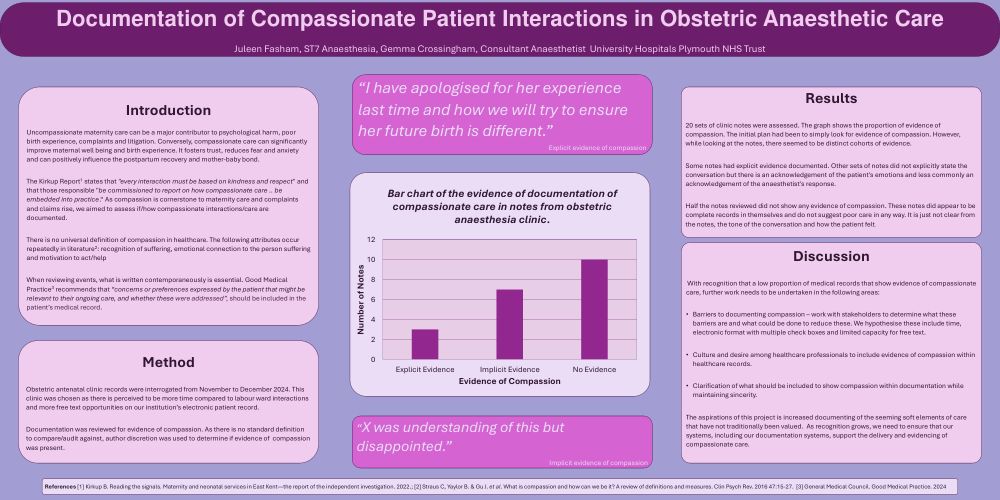
20 sets of clinic notes were assessed. The graph shows the proportion of evidence of compassion. The initial plan had been to simply look for evidence of compassion. However, while looking at the notes, there seemed to be distinct cohorts of evidence.
Some notes had explicit evidence documented. Other sets of notes did not explicitly state the conversation but there is an acknowledgement of the patient's emotions and less commonly an acknowledgement of the anaesthetist's response.
Half the notes reviewed did not show any evidence of compassion. These notes did appear to be complete records in themselves and do not suggest poor care in any way. It is just not clear from the notes, the tone of the conversation and how the patient felt.
Discussion
With recognition that a low proportion of medical records that show evidence of compassionate care, further work needs to be undertaken in the following areas: