215 posters, 5 topics, 22 sessions, 596 authors, 283 institutions
ePostersLive by SciGen Technologies S.A. All rights reserved.
Obstetric Anaesthesia Annual Scientific Meeting 2025
May 15 - 16, 2025 | ICC, 2 Lanyon Place, Belfast BT1 3WH

6779788
Anaesthesia for fetoscopic management of twin to twin transfusion syndrome
Poster Presenter
Authors
Affiliations
Part of Topic
Service Evaluation
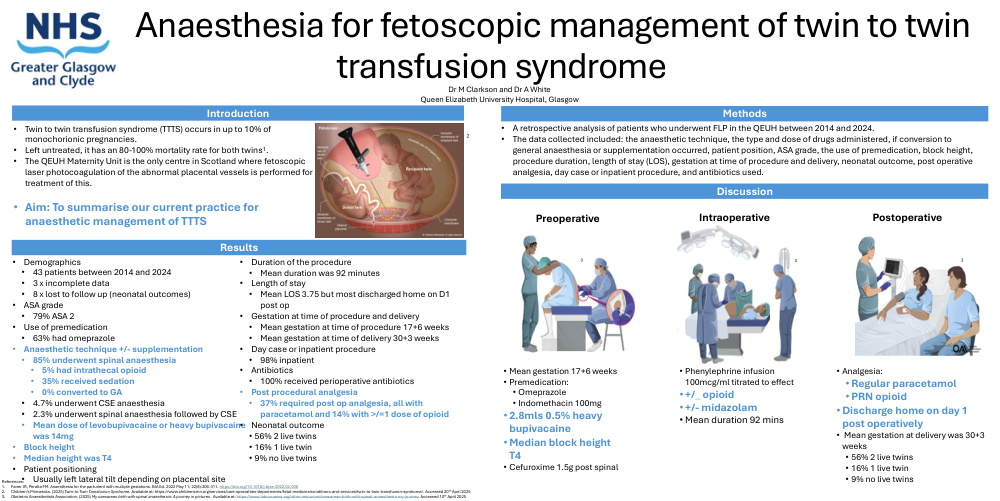
Anaesthesia for fetoscopic management of twin to twintransfusion syndrome. Dr M Clarkson and Dr A White, Queen Elizabeth University Hospital, Glasgow
Introduction
•Twin to twin transfusion syndrome (TTTS) occurs in up to 10% of monochorionic pregnancies.
•Left untreated, it has an 80-100% mortality rate for both twins1.
•The QEUH Maternity Unit is the only centre in Scotland where fetoscopic laser photocoagulation of the abnormal placental vessels is performed for treatment of this.
•Aim: To summarise our current practice for anaesthetic management of TTTS
Methods
•A retrospective analysis of patients who underwent FLP in the QEUH between 2014 and 2024.
•The data collected included: the anaesthetic technique, the type and dose of drugs administered, if conversion to general anaesthesia or supplementation occurred, patient position, ASA grade, the use of premedication, block height, procedure duration, length of stay (LOS), gestation at time of procedure and delivery, neonatal outcome, post operative analgesia, day case or inpatient procedure, and antibiotics used.
Results
•Demographics
•43 patients between 2014 and 2024
•3 x incomplete data
•8 x lost to follow up (neonatal outcomes)
•ASA grade
•79% ASA 2
•Use of premedication
•63% had omeprazole
•Anaesthetic technique +/- supplementation
•85% underwent spinal anaesthesia
•5% had intrathecal opioid
•35% received sedation
•0% converted to GA
•4.7% underwent CSE anaesthesia
•2.3% underwent spinal anaesthesia followed by CSE
•Mean dose of levobupivacaine or heavy bupivacaine was 14mg
•Block height
•Median height was T4
•Patient positioning
•Usually left lateral tilt depending on placental site
•Duration of the procedure
•Mean duration was 92 minutes
•Length of stay
•Mean LOS 3.75 but most discharged home on D1 post op
•Gestation at time of procedure and delivery
•Mean gestation at time of procedure 17+6 weeks
•Mean gestation at time of delivery 30+3 weeks
•Day case or inpatient procedure
•98% inpatient
•Antibiotics
•100% received perioperative antibiotics
•Post procedural analgesia
•37% required post op analgesia, all with paracetamol and 14% with >/=1 dose of opioid
•Neonatal outcome
•56% 2 live twins
•16% 1 live twin
•9% no live twins
Discussion
Preoperative:
•Mean gestation 17+6 weeks
•Premedication:
•Omeprazole
•Indomethacin 100mg
•2.8mls 0.5% heavy bupivacaine
•Median block height T4
Cefuroxime 1.5g post spinalIntraoperative:
•Phenylephrine infusion 100mcg/ml titrated to effect
•+/_ opioid
•+/- midazolam
•Mean duration 92 mins
Postoperative
•Analgesia:
•Regular paracetamol
•PRN opioid
•Discharge home on day 1 post operatively
• Mean gestation at delivery was 30+3 weeks
•56% 2 live twins
•16% 1 live twin
•9% no live twins
References:
1.Farrer JR, Peralta FM. Anaesthesia for the parturient with multiple gestations. BJA Ed. 2022 May 11; 22(8):306-311. https://doi.org/10.1016/j.bjae.2022.02.008
2.Children’s Minnesota. (2025) Twin-to-Twin Transfusion Syndrome. Available at: https://www.childrensmn.org/services/care-specialties-departments/fetal-medicine/conditions-and-services/twin-to-twin-transfusion-syndrome/. Accessed 20th April 2025
3.Obstetric Anaesthetists Association. (2025) My caesarean birth with spinal anaesthesia: A journey in pictures. Available at: https://www.labourpains.org/other-resources/caesarean-birth-with-spinal-anaesthesia-my-journey. Accessed 10th April 2025