215 posters, 5 topics, 22 sessions, 596 authors, 283 institutions
ePostersLive by SciGen Technologies S.A. All rights reserved.
Obstetric Anaesthesia Annual Scientific Meeting 2025
May 15 - 16, 2025 | ICC, 2 Lanyon Place, Belfast BT1 3WH

6779685
Adjusting to NRFit epidural needles in obstetric units at University Hospitals Sussex
Poster Presenter
Authors
Affiliations
Part of Topic
Service Evaluation
Adjusting to NRFit epidural needles in obstetric units at University Hospitals Sussex
A. Ball, J. Siu, A. Chubb, S. Green
Introduction
In January 2024, a National Patient Safety Alert was issued by NHS England, instructing every provider to transition to NRFit connectors for all intrathecal and epidural procedures1. Following this advice, University Hospitals Sussex transitioned from Luer epidural devices to NRFit across all departments. Following concerns about the new needles, complications rates were analysed, and a questionnaire was sent out to users.
Methods
A retrospective analysis of epidural insertion complication rates was carried out using the obstetric database Badgernet. 558 episodes were analysed in total. The former Portex Luer devices were compared with the Portex NRFit needles that had replaced them. Complication rates were statistically analysed. Following high complication rates and a departmental survey reporting a dislike of the new equipment, Portex NRFit needles were replaced with Pajunk needles, and complication rates were reaudited.
Results
1) Bleeding
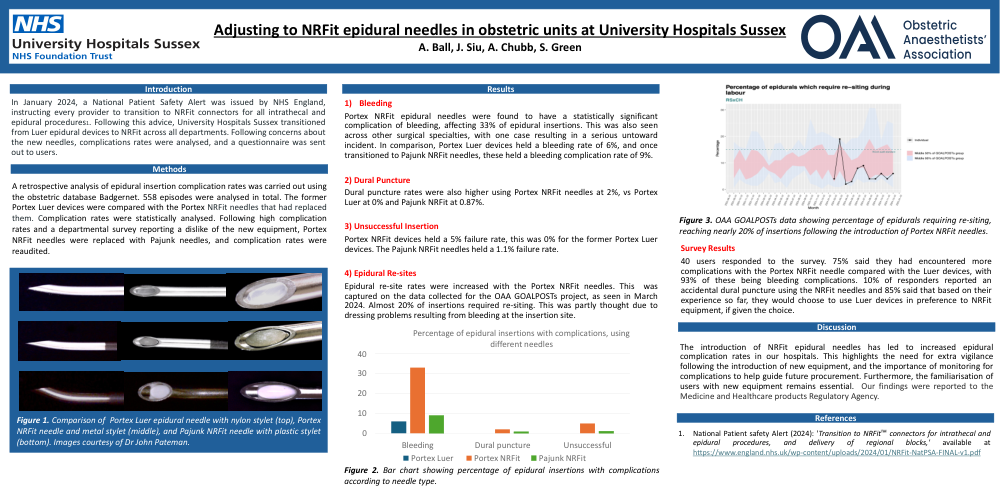
Portex NRFit epidural needles were found to have a statistically significant complication of bleeding, affecting 33% of epidural insertions. This was also seen across other surgical specialties, with one case resulting in a serious untoward incident. In comparison, Portex Luer devices held a bleeding rate of 6%, and once transitioned to PajunkNRFit needles, these held a bleeding complication rate of 9%.
2) Dural Puncture
Dural puncture rates were also higher using Portex NRFit needles at 2%, vs Portex Luer at 0% and PajunkNRFit at 0.87%.
3) Unsuccessful Insertion
Portex NRFit devices held a 5% failure rate, this was 0% for the former Portex Luer devices. The PajunkNRFit needles held a 1.1% failure rate.
4) Epidural Re-sites
Epidural re-site rates were increased with the Portex NRFit needles. This was captured on the data collected for the OAA GOALPOSTs project, as seen in March 2024. Almost 20% of insertions required re-siting. This was partly thought due to dressing problems resulting from bleeding at the insertion site.
Survey Results
40 users responded to the survey. 75% said they had encountered more complications with the Portex NRFit needle compared with the Luer devices, with 93% of these being bleeding complications. 10% of responders reported an accidental dural puncture using the NRFit needles and 85% said that based on their experience so far, they would choose to use Luer devices in preference to NRFitequipment, if given the choice.
Discussion
The introduction of NRFit epidural needles has led to increased epidural complication rates in our hospitals. This highlights the need for extra vigilance following the introduction of new equipment, and the importance of monitoring for complications to help guide future procurement. Furthermore, the familiarisation of users with new equipment remains essential. Our findings were reported to the Medicine and Healthcare products Regulatory Agency.