215 posters, 5 topics, 22 sessions, 596 authors, 283 institutions
ePostersLive by SciGen Technologies S.A. All rights reserved.
Obstetric Anaesthesia Annual Scientific Meeting 2025
May 15 - 16, 2025 | ICC, 2 Lanyon Place, Belfast BT1 3WH

6779579
Capnography waveform variation in obstetric anaesthetic areas across the UK
Poster Presenter
Authors
Mathew Lyons, Jennifer Proc, Mcnarry Alistair, Ward Patrick, Andrew Shepherd, CaVaUK Collaborators
Affiliations
Part of Topic
Service Evaluation
Capnography waveform variation in obstetric anaesthetic areas across the UK
Andrew A. Shepherd, Jennifer L. Proc, Patrick A. Ward, Alistair F. McNarry, Mathew Lyons on behalf of the CaVa UK Collaborators
NHS Borders, NHS Lothian, University of Edinburgh
Introduction
Capnography monitoring prevents deaths when interpreted correctly, but misidentification of CO2 waveforms continues to cause preventable mortality. The incidence of failed intubation in obstetrics is about 1 in 200 [1], which should be recognised from the capnography trace.
While morbidity and mortality from obstetric anaesthesia is very low [2], misinterpretation of monitoring data is possible given the acuity of many obstetric general anaesthetics.
To minimise the chance of this error, the Safe Anaesthesia Liaison Group (SALG) has recommended standardisation of waveform displays, but implementation extent remains unclear.
Methods
We conducted a survey evaluation of capnography waveforms across UK hospitals between September and October 2024. Ethical approval was not required.
Data were collected on waveform characteristics (colour, type, location) in clinical areas using standardised forms. Obstetric areas were identified by area names supplied by survey respondents.
Results
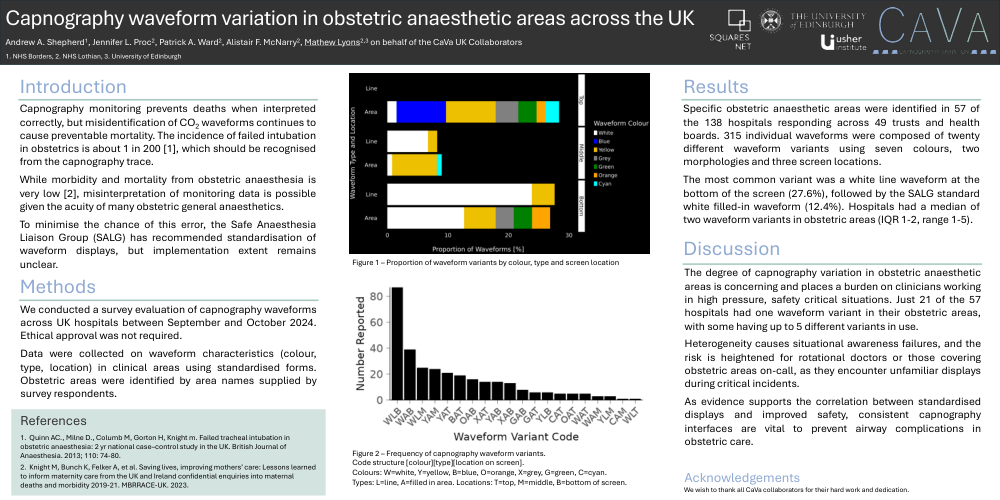
Specific obstetric anaesthetic areas were identified in 57 of the 138 hospitals responding across 49 trusts and health boards. 315 individual waveforms were composed of twenty different waveform variants using seven colours, two morphologies and three screen locations.
The most common variant was a white line waveform at the bottom of the screen (27.6%), followed by the SALG standard white filled-in waveform (12.4%). Hospitals had a median of two waveform variants in obstetric areas (IQR 1-2, range 1-5).
Discussion
The degree of capnography variation in obstetric anaesthetic areas is concerning and places a burden on clinicians working in high pressure, safety critical situations. Just 21 of the 57 hospitals had one waveform variant in their obstetric areas, with some having up to 5 different variants in use.
Heterogeneity causes situational awareness failures, and the risk is heightened for rotational doctors or those covering obstetric areas on-call, as they encounter unfamiliar displays during critical incidents.
As evidence supports the correlation between standardised displays and improved safety, consistent capnography interfaces are vital to prevent airway complications in obstetric care.
Acknowledgements
We wish to thank all CaVa collaborators for their hard work and dedication.