215 posters, 5 topics, 22 sessions, 596 authors, 283 institutions
ePostersLive by SciGen Technologies S.A. All rights reserved.
Obstetric Anaesthesia Annual Scientific Meeting 2025
May 15 - 16, 2025 | ICC, 2 Lanyon Place, Belfast BT1 3WH

6779575
Improving labour epidural monitoring through a midwife education programme
Poster Presenter
Authors
Graham Bolton, Tomas Grundy, Wilburn Caroline, Mahmoud Nervana
Affiliations
Part of Topic
Service Evaluation
Improving Labour Epidural Monitoring through Midwife Education
Background
Severe complications from epidurals in the obstetric setting are rare but can lead to significant morbidity or mortality. There are local and national guidelines (1) that state blood pressure (BP), sensory block (SB) and motor block (MB) should be monitored regularly during insertion and maintenance of epidural analgesia. There was anecdotal evidence that these monitoring standards were not being followed at our centre.
Methods
The methodology for this project was two-fold. First, to evaluate adherence with monitoring standards, we randomly selected ten patients that had received an epidural for intrapartum analgesia for each month of a three-month period (30 patients total) before and after our change to practice. Paper notes were reviewed to identify if BP, SB and MB were documented in line with current guidelines. Second, to identify ways to improve our service an anonymous questionnaire was sent out to midwives to evaluate previous epidural training, knowledge of current standards and knowledge of epidural complications.
Intervention
- Production of epidural information poster for display on the delivery unit education board.
- Integrated epidural teaching and simulation into pre-existing local teaching as part of PROMPT.
Results
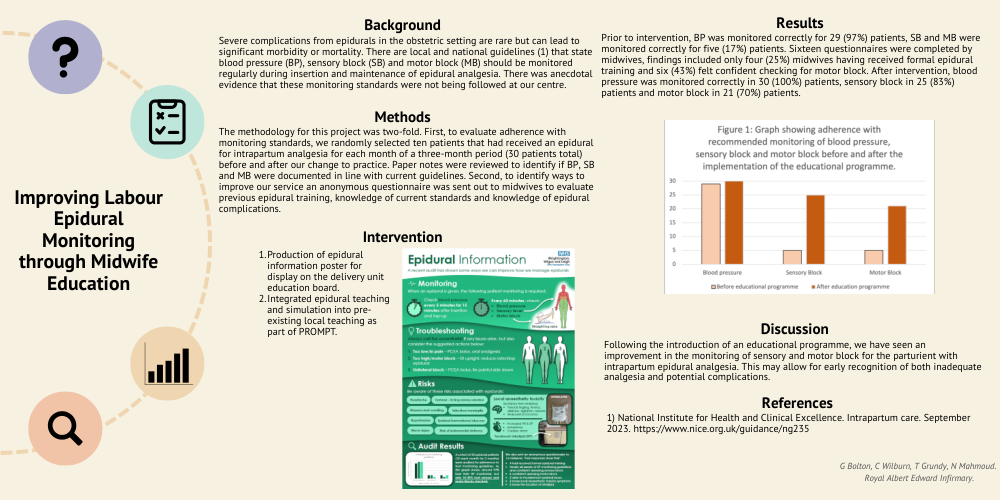
Prior to intervention, BP was monitored correctly for 29 (97%) patients, SB and MB were monitored correctly for five (17%) patients. Sixteen questionnaires were completed by midwives, findings included only four (25%) midwives having received formal epidural training and six (43%) felt confident checking for motor block. After intervention, blood pressure was monitored correctly in 30 (100%) patients, sensory block in 25 (83%) patients and motor block in 21 (70%) patients.
Discussion
Following the introduction of an educational programme, we have seen an improvement in the monitoring of sensory and motor block for the parturient with intrapartum epidural analgesia. This may allow for early recognition of both inadequate analgesia and potential complications.
References
1) National Institute for Health and Clinical Excellence. Intrapartum care. September 2023. https://www.nice.org.uk/guidance/ng235