90 posters, 5 videos, 1 audios, 6 topics, 3 sessions, 245 authors, 1 institutions
ePostersLive by SciGen Technologies S.A. All rights reserved.
Net Zero Clinical Care 2023
10 October 2023 | BMA House, London

31193
Implementing stickers to encourage patients to dispose of their inhalers correctly
Poster Presenter
Authors
Part of Topic
Low Carbon Treatments
Implementing stickers to encourage patients to dispose of their inhalers correctly
Metered dose inhalers (MDIs) contain hydrofluorocarbon (HFC) propellants (HFA134a and HFA227ea) which are powerful greenhouse gases. In the UK, approximately 70% of all inhaler prescriptions are for MDIs. They contribute to 3% of NHS emissions (or 850,000 tonnes of CO2 a year).1.
MDIs should not be put into domestic waste as propellant gases may remain in spent canisters and can escape into the atmosphere. Currently, there are no viable inhaler recycling schemes in the UK.
The most environmentally-friendly and safe solution is to encourage patients to return their used inhalers to a local pharmacy for disposal, where they will be sent to the appropriate clinical waste management stream for high-temperature incineration by authorised waste handlers. The HFC propellants will be broken down into products which are far less powerful greenhouse gases. This is an essential service that all pharmacies must offer and is funded by NHS England.2
Unfortunately, there is a very low return rate to pharmacies and a high proportion of MDIs are binned and go to landfill with almost half of their usable propellant left inside.3 Overall, there is a lack of awareness amongst both healthcare professionals (HCP) and the general population around the disposal of inhalers.
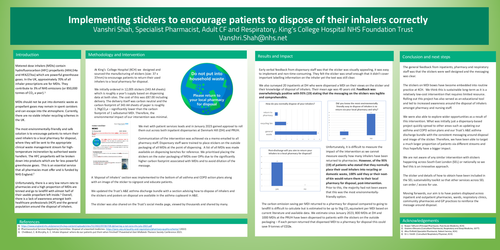
We initially ordered in 12,005 stickers (343 A4 sheets) which is roughly a year’s supply based on dispensing data at both sites. The cost of this was £87.00 including delivery. The delivery itself was carbon neutral and the carbon footprint of 343 A4 sheets of paper is roughly 1.7KgCO2e – significantly lower than the carbon footprint of 1 salbutamol MDI. Therefore, the environmental impact of our intervention was minimal
We met with patient services leads and in January 2023 gained approval to roll them out across both inpatient dispensaries at Denmark Hill (DH) and PRUH.
Communication of the intervention was achieved via a memo emailed to all pharmacy staff. Dispensary staff were trained to place stickers on the outside packaging of all MDIs at the point of dispensing. A list of all MDIs was made available on dispensing benches for reference. We prioritised placing the stickers on the outer packaging of MDIs over DPIs due to the significantly higher carbon footprint associated with MDIs and to avoid dilution of the message.
A ‘disposal of inhalers’ section was implemented to the bottom of all asthma and COPD action plans along with an image of the sticker to signpost and educate patients.
We updated the Trust’s A&E asthma discharge bundle with a section advising how to dispose of inhalers and the stickers and posters on disposal are available in the asthma cupboard in A&E.
The sticker was also shared on the Trust’s social media page, viewed by thousands and shared by many.
Early verbal feedback from dispensary staff was that the sticker was visually appealing, it was easy to implement and non-time-consuming. They felt the sticker was small enough that it didn’t cover important labelling information on the inhaler yet the text was still clear.
We also surveyed 20 inpatients at DH who were dispensed a MDI on their views on the sticker and their knowledge of disposal of inhalers. Their mean age was 45 years old. Feedback was overwhelmingly positive with 95% (19) stating that the messaging on the stickers was legible and comprehensible.
Unfortunately, it is difficult to measure the impact of the intervention as we cannot measure exactly how many inhalers have been returned to pharmacies. However, of the 95% (19) of patients who stated that they normally place their used inhalers into recycling or domestic waste, 100% said they or their next-of-kin would return them to their local pharmacy for disposal, post-intervention. Prior to this, the majority had not been aware that this was the most environmentally-friendly option.
The carbon emission saving per MDI returned to a pharmacy for disposal compared to going to landfill is difficult to calculate but is estimated to be up to 5kg CO2 equivalent per MDI based on current literature and available data. We estimate since January 2023, 800 MDIs at DH and 1000 MDIs at the PRUH have been dispensed to patients with the stickers on the outside packaging – If each person returned that dispensed MDI to a pharmacy for disposal this could save 9 tonnes of CO2e.
The general feedback from inpatients, pharmacy and respiratory staff was that the stickers were well designed and the messaging was clear.
The stickers on MDI boxes have become embedded into routine practice at KCH. We think this is sustainable long-term as it is a relatively low-cost intervention that requires limited resource. Rolling out this project has also served as an educational tool and led to increased awareness around the disposal of inhalers amongst pharmacy and nursing staff.
We were also able to explore wider opportunities as a result of this intervention. What was initially just a dispensary-based project quickly spread to other areas such as updating our asthma and COPD action plans and our Trust’s A&E asthma discharge bundle with the consistent messaging around disposal and image of the sticker. Therefore, we have been able to target a much larger proportion of patients via different streams and thus hopefully have a bigger impact.
We are not aware of any similar intervention with stickers happening across South East London (SEL) or nationally so we feel this is an innovative approach.
The sticker and details of how to obtain have been included in the SEL sustainability toolkit so that other services across SEL can order / access for use.
Moving forwards, our aim is to have posters displayed across inpatient and outpatient pharmacies, wards, respiratory clinics, community pharmacies and GP practices to reinforce the message around disposal.