90 posters, 5 videos, 1 audios, 6 topics, 3 sessions, 245 authors, 1 institutions
ePostersLive by SciGen Technologies S.A. All rights reserved.
Net Zero Clinical Care 2023
10 October 2023 | BMA House, London
30499
Sustainable Methods of Warming IV Fluids in a Theatre Environment
Poster Presenter
Authors
Part of Topic
Low Carbon Treatments
Sustainable Methods of Warming IV Fluids in a Theatre Environment
Dr G. Balfour (1) , Ben Crosby (2) , Dr P. McConnell (3)
(1) ACC4 Anaesthetics Trainee, West of Scotland, (2) University of Glasgow Medical Student, (3), Consultant Anaesthetist, Royal Alexandra Hospital Paisley
Introduction
Warming of IV fluids is an integral part of intra-operative care for our patients, and occurs as part of our practice to avoid hypothermia whilst in theatre. The ways in which IV fluids can be heated is either by pre-heating fluids in a warming cabinet, or by using a fluid warming giving set.
As the fluid warmer giving sets are made of plastic and pass through a heated element, this will have a greater environmental impact than by using pre-heated fluids from a warmed cabinet. Each of these giving sets is disposable. Therefore the financial and environmental costs of heating fluids via a heating insert will be greater than by using fluids from a warmed cabinet.
Aim
Our project aimed to quantify the use of heated inserts in our department and also to ascertain whether there was any difference in the temperature of fluid delivered to patients from either of these two methods.
Method
Before commencing this project, we identified the number of heating giving sets being used in the department. A total of 230 sets had been used in the preceding year quarter, each have a cost of £6.74. This demonstrates a notable financial cost to the department. While we were unable to conduct a specific carbon impact assessment for these heating inserts, it is clear that these plastic sets confer an adverse environmental impact when compared to the alternative of using warmed cabinets.
We aimed to assess the efficacy of each method of warming by measuring the maintained temperature of fluid and therefore designed and conducted an experiment to assess each method. This experiment was conducted in the theatre environment and involved measurement of the temperature of two bags of IV fluid - one pre-heated in a warming cabinet versus one running through a warming giving set. Fluids were run at a constant rate, with temperatures measured at 15 minute intervals up to one hour.
Results
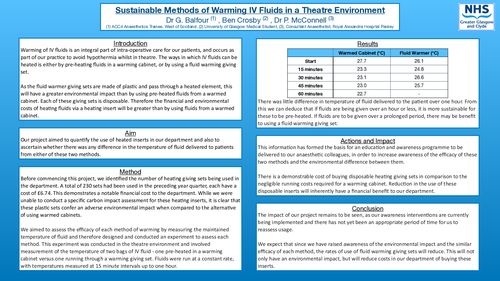
There was little difference in temperature of fluid delivered to the patient over one hour. From this we can deduce that if fluids are being given over an hour or less, it is more sustainable for these to be pre-heated. If fluids are to be given over a prolonged period, there may be benefit to using a fluid warming giving set.
Actions and Impact
This information has formed the basis for an education and awareness programme to be delivered to our anaesthetic colleagues, in order to increase awareness of the efficacy of these two methods and the environmental difference between them.
There is a demonstrable cost of buying disposable heating giving sets in comparison to the negligible running costs required for a warming cabinet. Reduction in the use of these disposable inserts will inherently have a financial benefit to our department.
Conclusion
The impact of our project remains to be seen, as our awareness interventions are currently being implemented and there has not yet been an appropriate period of time for us to reassess usage.
We expect that since we have raised awareness of the environmental impact and the similar efficacy of each method, the rates of use of fluid warming giving sets will reduce. This will not only have an environmental impact, but will reduce costs in our department of buying these inserts.