90 posters, 5 videos, 1 audios, 6 topics, 3 sessions, 245 authors, 1 institutions
ePostersLive by SciGen Technologies S.A. All rights reserved.
Net Zero Clinical Care 2023
10 October 2023 | BMA House, London
31190
Patient Empowerment for Sustainable Healthcare: Switching to Carbon Friendly Inhalers
Poster Presenter
Authors
Part of Topic
Low Carbon Treatments
Patient Empowerment for Sustainable Healthcare: Switching to Carbon Friendly Inhalers
Background:
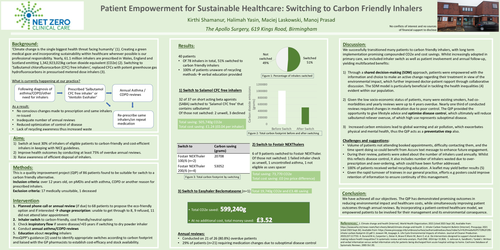
‘Climate change is the single biggest health threat facing humanity’ (1). Creating a green medical gaze and incorporating sustainability within healthcare wherever possible is our professional responsibility. Yearly, 61.1 million inhalers are prescribed in Wales, England and Scotland emitting 1,342,923,023kg carbon dioxide equivalent (CO2e) (2). Switching to ’Salbutamol chlorofluorocarbon (CFC) free inhalers’, replaced CFCs with potent greenhouse gas hydrofluorocarbons in pressurised metered dose inhalers (3).
What is currently happening at our practice?
As a result:
Aims:
1) To switch at least 30% of inhalers of eligible patients to carbon-friendly and cost-efficient inhalers in keeping with NICE guidelines.
2) To improve health outcomes by conducting at least 75% of overdue annual reviews.
3) To raise awareness of efficient disposal of inhalers.
Methods:
This is a quality improvement project (QIP) of 86 patients found to be suitable for switch to a carbon friendly alternative.
Inclusion criteria: over 12 years old, on pMDIs and with asthma, COPD or another reason for prescribed inhalers.
Exclusion criteria: 17 medically unsuitable, 1 deceased
Intervention:
2. Inhaler switch to carbon-friendly, cost friendly/neutral option
3. Check inspiratory flow if severe disease/>65 years if switching to dry powder inhaler
4. Conduct annual asthma/COPD reviews
5. Education about recycling inhalers
We used PresQIPP’s guidance (2) to identify appropriate switches according to carbon footprint and liaised with the GP pharmacists to establish cost-efficacy and stock availability
Results:
40 patients:
1) Switch to Salamol CFC free inhalers
32 of 37 on short acting beta agonists (SABA) switched to ‘Salamol CFC free’ that contains salbutamol. Of those not switched: 2 unwell, 3 declined
Total saving: 505,740g CO2e
Total cost saving: £1.24 (£0.04 per inhaler)
2) Switch to FostairNEXThalers
6 of 9 patients switched to Fostair NEXThaler. Of those not switched: 1 failed inhaler check as unwell, 1 uncontrolled asthma, 1 not eligible as uses spacer
Total saving: 73,770 CO2e
Total cost saving: £0 (no price difference)
3) Switch to EasyhalerBeclomatasone(n=1): Total 19,740g CO2e and £3.48 saving
Annual reviews:
Discussion:
We successfully transitioned many patients to carbon friendly inhalers, with long term implementation promising compounded CO2e and cost savings. Our approach, increasingly adopted in primary care, combined inhaler switch with patient involvement and annual follow-up, yielding multifaceted benefits:
Challenges and suggestions:
Conclusion:
We have achieved all our objectives. The QIP has demonstrated promising outcomes in reducing environmental impact and healthcare costs, while simultaneously improving patient outcomes through annual reviews. By incorporating a patient-centred healthcare model, we empowered patients to be involved for their management and its environmental consequence.