90 posters, 5 videos, 1 audios, 6 topics, 3 sessions, 245 authors, 1 institutions
ePostersLive by SciGen Technologies S.A. All rights reserved.
Net Zero Clinical Care 2023
10 October 2023 | BMA House, London
30594
I know where you BIn!
Poster Presenter
Authors
Part of Topic
Low Carbon Treatments
“I KNOW WHERE YOU BIN!”- INHALER DISPOSAL PRACTICES IN A PAEDIATRIC DEPARTEMENT, ONE YEAR ON
Holloway V, Thie A, Srinivas J
Introductions and Aims:
Inhalers contribute disproportionately to NHS carbon emissions: around 4%.
Metered-dose inhalers (MDIs) release hydrofluorocarbon (HFC) propellant gas. Alongside efforts to replace MDIs with lower-impact alternatives, the NHS has identified inhaler disposal as an area for improvement.
When inhalers go into landfill, they release their remaining propellant. This accounts for up to 25% of their total emissions. This can be avoided by correct disposal and incineration
We designed an online survey, open to all health professionals in our paediatrics department. Staff could access this via a QR code or a link. Responses were collected over a 6-week period.
Questions focused on:
We collected 31 responses, from nurses (39%) and doctors (61%) who regularly prescribe or dispense inhalers.
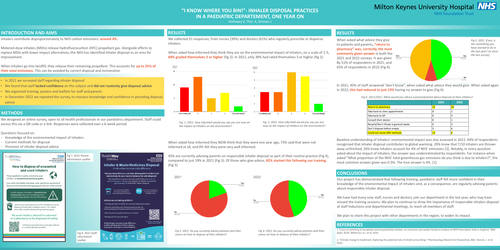
When asked how informed they think they are on the environmental impact of inhalers, on a scale of 1-5, 68% graded themselves 3 or higher (fig 2). In 2021, only 39% had rated themselves 3 or higher (fig 1).
When asked how informed they NOW think that they were one year ago, 73% said that were not informed at all, and 0% felt they were very well informed.
45% are currently advising parents on responsible inhaler disposal as part of their routine practice (Fig 4), compared to just 19% in 2021 (Fig 3). Of those who give advice, 82% started this following our training. (Fig 5)
When asked what advice they give to patients and parents, “return to pharmacy” was, correctly, the most commonly given answer in both the 2021 and 2022 surveys. It was given by 51% of respondents in 2021, and 65% of respondents in 2022 (Fig 6).
In 2021, 45% of staff answered “don’t know”, when asked what advice they would give. When asked again in 2022, this had reduced to just 19% having no answer to give (Fig 6).
Baseline understanding of inhalers’ environmental impact was also assessed in 2022. 84% of respondents recognised that inhaler disposal contributes to global warming. 29% knew that 7/10 inhalers are thrown away unfinished, 26% knew inhalers account for 4% of NHS’ emissions [2]. Notably, in every question asked about the impact of inhalers, the answer was underestimated by respondents. For instance when asked ”What proportion of the NHS’ total greenhouse gas emissions do you think is due to inhalers?”, the most common answer given was 0.5%. The true answer is 4%. [1].
Conclusions:
Our project has demonstrated that following training, paediatric staff felt more confident in their knowledge of the environmental impact of inhalers and, as a consequence, are regularly advising parents about responsible inhaler disposal.
We have had many new staff, nurses and doctors, join our department in the last year, who may have missed the training sessions. We plan to continue to show the importance of responsible inhalers disposal at staff inductions and departmental meetings, to reach all members of staff.
We plan to share this project with other departments in the region, to widen its impact.
References:
2. “Climate change in healthcare: Exploring the potential role of Inhaler prescribing,” Pharmacology Research & Perspectives, 8(6). Hansen, J. et al. 2020.