90 posters, 5 videos, 1 audios, 6 topics, 3 sessions, 245 authors, 1 institutions
ePostersLive by SciGen Technologies S.A. All rights reserved.
Net Zero Clinical Care 2023
10 October 2023 | BMA House, London

30566
Rapid change in a frozen waste-land
Poster Presenter
Authors
Part of Topic
Low Carbon Treatments
What
Ethyl Chloride is commonly used to provide a ‘cold’ stimulus to check the adequacy of neuraxial anaesthesia in Obstetrics. This ‘cold in a can’ has significant financial (£20.34 per can) and environmental cost (1440km truck miles). It is irritant, toxic when inhaled, and flammable.
Why
Ethyl Chloride is classified as a ‘high cost medication’ by our Pharmacy department at St Michael’s Hospital, Bristol , and a new directive was put out to reduce its consumption. Therefore Ethyl Chloride was a prime target for change to achieve a better triple bottom line (better for the planet, better for patients and better financially).
CoolSticks were sought as an alternative. These are metal rods that can be cooled in a fridge, have been proven to be more clinically effective at testing neuraxial blockade and are completely reusable.
How
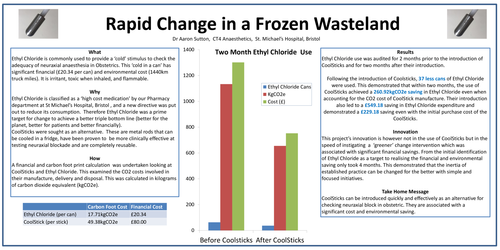
A financial and carbon foot print calculation was undertaken looking at CoolSticks and Ethyl Chloride. This examined the CO2 costs involved in their manufacture, delivery and disposal. This was calculated in kilograms of carbon dioxide equivalent (kgCO2e).
Results
Ethyl Chloride use was audited for 2 months prior to the introduction of CoolSticks and for two months after their introduction.
Following the introduction of Coolsticks, 37 less cans of Ethyl Chloride were used. This demonstrated that within two months, the use of CoolSticks achieved a 260.92kgCO2e saving in Ethyl Chloride even when accounting for the CO2 cost of CoolStick manufacture. Their introduction also led to a £549.18 saving in Ethyl Chloride expenditure and demonstrated a £229.18 saving even with the initial purchase cost of the CoolSticks.
Innovation
This project’s innovation is however not in the use of CoolSticks but in the speed of instigating a ‘greener’ change intervention which was associated with significant financial savings. From the initial identification of Ethyl Chloride as a target to realising the financial and environmental saving only took 4 months. This demonstrated that the inertia of established practice can be changed for the better with simple and focused initiatives.
Take Home Message
CoolSticks can be introduced quickly and effectively as an alternative for checking neuraxial block in obstetric. They are associated with a significant cost and environmental saving.