90 posters, 5 videos, 1 audios, 6 topics, 3 sessions, 245 authors, 1 institutions
ePostersLive by SciGen Technologies S.A. All rights reserved.
Net Zero Clinical Care 2023
10 October 2023 | BMA House, London

30523
MCF Classifier - Measuring, benchmarking and optimising the carbon footprint of medicines use
Poster Presenter
Authors
Part of Topic
Low Carbon Treatments
Video
MCF Classifier - measuring, benchmarking, and optimising the carbon footprint of medicines
Haroon Taylor, Nazneen Rahman
YewMaker
Introduction
-
Medicines account for 25% of NHS greenhouse gas emissions.
-
Product-level medicine carbon footprint data is limited, hindering efforts to reduce emissions related to medicines.
-
To address this, we have created Medicine Carbon Footprint (MCF) Classifier, a suite of applications to measure, classify, benchmark, and visualise medicine carbon footprints 1.
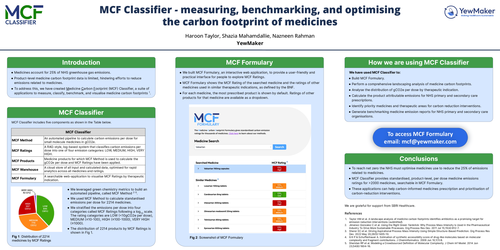
MCF Classifier includes five components:
MCF Method - An automated pipeline to calculate carbon emissions per dose for small molecule medicines in gCO2e.
MCF Ratings - A RAG-style, log-based system that classifies carbon emissions per dose into one of four emission categories: LOW, MEDIUM, HIGH, VERY HIGH.
MCF Products - Medicine products for which MCF Method is used to calculate the gCO2e per dose and MCF Ratings have been applied.
MCF Warehouse - A cloud store of all input and calculated data, optimised for rapid analytics across all medicines and ratings.
MCF Formulary - A searchable web-application to visualise MCF Ratings by therapeutic indication.
-
We leveraged green chemistry metrics to build an automated pipeline, called MCF Method 2-5.
-
We used MCF Method to calculate standardised emissions per dose for 2214 medicines.
-
We stratified the emissions per dose into four categories called MCF Ratings following a log10 scale. The rating categories are LOW (<10gCO2e per dose), MEDIUM (≥10-100), HIGH (≥100-1000), VERY HIGH (≥1000).
-
The distribution of 2214 products by MCF Ratings is shown in Fig 1.
MCF Formulary
-
We built MCF Formulary, an interactive web application, to provide a user-friendly and practical interface for people to explore MCF Ratings.
-
MCF Formulary shows the MCF Rating of the searched medicine and the ratings of other medicines used in similar therapeutic indications, as defined by the BNF.
-
For each medicine, the most prescribed product is shown by default. Ratings of other products for that medicine are available as a dropdown.
How we are using MCF Classifier
We have used MCF Classifier to:
-
Build MCF Formulary.
-
Perform a comprehensive landscaping analysis of medicine carbon footprints.
-
Analyse the distribution of gCO2e per dose by therapeutic indication.
-
Calculate the product attributable emissions for NHS primary and secondary care prescriptions.
-
Identify priority medicines and therapeutic areas for carbon reduction interventions.
-
Generate benchmarking medicine emission reports for NHS primary and secondary care organisations.
To access MCF Formulary email: mcf@yewmaker.com
Conclusions
-
To reach net zero the NHS must optimise medicines use to reduce the 25% of emissions related to medicines.
-
MCF Classifier provides standardised, product-level, per dose medicine emissions ratings for >2000 medicines, searchable in MCF Formulary.
-
These applications can help carbon-informed medicines prescription and prioritisation of carbon-reduction interventions.
We are grateful for support from SBRI Healthcare.
References
-
Taylor HM et al. A landscape analysis of medicine carbon footprints identifies antibiotics as a promising target for emission reduction interventions (submitted).
-
Jimenez-Gonzalez C et al. Using the Right Green Yardstick: Why Process Mass Intensity Is Used in the Pharmaceutical Industry To Drive More Sustainable Processes. Org Process Res Dev. 2011 Jul 15;15(4):912–7.
-
Sherer EC et al. Driving Aspirational Process Mass Intensity Using Simple Structure-Based Prediction. Org Process Res Dev. 2022 May 20;26(5):1405–10.
-
Ertl P & Schuffenhauer A. Estimation of synthetic accessibility score of drug-like molecules based on molecular complexity and fragment contributions. J Cheminformatics. 2009 Jun 10;1(1):8.
-
Sheridan RP et al. Modeling a Crowdsourced Definition of Molecular Complexity. J Chem Inf Model. 2014 Jun 23;54(6):1604–16.