586 posters, 8 topics, 23 sessions, 1,077 authors, 622 institutions
ePostersLive by SciGen Technologies S.A. All rights reserved.
ISQua's 40th International Conference 2024
24th - 27th September 2024 | Istanbul, Türkiye

P523
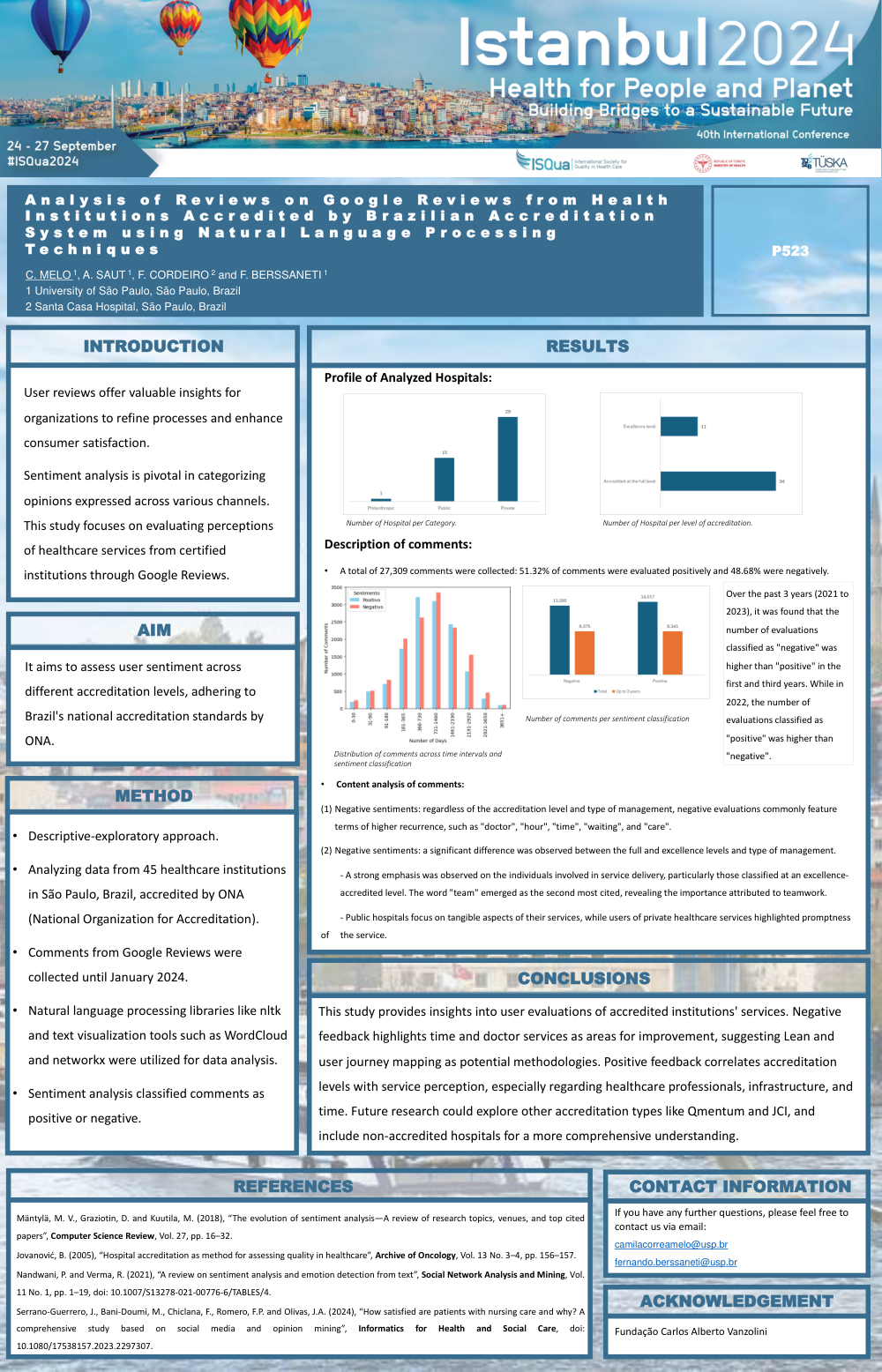
Analysis of Reviews on Google Reviews from Health Institutions Accredited by Brazilian Accreditation System using Natural Language Processing Techniques
Poster Presenter
Part of Topic
Future of Healthcare: AI and Digital Transformation
INTROCUCTION:
User reviews offer valuable insights for organizations to refine processes and enhance consumer satisfaction.
Sentiment analysis is pivotal in categorizing opinions expressed across various channels. This study focuses on evaluating perceptions of healthcare services from certified institutions through Google Reviews.
AIM:
It aims to assess user sentiment across different accreditation levels, adhering to Brazil's national accreditation standards by ONA.
METHOD:
Over the past 3 years (2021 to 2023), it was found that the number of evaluations classified as "negative" was higher than "positive" in the first and third years. While in 2022, the number of evaluations classified as "positive" was higher than "negative".
- A strong emphasis was observed on the individuals involved in service delivery, particularly those classified at an excellence- accredited level. The word "team" emerged as the second most cited, revealing the importance attributed to teamwork.
- Public hospitals focus on tangible aspects of their services, while users of private healthcare services highlighted promptness of the service.
CONCLUSION:
This study provides insights into user evaluations of accredited institutions' services. Negative feedback highlights time and doctor services as areas for improvement, suggesting Lean and user journey mapping as potential methodologies. Positive feedback correlates accreditation levels with service perception, especially regarding healthcare professionals, infrastructure, and time. Future research could explore other accreditation types like Qmentum and JCI, and include non-accredited hospitals for a more comprehensive understanding.