586 posters, 8 topics, 23 sessions, 1,077 authors, 622 institutions
ePostersLive by SciGen Technologies S.A. All rights reserved.
ISQua's 40th International Conference 2024
24th - 27th September 2024 | Istanbul, Türkiye

ISQUA2024-ABS-1722
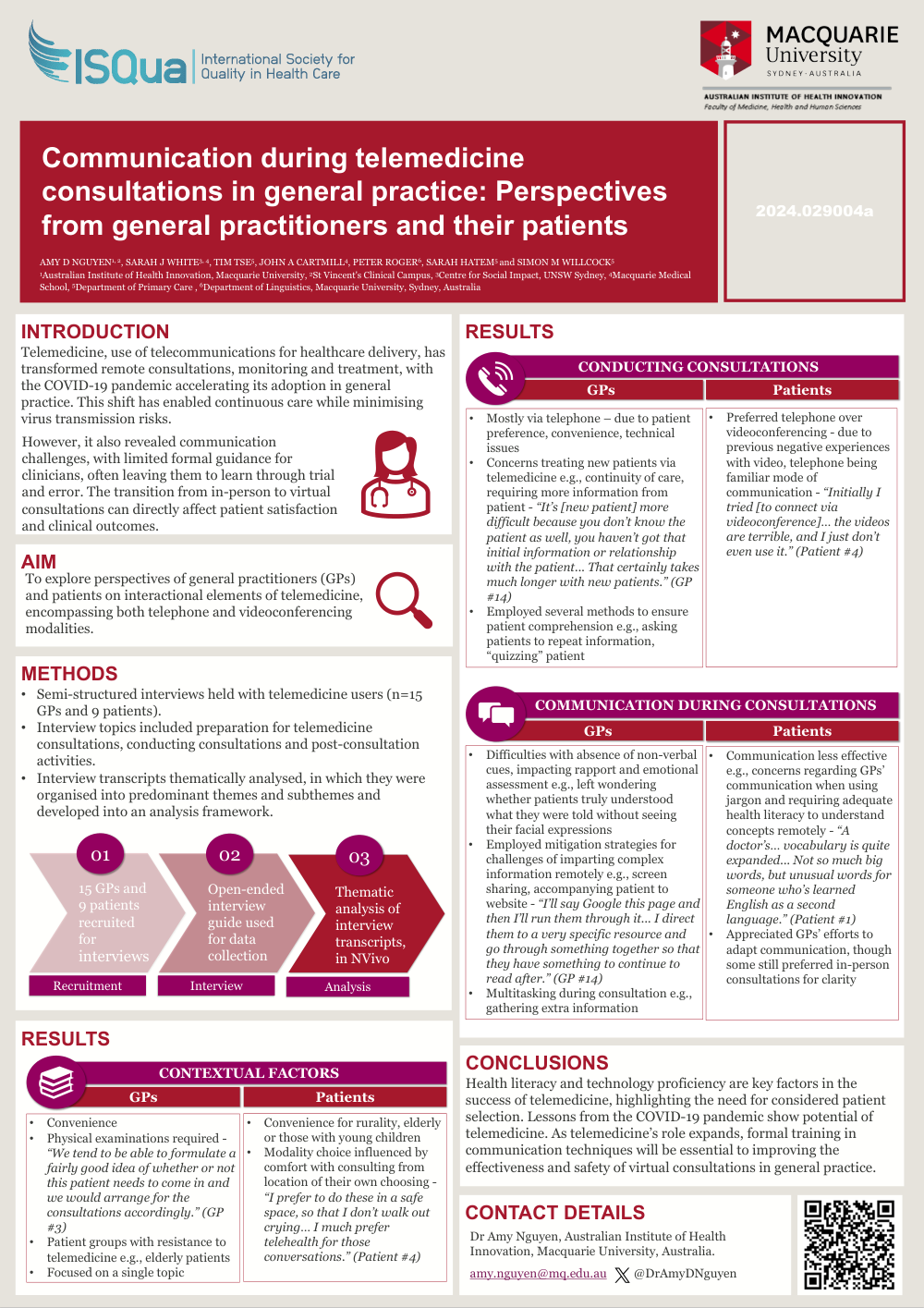
Communication during telemedicine consultations in general practice: Perspectives from general practitioners and their patients
Poster Presenter
Authors
Amy NGUYEN, Sarah WHITE, Tim TSE, John CARTMILL, Peter ROGER, Sarah HATEM, Simon WILLCOCK
Affiliations
Macquarie University, AUSTRALIAN INSTITUTE OF HEALTH INNOVATION, MACQUARIE UNIVERSITY, Centre for Social Impact, UNSW Sydney, Department of Primary Care, Macquarie University, Macquarie Medical School, Macquarie University, Department of Linguistics, Macquarie University
Part of Topic
Future of Healthcare: AI and Digital Transformation
Communication during telemedicine consultations in general practice: Perspectives from general practitioners and their patients
AMY D NGUYEN, SARAH J WHITE, TIM TSE, JOHN A CARTMILL, PETER ROGER, SARAH HATEM and SIMON M WILLCOCK
1 Australian Institute of Health Innovation, Macquarie University, 2 St Vincent's Clinical Campus, 3 Centre for Social Impact, UNSW Sydney, 4 Macquarie Medical School, 5 Department of Primary Care , 6 Department of Linguistics, Macquarie University, Sydney, Australia
2024.029004a
INTRODUCTION
Telemedicine, use of telecommunications for healthcare delivery, has transformed remote consultations, monitoring and treatment, with the COVID-19 pandemic accelerating its adoption in general practice. This shift has enabled continuous care while minimising virus transmission risks.
However, it also revealed communication challenges, with limited formal guidance for clinicians, often leaving them to learn through trial and error. The transition from in-person to virtual consultations can directly affect patient satisfaction and clinical outcomes.
AIM
To explore perspectives of general practitioners (GPs) and patients on interactional elements of telemedicine, encompassing both telephone and videoconferencing modalities.
METHODS
•Semi-structured interviews held with telemedicine users (n=15 GPs and 9 patients).
•Interview topics included preparation for telemedicine consultations, conducting consultations and post-consultation activities.
•Interview transcripts thematically analysed, in which they were organised into predominant themes and subthemes and developed into an analysis framework.
RESULTS
CONTEXTUAL FACTORS
GPs
•Convenience
•Physical examinations required - “We tend to be able to formulate a fairly good idea of whether or not this patient needs to come in and we would arrange for the consultations accordingly.” (GP #3)
•Patient groups with resistance to telemedicine e.g., elderly patients
•Focused on a single topic
Patients
•Convenience for rurality, elderly or those with young children
•Modality choice influenced by comfort with consulting from location of their own choosing - “I prefer to do these in a safe space, so that I don’t walk out crying… I much prefer telehealth for those conversations.” (Patient #4)
CONDUCTING CONSULTATIONS
GPs
•Mostly via telephone – due to patient preference, convenience, technical issues
•Concerns treating new patients via telemedicine e.g., continuity of care, requiring more information from patient - “It’s [new patient] more difficult because you don’t know the patient as well, you haven’t got that initial information or relationship with the patient... That certainly takes much longer with new patients.” (GP #14)
•Employed several methods to ensure patient comprehension e.g., asking patients to repeat information, “quizzing” patient
Patients
•Preferred telephone over videoconferencing - due to previous negative experiences with video, telephone being familiar mode of communication - “Initially I tried [to connect via videoconference]… the videos are terrible, and I just don’t even use it.” (Patient #4)
COMMUNICATION DURING CONSULTATIONS
GPs
•Difficulties with absence of non-verbal cues, impacting rapport and emotional assessment e.g., left wondering whether patients truly understood what they were told without seeing their facial expressions
•Employed mitigation strategies for challenges of imparting complex information remotely e.g., screen sharing, accompanying patient to website - “I’ll say Google this page and then I’ll run them through it... I direct them to a very specific resource and go through something together so that they have something to continue to read after.” (GP #14)
•Multitasking during consultation e.g., gathering extra information
Patients
•Communication less effective e.g., concerns regarding GPs’ communication when using jargon and requiring adequate health literacy to understand concepts remotely - “A doctor’s… vocabulary is quite expanded... Not so much big words, but unusual words for someone who’s learned English as a second language.” (Patient #1)
•Appreciated GPs’ efforts to adapt communication, though some still preferred in-person consultations for clarity
CONCLUSIONS
Health literacy and technology proficiency are key factors in the success of telemedicine, highlighting the need for considered patient selection. Lessons from the COVID-19 pandemic show potential of telemedicine. As telemedicine’s role expands, formal training in communication techniques will be essential to improving the effectiveness and safety of virtual consultations in general practice.