586 posters, 8 topics, 23 sessions, 1,077 authors, 622 institutions
ePostersLive by SciGen Technologies S.A. All rights reserved.
ISQua's 40th International Conference 2024
24th - 27th September 2024 | Istanbul, Türkiye

ISQUA2024-ABS-1784
From Bits to Brilliance: Enhancing the Efficiency of Cancer Registry Coding Quality Review by Human-factors engineering digitalization at a Medical Center in Taiwan
Poster Presenter
Authors
Wei-Mei Chen, Mau-Shin Chi, Yan-Qing Chen, Chia-Kan Lin, Mei-Ching Chou, Ching-Yuan Cheng, Jiun-Yih Lee, Sheng-Mou Hou
Affiliations
Part of Topic
Future of Healthcare: AI and Digital Transformation
From Bits to Brilliance: Enhancing the Efficiency of Cancer Registry Coding Quality Review by Human-factors engineering digitalization at a Medical Center in Taiwan
Wei-Mei Chen1 , Yan-Qing Chen1 , Chia-Kan Lin2 , Mei-Ching Chou1 , Ching-Yuan Cheng3 , Jiun-Yih Lee4, Sheng-Mou Hou5 , Mau-Shin Chi 6* 1 Cancer Registration Division, Cancer Prevention and Management Center, Shin Kong Wu Ho-Su Memorial Hospital 2 Information Department, Application System Maintenance Section, Shin Kong Wu Ho-Su Memorial Hospital 3 Department of Chest Medicine, Shin Kong Wu Ho-Su Memorial Hospital 4 Center for Quality Management, Shin Kong Wu Ho-Su Memorial Hospital 5 Superintendent Office , Shin Kong Wu Ho-Su Memorial Hospital 6 Department of Radiation Therapy & Oncology, Shin Kong Wu Ho-Su Memorial Hospital
INTRODUCTION
Accurate cancer registration coding through medical record reviews is crucial. The current review process includes case selection, reviewer assignment, form printing, binding, distribution, statistical analysis, and final reviews. However, the return rate of reviewed forms after one month is only about 50%, with an average completion time of two months. Significant time is spent on follow-ups, often due to misplaced paper forms that require reprinting and incomplete fields after form retrieval.
AIM
The primary objective is to identify factors affecting the review process through an interdisciplinary team, with the goal of implementing strategies to achieve a 50% reduction in overall review time.
METHOD
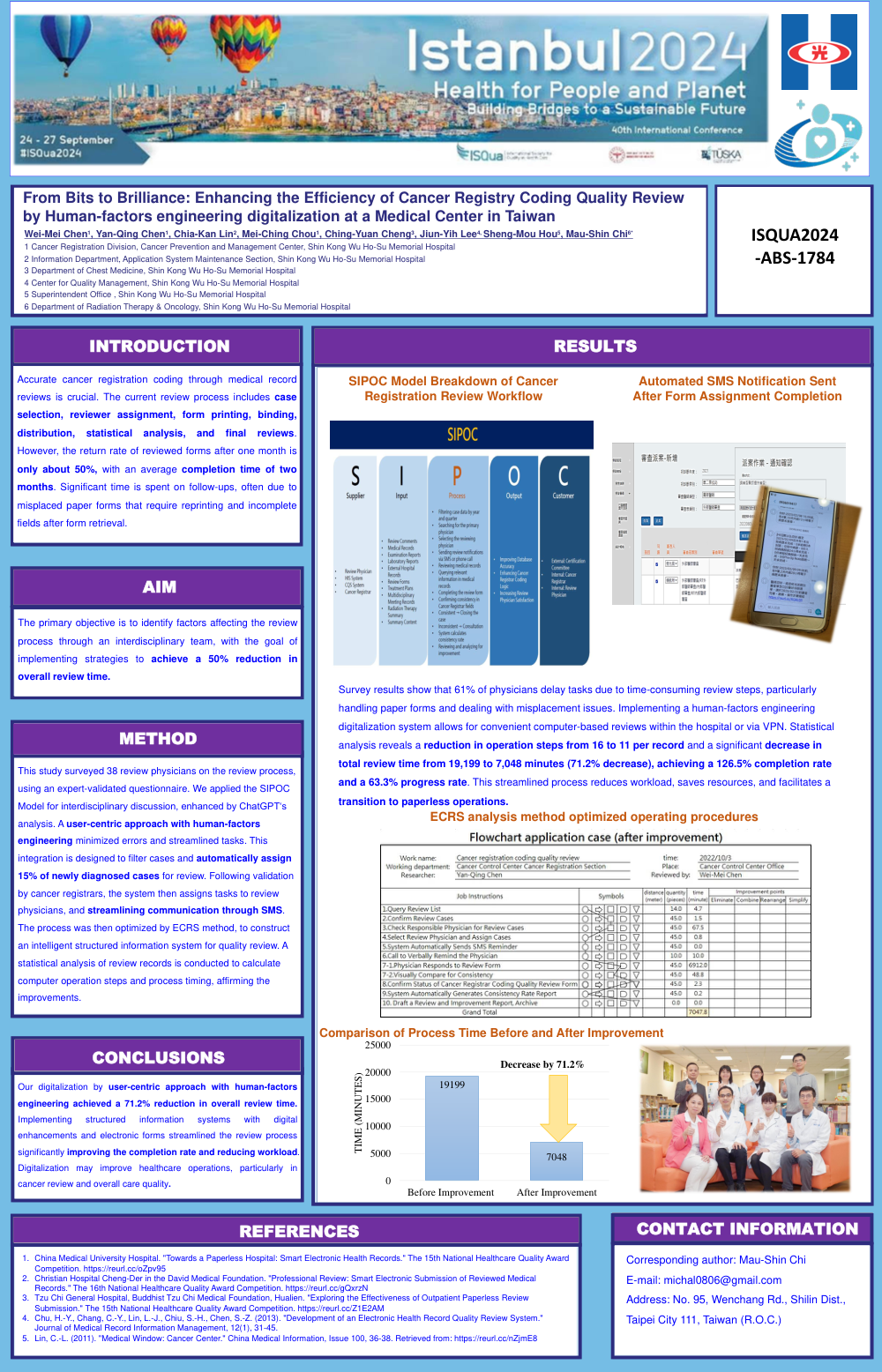
This study surveyed 38 review physicians on the review process, using an expert-validated questionnaire. We applied the SIPOC Model for interdisciplinary discussion, enhanced by ChatGPT‘s analysis. A user-centric approach with human-factors engineering minimized errors and streamlined tasks. This integration is designed to filter cases and automatically assign 15% of newly diagnosed cases for review. Following validation by cancer registrars, the system then assigns tasks to review physicians, and streamlining communication through SMS. The process was then optimized by ECRS method, to construct an intelligent structured information system for quality review. A statistical analysis of review records is conducted to calculate computer operation steps and process timing, affirming the improvements.
RESULTS
Survey results show that 61% of physicians delay tasks due to time-consuming review steps, particularly handling paper forms and dealing with misplacement issues. Implementing a human-factors engineering digitalization system allows for convenient computer-based reviews within the hospital or via VPN. Statistical analysis reveals a reduction in operation steps from 16 to 11 per record and a significant decrease in total review time from 19,199 to 7,048 minutes (71.2% decrease), achieving a 126.5% completion rate and a 63.3% progress rate. This streamlined process reduces workload, saves resources, and facilitates a transition to paperless operations.
CONCLUSIONS
Our digitalization by user-centric approach with human-factors engineering achieved a 71.2% reduction in overall review time. Implementing structured information systems with digital enhancements and electronic forms streamlined the review process significantly improving the completion rate and reducing workload. Digitalization may improve healthcare operations, particularly in cancer review and overall care quality.
REFERENCES
1. China Medical University Hospital. "Towards a Paperless Hospital: Smart Electronic Health Records." The 15th National Healthcare Quality Award Competition. https://reurl.cc/oZpv95 2. Christian Hospital Cheng-Der in the David Medical Foundation. "Professional Review: Smart Electronic Submission of Reviewed Medical Records." The 16th National Healthcare Quality Award Competition. https://reurl.cc/gQxrzN 3. Tzu Chi General Hospital, Buddhist Tzu Chi Medical Foundation, Hualien. "Exploring the Effectiveness of Outpatient Paperless Review Submission." The 15th National Healthcare Quality Award Competition. https://reurl.cc/Z1E2AM 4. Chu, H.-Y., Chang, C.-Y., Lin, L.-J., Chiu, S.-H., Chen, S.-Z. (2013). "Development of an Electronic Health Record Quality Review System." Journal of Medical Record Information Management, 12(1), 31-45. 5. Lin, C.-L. (2011). "Medical Window: Cancer Center." China Medical Information, Issue 100, 36-38. Retrieved from: https://reurl.cc/nZjmE8
CONTACT INFORMATION
Corresponding author: Mau-Shin Chi E-mail: michal0806@gmail.com Address: No. 95, Wenchang Rd., Shilin Dist., Taipei City 111, Taiwan (R.O.C.)