586 posters, 8 topics, 23 sessions, 1,077 authors, 622 institutions
ePostersLive by SciGen Technologies S.A. All rights reserved.
ISQua's 40th International Conference 2024
24th - 27th September 2024 | Istanbul, Türkiye

P432
The Dartmouth MS Center Learning Community: Equipping People with Multiple Sclerosis with Tools for Improving Self-Efficacy and Self-Management
Poster Presenter
Authors
Part of Topic
Co-production - Creating a patient-centred healthcare service
The Dartmouth MS Center Learning Community: Equipping People with Multiple Sclerosis with Tools for Improving Self Efficacy & Management
Andrew D. Smith III, MD & E. Chandlee Bryan, M.Ed.
Dartmouth Health, Dartmouth Hitchcock Medical Center
Lebanon, NH, USA
People with Chronic Illness want to Learn from their Providers & Fellow Patients
Multiple Sclerosis (MS) is an autoimmune disease of the central nervous system and a “3C” condition: chronic, costly, and complex. Building on work with the ICoHN Co-Value Study, a neurologist and a Person with MS (PwMS) co-designed a three-part webinar series for newly designed PwMS and their families to teach strategies for navigating MS, their local healthcare system, and wellness.
Hypothesis: When PwMS are trained to navigate MS and the healthcare system, self-management and self-efficacy will improve.
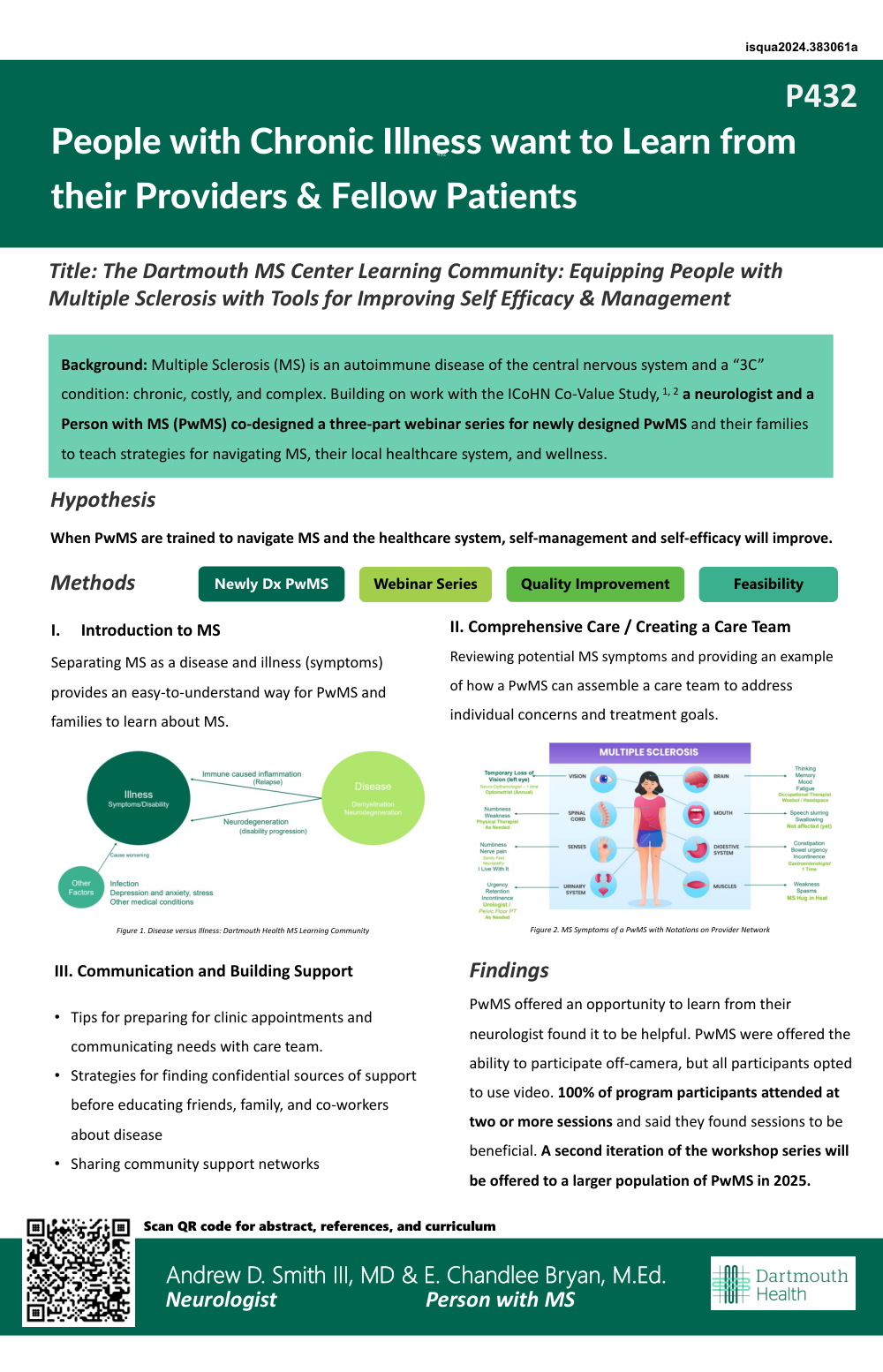
Methodology: This was a co-production project designed by a Neurologist (Smith) and a Person with MS (Bryan) for newly diagnosed PwMS. This was a webinar series that was developed as a quality improvement study to evaluate the feasibility of scaling up the intervention. The workshop was presented in three modules.
I. Introduction to MS
Separating MS as a disease and illness (symptoms) provides an easy-to-understand way for PwMS and families to learn about MS.
II. Comprehensive Care / Creating a Care Team
Reviewing potential MS symptoms and providing an example of how a PwMS can assemble a care team to address individual concerns and treatment goals.
III. Communication and Building Support
• Tips for preparing for clinic appointments and communicating needs with care team.
• Strategies for finding confidential sources of support before educating friends, family, and co-workers about disease
• Sharing community support networks
Findings
PwMS offered an opportunity to learn from their neurologist found it to be helpful.
PwMS were offered the ability to participate off-camera, but all participants opted to use video.
100% of program participants attended at two or more sessions and said they found sessions to be beneficial. A second iteration of the workshop series will be offered to a larger population of PwMS in 2025.