586 posters, 8 topics, 23 sessions, 1,077 authors, 622 institutions
ePostersLive by SciGen Technologies S.A. All rights reserved.
ISQua's 40th International Conference 2024
24th - 27th September 2024 | Istanbul, Türkiye

ISQUA2024-ABS-2344
In-vitro fertilization (IVF) patient perspective and experiences with digital innovation during treatment in Vietnam.
Poster Presenter
Authors
Affiliations
My Duc Hospital, IVFMD, My Duc Hospital, Ho Chi Minh City, Viet Nam.
Part of Topic
Co-production - Creating a patient-centred healthcare service
POSTER CODE : ISQUA2024-ABS-2344
In-vitro fertilization (IVF) patient perspective and experiences with digital innovation during treatment in Vietnam. Anh H. Dang* 1, 2, Bao G. Huynh1, 2, Hoan K. Nguyen1, Can D. Dang1, Tuong M. Ho1, 2
1 IVFMD, My Duc Hospital, Ho Chi Minh City, Viet Nam
2 HOPE Research Center, My Duc Hospital, Ho Chi Minh City, Viet Nam
Introduction: Infertility is defined as the failure to achieve pregnancy after 12 months of regular unprotected sexual
intercourse (Zegers-Hochschild et al., 2017). Although the overall number of couples has decreased, Vietnamese couples seeking infertility treatment have increased in number. Various treatments available for couples experiencing infertility issues include ovulation induction with timed intercourse, artificial insemination with husband (AIH), inter uterine insemination (IUI), in vitro fertilization (IVF), and the latest in vitro maturation (IVM). However, a typical IVF cycle includes long gonadotropin stimulation, followed by oocyte retrieval, which can be fertilized in vitro either mixed with sperm or with intracytoplasmic sperm injection, then the fertilized eggs (embryos) are cultured under optimal conditions and transferred into the uterus (embryo transplantation) is routinely preferred. Moreover, the appropriate therapeutic strategies for the patients based on clinical examinations, such as hormonal level measurements, ultrasonographic images of the uterus and ovaries, radiological findings (hysterosalpingography), and sperm analysis …could be suggested, that may be overly complicated and complex to patients. All of those make the couples have difficulty in making sense of their fertility problems and make the psychological impacts which affected specifically not only the associated treatment protocol but also the rate of success become important. Indeed, people are unaware of their own fertility potential, the constraints on their fertility, the signs, symptoms, side-effects or preventable causes of fertility problems or the available ART with the following detailed steps that can shape their reproductive lives and release their stress partially during the treatment (İnam & Satılmış, 2023).
On the other hand, the internet has become a common source offertility treatment-related information, and social media is viewed as a potentially effective avenue for dissemination of fertility-related news and education. It has been reported that a median of 76% of the population among 18 advanced economies surveyed have smartphones, it is likely that couples of reproductive ages would access information about fertility and increase their literacy using the internet via smartphone (Silver, 2019). Although the evidence is still limited, considering the ease of access to low quality information like social media, it is conceivable that misinformation and/or poor-quality information may adversely affect patients seeking and getting fertility treatment; thus, IVF clinic digital innovative approaches such as mobile application to providing both accessible and accurate information are desired. Accumulating evidence indicates that providing quality- assured information could improve patients’ fertility-related knowledge, experiences and help decision-making(Curchoe, 2020).
AIM:
Within the Vietnamese context, it is reasonable to hypothesize that providing high-quality information and experiences via a smartphone application can be an appealing strategy to help offset the damage incurred from vastly accessible low-quality information and rapidly reduce the rate of drop-out treatment. These are the reasons since 2019, at IVFMD, My Duc Hospital,Ho Chi Minh city, Vietnam, IVFMD Mobile App has been designed and routinely used for IVF patients. However, to improve literacy on Vietnamese fertility treatment and strategically renovate our mobile application, we must investigate the perspectives and experiences of IVF patients in our smartphone application.
Methods:
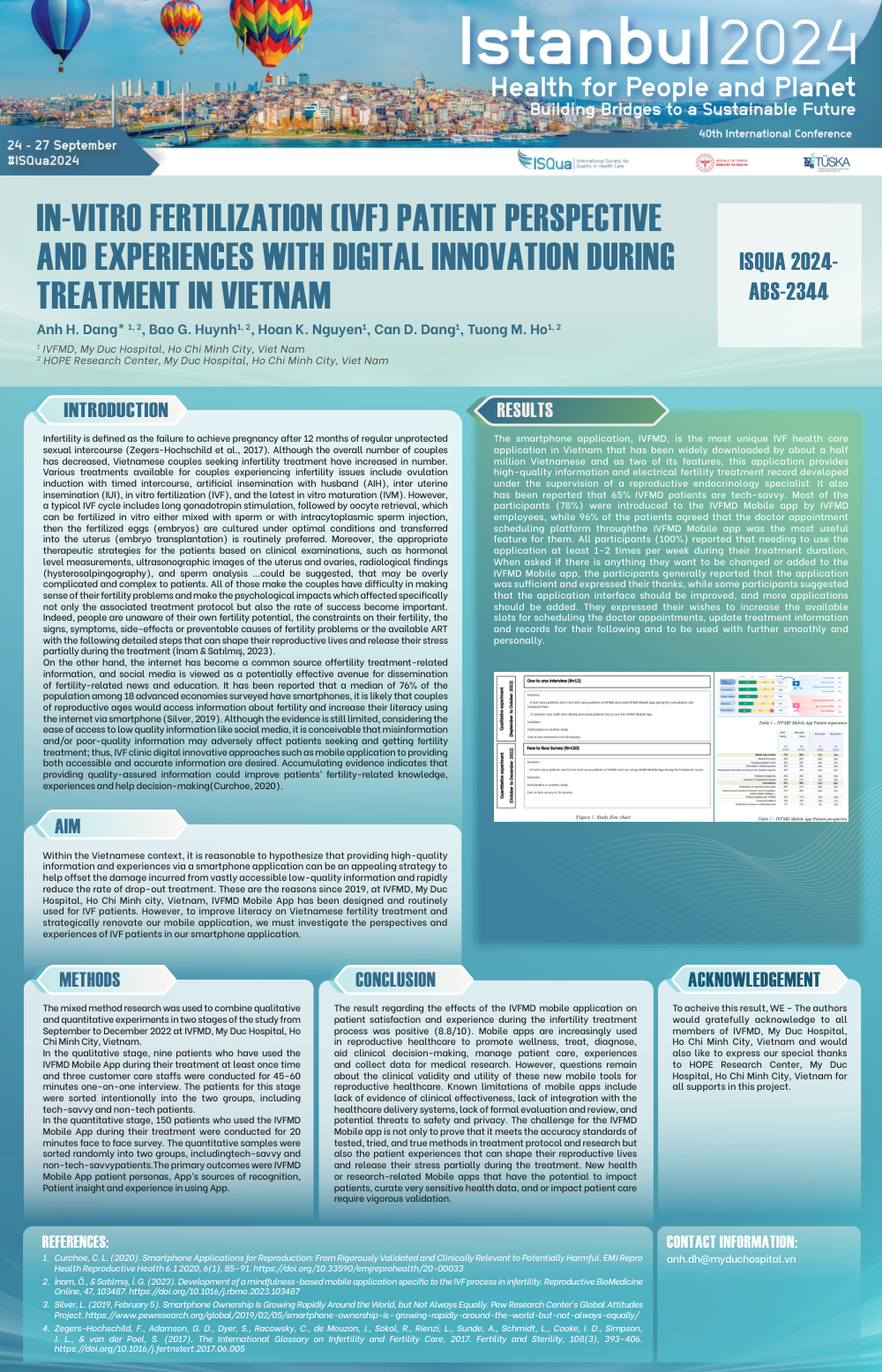
The mixed method research was used to combine qualitative and quantitative experiments in two stages of the study from September to December 2022 at IVFMD, My Duc Hospital, Ho Chi Minh City, Vietnam.
In the qualitative stage, nine patients who have used the IVFMD Mobile App during their treatment at least once time and three customer care staffs were conducted for 45-60 minutes one-on-one interview. The \ patients for this stage were sorted intentionally into the two groups, including tech-savvy and non-tech patients.
In the quantitative stage, 150 patients who used the IVFMD Mobile App during their treatment were conducted for 20 minutes face to face survey. The quantitative samples were sorted randomly into two groups, includingtech-savvy and non-tech-savvypatients.The primary outcomes were IVFMD Mobile App patient personas, App’s sources of recognition, Patient insight and experience in using App.
Results:
The smartphone application, IVFMD, is the most unique IVF health care application in Vietnam that has been widely downloaded by about a half million Vietnamese and as two of its features, this application provides high-quality information and electrical fertility treatment record developed under the supervision of a reproductive endocrinology specialist. It also has been reported that 65% IVFMD patients are tech-savvy. Most of the participants (78%) were introduced to the IVFMD Mobile app by IVFMD employees, while 96% of the patients agreed that the doctor appointment scheduling platform throughthe IVFMD Mobile app was the most useful feature for them. All participants (100%) reported that needing to use the application at least 1-2 times per week during their treatment duration. When asked if there is anything they want to be changed or added to the IVFMD Mobile app, the participants generally reported that the application was sufficient and expressed their thanks, while some participants suggested that the application interface should be improved, and more applications should be added. They expressed their wishes to increase the available slots for scheduling the doctor appointments, update treatment information and records for their following and to be used with further smoothly and personally
Conclusion:
The result regarding the effects of the IVFMD mobile application on patient satisfaction and experience during the infertility treatment process was positive (8.8/10). Mobile apps are increasingly used in reproductive healthcare to promote wellness, treat, diagnose, aid clinical decision-making, manage patient care, experiences and collect data for medical research. However, questions remain about the clinical validity and utility of these new mobile tools for reproductive healthcare. Known limitations of mobile apps include lack of evidence of clinical effectiveness, lack of integration with the healthcare delivery systems, lack of formal evaluation and review, and potential threats to safety and privacy. The challenge for the IVFMD Mobile app is not only to prove that it meets the accuracy standards of tested, tried, and true methods in treatment protocol and research but also the patient experiences that can shape their reproductive lives and release their stress partially during the treatment. New health or research-related Mobile apps that have the potential to impact patients, curate very sensitive health data, and or impact patient care require vigorous validation.
Acknowledgement:
To acheive this result, WE – The authors would gratefully acknowledge to all members of IVFMD, My Duc Hospital, Ho Chi Minh City, Vietnam and would also like to express our special thanks to HOPE Research Center, My Duc Hospital, Ho Chi Minh City, Vietnam for all supports in this project.
References:
- Curchoe, C. L. (2020). Smartphone Applications for Reproduction: From Rigorously Validated and Clinically Relevant to Potentially Harmful. EMJ Repro Health Reproductive Health 6.1 2020, 6(1), 85–91. https://doi.org/10.33590/emjreprohealth/20-00033
- İnam, Ö., & Satılmış, İ. G. (2023). Development of a mindfulness-based mobile application specific to the IVF process in infertility. Reproductive BioMedicine Online, 47, 103487. https://doi.org/10.1016/j.rbmo.2023.103487
- Silver, L. (2019, February 5). Smartphone Ownership Is Growing Rapidly Around the World, but Not Always Equally. Pew Research Center’s Global Attitudes Project. https://www.pewresearch.org/global/2019/02/05/smartphone-ownership-is- growing-rapidly-around-the-world-but-not-always-equally/
- Zegers-Hochschild, F., Adamson, G. D., Dyer, S., Racowsky, C., de Mouzon, J., Sokol, R., Rienzi, L., Sunde, A., Schmidt, L., Cooke, I. D., Simpson, J. L., & van der Poel, S. (2017). The International Glossary on Infertility and Fertility Care, 2017. Fertility and Sterility, 108(3), 393–406. https://doi.org/10.1016/j.fertnstert.2017.06.005
Contact information
Msc. Anh H. Dang
Email : anh.dh@myduchospital.vn