586 posters, 8 topics, 23 sessions, 1,077 authors, 622 institutions
ePostersLive by SciGen Technologies S.A. All rights reserved.
ISQua's 40th International Conference 2024
24th - 27th September 2024 | Istanbul, Türkiye

P436
EVALUATION OF CONTENT WEBSITE OF ACCREDITED HOSPITALS
Part of Topic
Co-production - Creating a patient-centred healthcare service
Introduction: Websites are one of the most important tools for hospitals to communicate with their stakeholders. A well-designed website contributes to effective communication of messages to the target audience, accurate recognition of the service provider and a strong positive image in the minds of stakeholders.
Aim: The aim of this study is to evaluate the website content of hospitals operating in Türkiye accredited by four different accreditation organizations and to determine the differences in terms of accreditation organizations.
Methods: In this study, the website content of 56 hospitals operating in Türkiye and accredited by Joint Commission International (JCI), Trust Effective Medicine Optimized Services (TEMOS), American Accreditation Commission International (AACI) and Türkiye Health Care Quality and Accreditation Institute (TÜSKA) were analyzed. Two of the analysed hospitals are accredited by both TÜSKA and TEMOS, and one of them is accredited by both JCI and TEMOS. The scale developed by Maifredi et al. (2010) and adapted into Turkish by Birdir and Buzcu (2014) was used as a data collection tool. Five more items were added to the scale, which consisted of five dimensions and 85 items in total, in line with the literature, and a total of 90 items were evaluated. The websites were examined by researchers between January 27 and February 5, 2024. Scale items were coded as "Yes=1" if they were present on the website examined and "No=0" if they were not, and the evaluation was made according to the number of "yes". In order to ensure that the researchers could evaluate in the exact same way, a joint evaluation was carried out on a hospital and a consensus was reached on which item to look at. The data obtained as a result of evaluation and coding were analyzed through SPSS 23 package program.
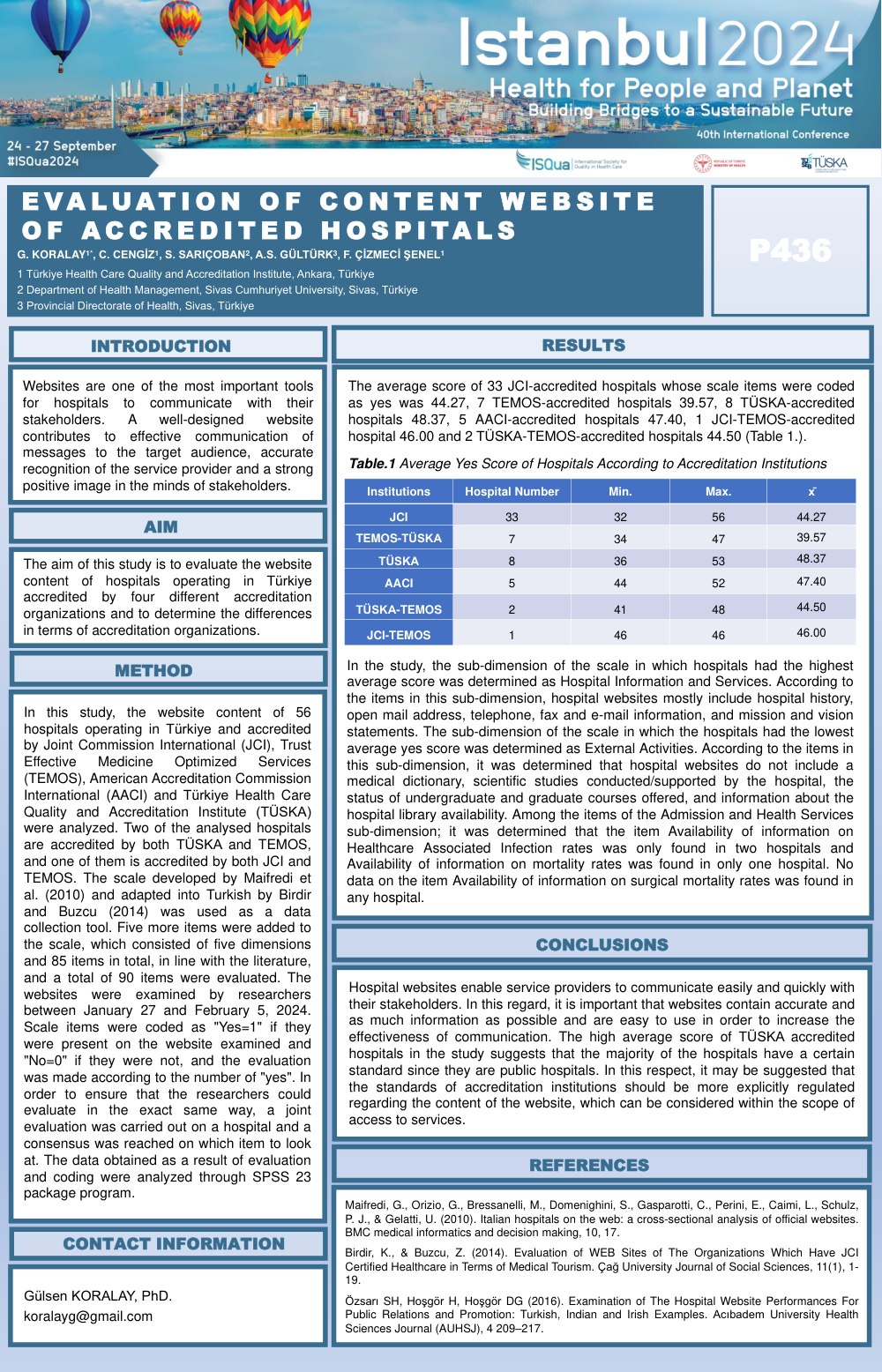
Results: The average score of 33 JCI-accredited hospitals whose scale items were coded as yes was 44.27, 7 TEMOS-accredited hospitals 39.57, 8 TÜSKA-accredited hospitals 48.37, 5 AACI-accredited hospitals 47.40, 1 JCI-TEMOS-accredited hospital 46.00 and 2 TÜSKA-TEMOS-accredited hospitals 44.50 (Table 1.).
In the study, the sub-dimension of the scale in which hospitals had the highest average score was determined as Hospital Information and Services. According to the items in this sub-dimension, hospital websites mostly include hospital history, open mail address, telephone, fax and e-mail information, and mission and vision statements. The sub-dimension of the scale in which the hospitals had the lowest average yes score was determined as External Activities. According to the items in this sub-dimension, it was determined that hospital websites do not include a medical dictionary, scientific studies conducted/supported by the hospital, the status of undergraduate and graduate courses offered, and information about the hospital library availability. Among the items of the Admission and Health Services sub-dimension; it was determined that the item Availability of information on Healthcare Associated Infection rates was only found in two hospitals and Availability of information on mortality rates was found in only one hospital. No data on the item Availability of information on surgical mortality rates was found in any hospital.
Conclusion: Hospital websites enable service providers to communicate easily and quickly with their stakeholders. In this regard, it is important that websites contain accurate and as much information as possible and are easy to use in order to increase the effectiveness of communication. The high average score of TÜSKA accredited hospitals in the study suggests that the majority of the hospitals have a certain standard since they are public hospitals. In this respect, it may be suggested that the standards of accreditation institutions should be more explicitly regulated regarding the content of the website, which can be considered within the scope of access to services.
Refrences:
- Maifredi, G., Orizio, G., Bressanelli, M., Domenighini, S., Gasparotti, C., Perini, E., Caimi, L., Schulz, P. J., & Gelatti, U. (2010). Italian hospitals on the web: a cross-sectional analysis of official websites. BMC medical informatics and decision making, 10, 17.
- Birdir, K., & Buzcu, Z. (2014). Evaluation of WEB Sites of The Organizations Which Have JCI Certified Healthcare in Terms of Medical Tourism. Çağ University Journal of Social Sciences, 11(1), 1-19.
- Özsarı SH, Hoşgör H, Hoşgör DG (2016). Examination of The Hospital Website Performances For Public Relations and Promotion: Turkish, Indian and Irish Examples. Acıbadem University Health Sciences Journal (AUHSJ), 4 209–217.