586 posters, 8 topics, 23 sessions, 1,077 authors, 622 institutions
ePostersLive by SciGen Technologies S.A. All rights reserved.
ISQua's 40th International Conference 2024
24th - 27th September 2024 | Istanbul, Türkiye

P537
Breast Cancer Diagnosis Analysis: Employing MATLAB Pre-trained Models with Machine and Deep Learning
Poster Presenter
Authors
Affiliations
Part of Topic
Future of Healthcare: AI and Digital Transformation
Introduction:
Breast cancer is one of the major global health burdens and a leading cause of death in the female population [1]. We acknowledge the utmost importance of early screening, detection, diagnosis, and treatment of breast cancer [2]. Furthermore, despite various challenges, Artificial intelligence remains and will continue to be an effective solution that brings specific benefits [3].
Methods:
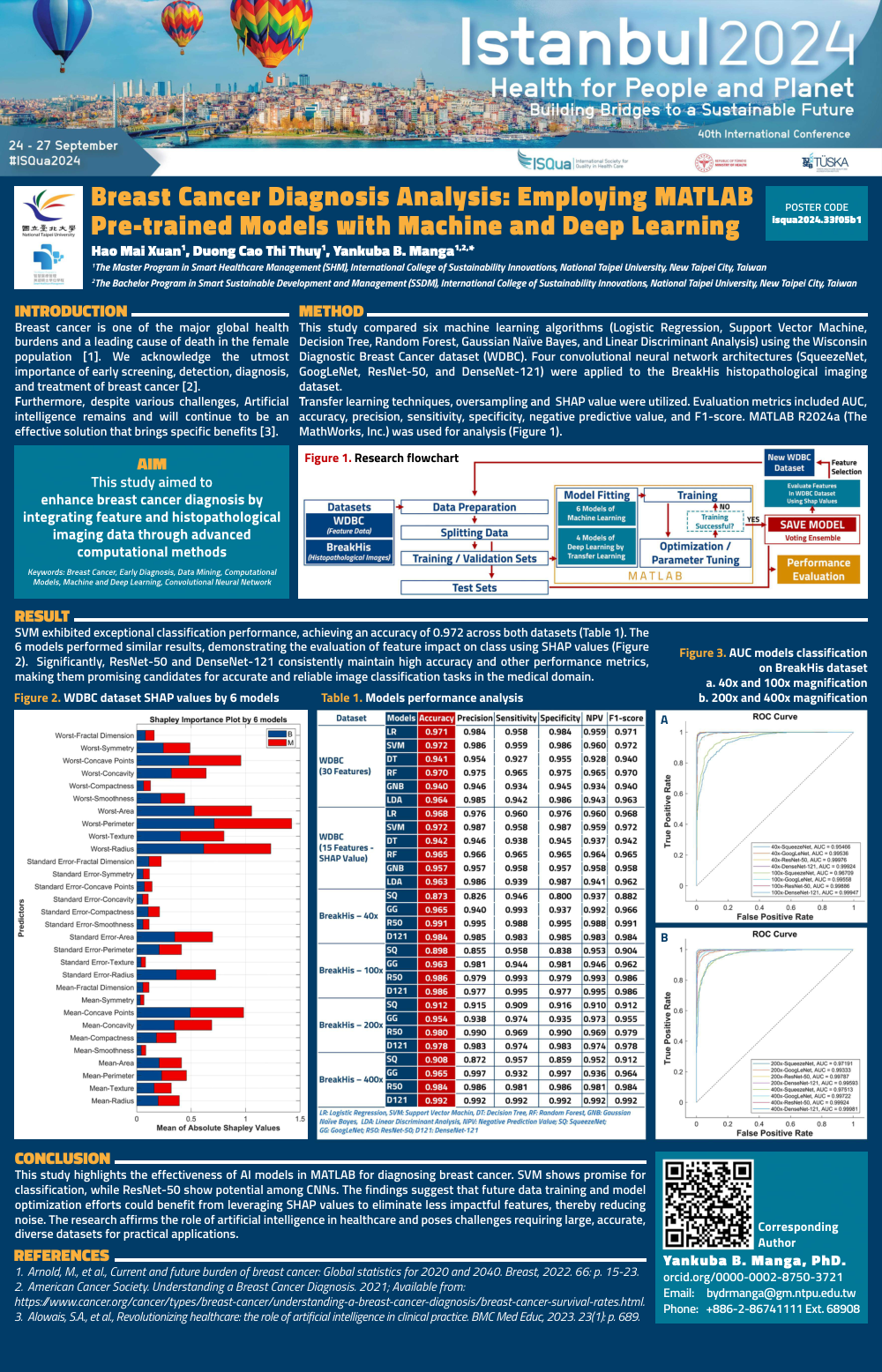
This study compared six machine learning algorithms (Logistic Regression, Support Vector Machine, Decision Tree, Random Forest, Gaussian Naïve Bayes, and Linear Discriminant Analysis) using the Wisconsin Diagnostic Breast Cancer dataset (WDBC). Four convolutional neural network architectures (SqueezeNet, GoogLeNet, ResNet-50, and DenseNet-121) were applied to the BreakHis histopathological imaging dataset. Transfer learning techniques, oversampling and SHAP value were utilized. Evaluation metrics included AUC, accuracy, precision, sensitivity, specificity, negative predictive value, and F1-score. MATLAB R2024a (The MathWorks, Inc.) was used for analysis (Figure 1).
Results:
SVM exhibited exceptional classification performance, achieving an accuracy of 0.972 across both datasets (Table 1). The 6 models performed similar results, demonstrating the evaluation of feature impact on class using SHAP values (Figure 2). Significantly, ResNet-50 and DenseNet-121 consistently maintain high accuracy and other performance metrics, making them promising candidates for accurate and reliable image classification tasks in the medical domain.
Conclusion: The study successfully evaluated the two datasets of different histopathological images through machine and deep learning models, emphasizing the importance of early breast cancer diagnosis. The pre-trained models exhibited superior performance, particularly the DenseNet-121 model, which could be a promising model for early breast cancer diagnosis. The comprehensive nature of the results, encompassing various performance and magnification levels, provides a thorough understanding of the models’ capabilities in different contexts, contributing valuable insights for both diagnostic and research applications. The results underscore the significance of integrating machine learning algorithms with imaging for a comprehensive approach to cancer classification and early diagnosis. However, data diversity and size challenges were noted, emphasizing the need for further research to optimize real-world outcomes.
References:
1. Arnold, M., et al., Current and future burden of breast cancer: Global statistics for 2020 and 2040. Breast, 2022. 66: p. 15-23.
2. American Cancer Society. Understanding a Breast Cancer Diagnosis. 2021; Available from: https://www.cancer.org/cancer/types/breast-cancer/understanding-a-breast-cancer-diagnosis/breast-cancer-survival-rates.html.
3. Alowais, S.A., et al., Revolutionizing healthcare: the role of artificial intelligence in clinical practice. BMC Med Educ, 2023. 23(1): p. 689.
Keywords: Breast Cancer, Early Diagnosis, Data Mining, Computational Models, Machine and Deep Learning, Convolutional Neural Network