586 posters, 8 topics, 23 sessions, 1,077 authors, 622 institutions
ePostersLive by SciGen Technologies S.A. All rights reserved.
ISQua's 40th International Conference 2024
24th - 27th September 2024 | Istanbul, Türkiye

P437
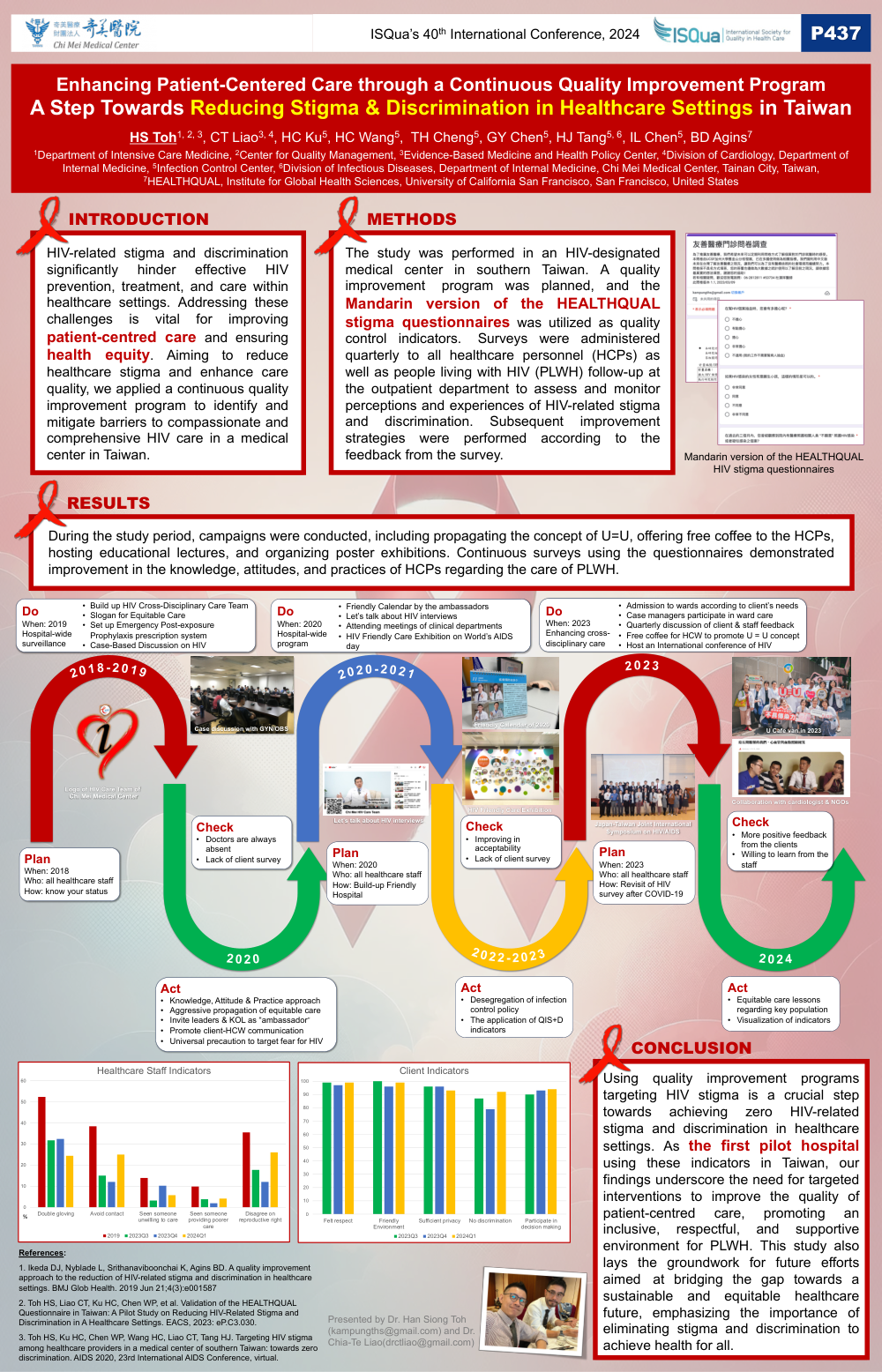
Enhancing Patient-Centered Care through a Continuous Quality Improvement Program: A Step Towards Reducing Stigma and Discrimination in Healthcare Settings in Taiwan
Poster Presenter
Authors
Han Siong Toh, Chia-Te Liao, Hui-Chun Ku, Hui-Chuan Wang, Tang-Hsin Cheng, Guan-Yu Chen, Hung-Jen Tang, Ing-Ling Chen, Bruce D. Agins
Affiliations
Chi Mei Medical Center, 1 Department of Intensive Care Medicine, 2 Center for Quality Management, 3 Evidence-Based Medicine and Health Policy Center, Chi Mei Medical Center, Tainan City, Taiwan, Evidence-Based Medicine and Health Policy Center & Division of Cardiology, Department of Internal Medicine, Chi Mei Medical Center, Tainan City, Taiwan, Infection Control Center, Chi Mei Medical Center, Tainan City, Taiwan, Infection Control Center & Division of Infectious Diseases, Department of Internal Medicine, Chi Mei Medical Center, Tainan City, Taiwan, HEALTHQUAL, Institute for Global Health Sciences, University of California San Francisco, San Francisco, United States
Part of Topic
Co-production - Creating a patient-centred healthcare service
Introduction:
HIV-related stigma and discrimination significantly hinder effective HIV prevention, treatment, and care
within healthcare settings. Addressing these challenges is vital for improving patient-centered care and ensuring health
equity. Aiming to reduce healthcare stigma and enhance care quality, we applied a continuous quality improvement
program to identify and mitigate barriers to compassionate and comprehensive HIV care in a medical center in Taiwan.
Methods:
The study was performed in an HIV-designated medical center in southern Taiwan. A quality improvement
program was planned, and the Mandarin version of the HEALTHQUAL stigma questionnaires was utilized as quality
control indicators.1,2 Surveys were administered quarterly to all healthcare personnel (HCPs) as well as people living with
HIV (PLWH) follow-up at the outpatient department to assess and monitor perceptions and experiences of HIV-related
stigma and discrimination. Subsequent improvement strategies were performed according to the feedback from the
survey.
Results:
During the study period, campaigns were conducted, including propagating the concept of U=U, offering free
coffee to the HCPs, hosting educational lectures, and organizing poster exhibitions. Continuous surveys using the
questionnaires demonstrated improvement in the knowledge, attitudes, and practices of HCPs regarding the care of
PLWH.
Conclusion:
Using quality improvement programs targeting HIV stigma is a crucial step towards achieving zero HIVrelated
stigma and discrimination in healthcare settings. As the first pilot hospital using these indicators in Taiwan, our
findings underscore the need for targeted interventions to improve the quality of patient-centered care, promoting a more
inclusive, respectful, and supportive environment for PLWH. This study also lays the groundwork for future efforts aimed
at bridging the gap towards a sustainable and equitable healthcare future, emphasizing the importance of eliminating
stigma and discrimination to achieve health for all.