586 posters, 8 topics, 23 sessions, 1,077 authors, 622 institutions
ePostersLive by SciGen Technologies S.A. All rights reserved.
ISQua's 40th International Conference 2024
24th - 27th September 2024 | Istanbul, Türkiye

P542
Harnessing Artificial Intelligence-Powered Computer-Aided Detection to Improve Implementation Efficiency of TB Case Finding and Enhance Access to TB Services in the Philippines
Poster Presenter
Part of Topic
Future of Healthcare: AI and Digital Transformation
Harnessing Artificial Intelligence-Powered Computer-Aided Detection to Improve Implementation Efficiency of TB Case Finding and Enhance Access to TB Services in the Philippines
Introduction
Tuberculosis (TB) persists as a public health challenge globally and in the Philippines. In 2022, the country’s TB Treatment Coverage Rate remained low at 54%, underscoring the need for innovative strategies to improve detection.
Current country guidelines recommend the use of chest X-rays (CXR); however, its widespread adoption faces obstacles, including accessibility and a lack of onsite radiologists for immediate image interpretation.
Traditional case finding (CF) utilizes digital X-ray, where images are sent to a radiologist for reading, and results are delivered 3-5 days after the event.
Aim
USAID’s TB Platforms adapted the use of computer-aided detection (CAD) technology to enable CXR screening feasible in diverse settings.
The study aimed to determine the applicability of CAD in diverse settings for improving implementation efficiency and increasing TB case detection.
Methods
Use of CXR/CAD enabled onsite sputum collection since CXR results are released in 1-2 minutes.
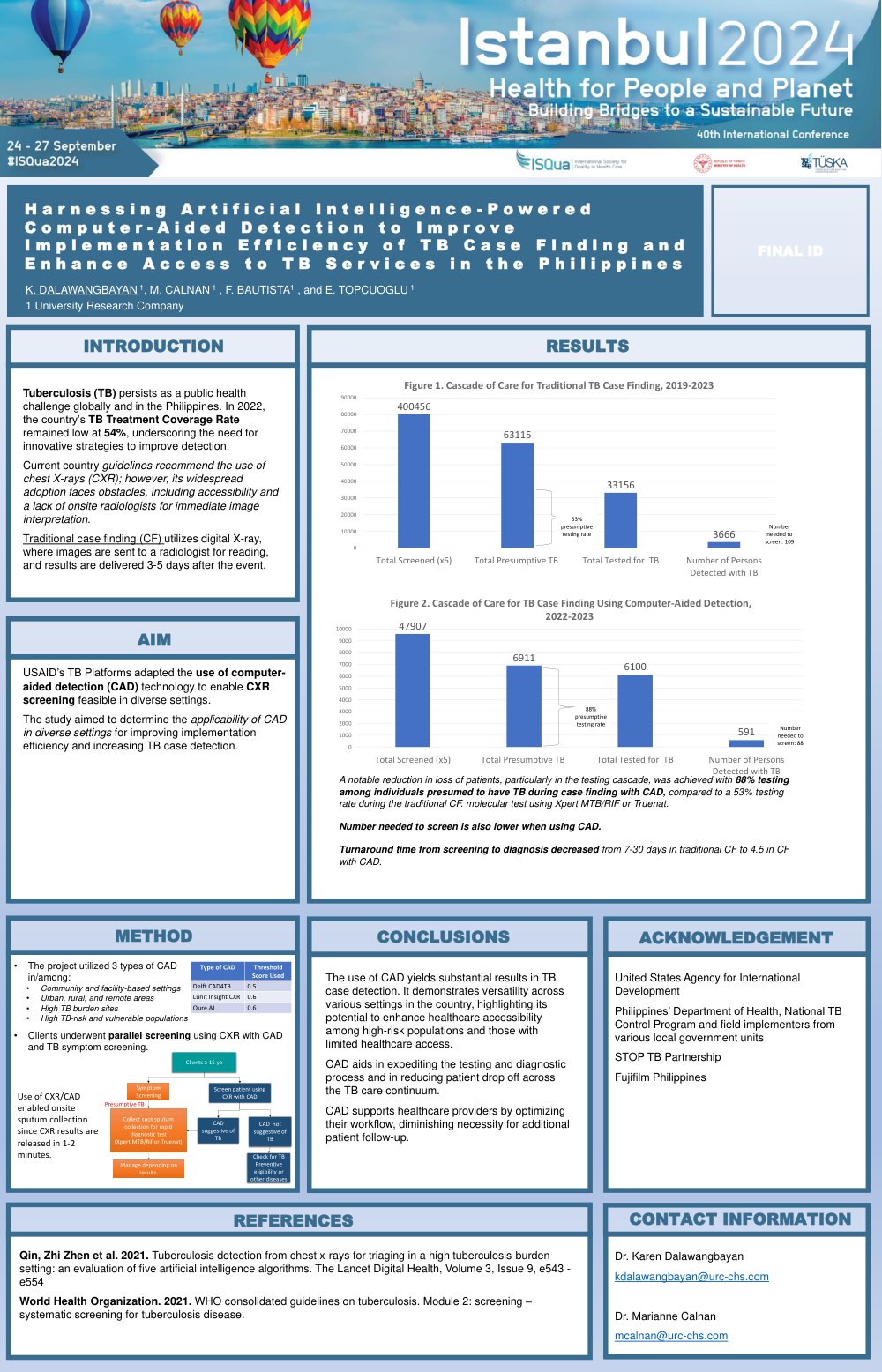
A notable reduction in loss of patients, particularly in the testing cascade, was achieved with 88% testing among individuals presumed to have TB during case finding with CAD, compared to a 53% testing rate during the traditional CF. molecular test using Xpert MTB/RIF or Truenat.
Number needed to screen is also lower when using CAD.
Turnaround time from screening to diagnosis decreased from 7-30 days in traditional CF to 4.5 in CF with CAD.
The use of CAD yields substantial results in TB case detection. It demonstrates versatility across various settings in the country, highlighting its potential to enhance healthcare accessibility among high-risk populations and those with limited healthcare access.
CAD aids in expediting the testing and diagnostic process and in reducing patient drop off across the TB care continuum.
CAD supports healthcare providers by optimizing their workflow, diminishing necessity for additional patient follow-up.