586 posters, 8 topics, 23 sessions, 1,077 authors, 622 institutions
ePostersLive by SciGen Technologies S.A. All rights reserved.
ISQua's 40th International Conference 2024
24th - 27th September 2024 | Istanbul, Türkiye

P428
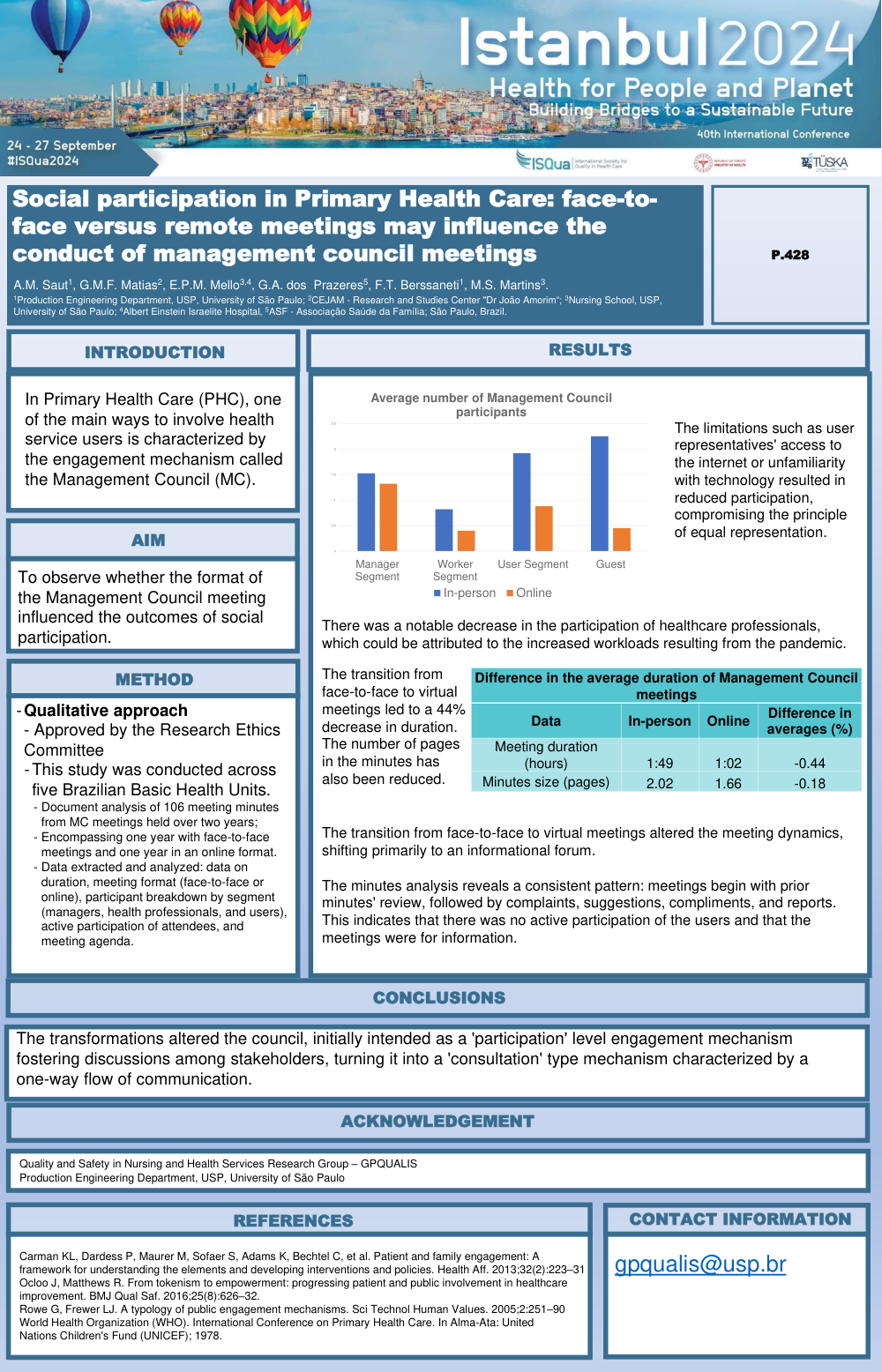
Social participation in primary health care: face-to-face versus remote meetings may influence the conduct of management council meetings
Poster Presenter
Authors
Affiliations
Part of Topic
Co-production - Creating a patient-centred healthcare service
Social participation in primary health care: face-to-face versus remote meetings may influence the conduct of
management council meetings
Introduction: The International Conference on Primary Health Care held in Alma-Ata in 1978 established that primary
health care services require social participation in the planning, organization, operation, and control of care (1). In
Primary Health Care (PHC), one of the main ways to involve health service users is characterized by the engagement
mechanism called the Management Council (MC). The aim of the study was to observe whether the format of the MC
meeting influenced the outcomes of social participation.
Methods: Document analysis of minutes from MC meetings held over two years (totaling 106 minutes), encompassing
one year with face-to-face meetings and the subsequent year conducted in an online format. Initially, all minutes were
comprehensively reviewed. Subsequently, data on duration, meeting format (face-to-face or online), participant
breakdown by segment (managers, health professionals, and users), active participation of attendees, and meeting
agenda were extracted. This study was conducted across five Brazilian Basic Health Units and approved by the Research Ethics Committee.
Results: The transition from face-to-face to virtual meetings led to a 44% decrease in duration and altered the meeting
dynamics, shifting primarily to an informational forum. Also limitations such as user representatives' access to the internet
or unfamiliarity with technology resulted in reduced participation, compromising the principle of equal representation.
Moreover, there was a notable decrease in the participation of healthcare professionals, which could be attributed to the
increased workloads resulting from the pandemic. Additionally, minutes analysis reveals a consistent pattern: meetings
begin with prior minutes' review, followed by complaints, suggestions, compliments, and reports. This indicates that there
was no active participation of the users and that the meetings were for information.
Conclusion: The transformations altered the council, initially intended as a 'participation' level engagement mechanism
fostering discussions among stakeholders, turning it into a 'consultation' type mechanism characterized by a one-way
flow of communication.