586 posters, 8 topics, 23 sessions, 1,077 authors, 622 institutions
ePostersLive by SciGen Technologies S.A. All rights reserved.
ISQua's 40th International Conference 2024
24th - 27th September 2024 | Istanbul, Türkiye

P552
A toolkit for learning health systems implementation: Creating more responsive and sustainable systems of care
Poster Presenter
Authors
Part of Topic
Future of Healthcare: AI and Digital Transformation
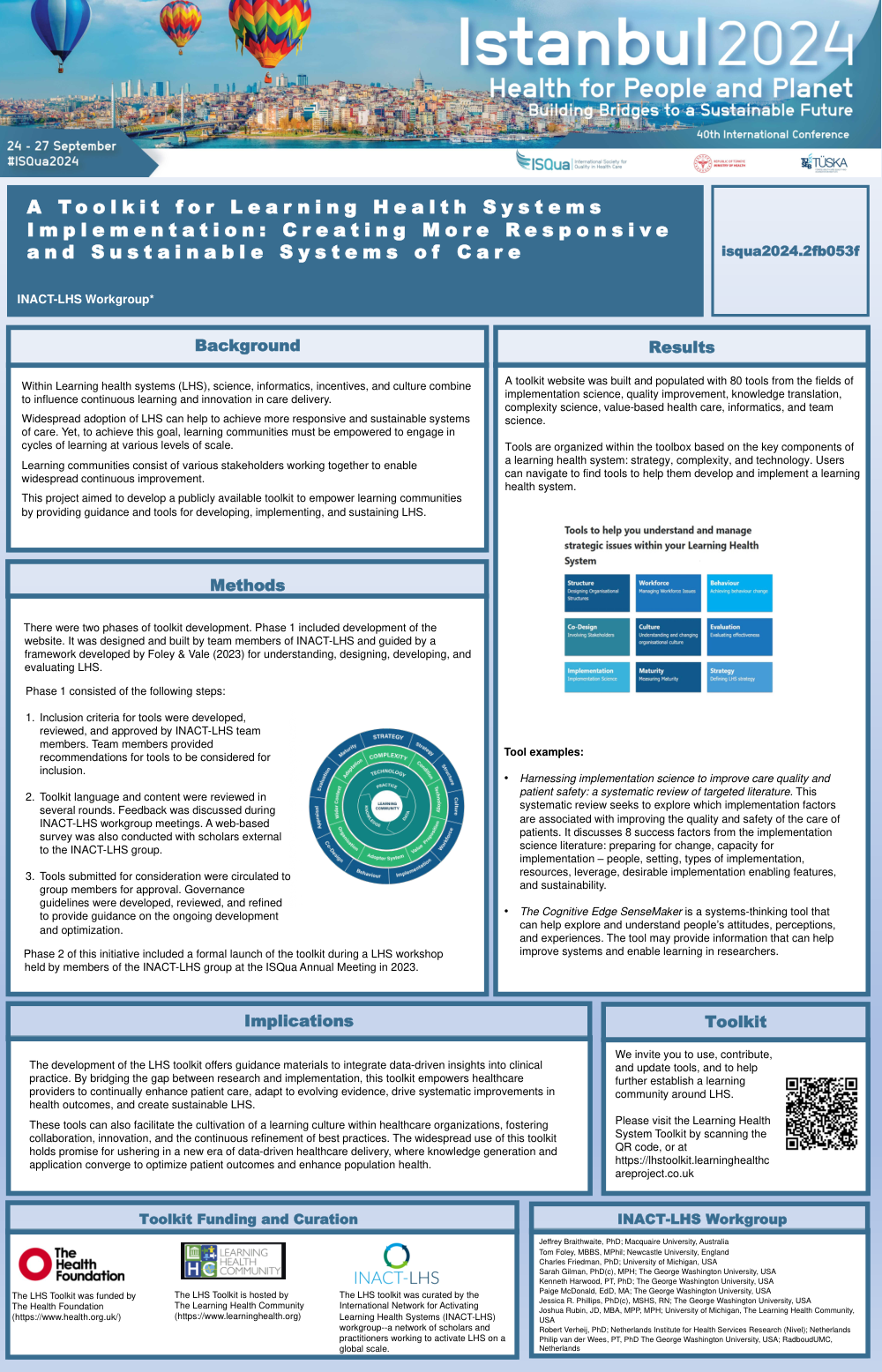
Title: A Toolkit for Learning Health Systems Implementation: Creating More Responsive and Sustainable Systems of Care
Background: Within Learning health systems (LHS), science, informatics, incentives, and culture combine to influence continuous learning and innovation in care delivery.
Widespread adoption of LHS can help to achieve more responsive and sustainable systems of care. Yet, to achieve this goal, learning communities must be empowered to engage in cycles of learning at various levels of scale.
Learning communities consist of various stakeholders working together to enable widespread continuous improvement.
This project aimed to develop a publicly available toolkit to empower learning communities by providing guidance and tools for developing, implementing, and sustaining LHS.
Methods: There were two phases of toolkit development. Phase 1 included development of the website. It was designed and built by team members of INACT-LHS and guided by a framework developed by Foley & Vale (2023) for understanding, designing, developing, and evaluating LHS. Phase 1 consisted of the following steps: 1.Inclusion criteria for tools were developed, reviewed, and approved by INACT-LHS team members. Team members provided recommendations for tools to be considered for inclusion. 2.Toolkit language and content were reviewed in several rounds. Feedback was discussed during INACT-LHS workgroup meetings. A web-based survey was also conducted with scholars external to the INACT-LHS group. 3.Tools submitted for consideration were circulated to group members for approval. Governance guidelines were developed, reviewed, and refined to provide guidance on the ongoing development and optimization.
Results: A toolkit website was built and populated with 80 tools from the fields of implementation science, quality improvement, knowledge translation, complexity science, value-based health care, informatics, and team science. Tools are organized within the toolbox based on the key components of a learning health system: strategy, complexity, and technology. Users can navigate to find tools to help them develop and implement a learning health system.
Tool examples: 1. Harnessing implementation science to improve care quality and patient safety: a systematic review of targeted literature. This systematic review seeks to explore which implementation factors are associated with improving the quality and safety of the care of patients. It discusses 8 success factors from the implementation science literature: preparing for change, capacity for implementation – people, setting, types of implementation, resources, leverage, desirable implementation enabling features, and sustainability. 2. The Cognitive Edge SenseMaker is a systems-thinking tool that can help explore and understand people’s attitudes, perceptions, and experiences. The tool may provide information that can help improve systems and enable learning in researchers.
Implications: The development of the LHS toolkit offers guidance materials to integrate data-driven insights into clinical practice. By bridging the gap between research and implementation, this toolkit empowers healthcare providers to continually enhance patient care, adapt to evolving evidence, drive systematic improvements in health outcomes, and create sustainable LHS.
These tools can also facilitate the cultivation of a learning culture within healthcare organizations, fostering collaboration, innovation, and the continuous refinement of best practices. The widespread use of this toolkit holds promise for ushering in a new era of data-driven healthcare delivery, where knowledge generation and application converge to optimize patient outcomes and enhance population health.