586 posters, 8 topics, 23 sessions, 1,077 authors, 622 institutions
ePostersLive by SciGen Technologies S.A. All rights reserved.
ISQua's 40th International Conference 2024
24th - 27th September 2024 | Istanbul, Türkiye

P555
Application of cloud checklists to improve the accuracy of patient examination processes
Part of Topic
Future of Healthcare: AI and Digital Transformation
Application of Cloud Checklists to Improve the Accuracy of Patient Examination Processes
Introduction: This study uses QR-code to present electronic checklists of examination preparation in cloud, and improve the accuracy of nursing staff in performing the patient examination processes.
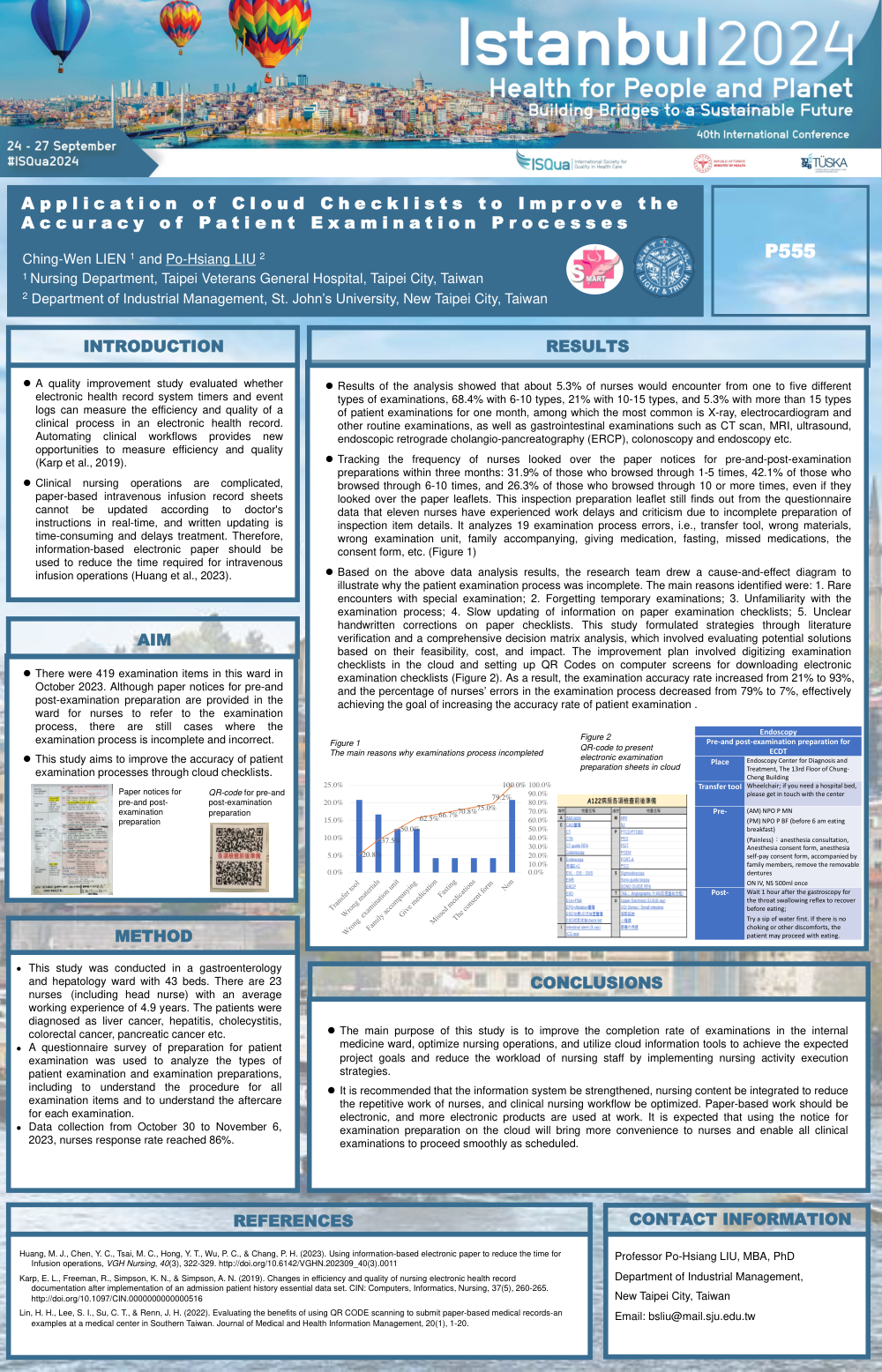
Methods: This study was conducted in a gastroenterology and hepatology ward with 43 beds. There are 23 nurses (including head nurse) with an average working experience of 4.9 years. The patients were diagnosed as liver cancer, hepatitis, cholecystitis, colorectal cancer, pancreatic cancer etc. A questionnaire survey of preparation for patient examination was used to analyze the types of patient examination and examination preparations, including to understand the procedure for all examination items and to understand the after[1]care for each examination. Data collection from October 30 to November 6, 2023, nurses response rate reached 86%.
Results: Results of the analysis showed that about 5.3% of nurses would encounter from one to five different types of examinations, 68.4% with 6-10 types, 21% with 10-15 types, and 5.3% with more than 15 types of patient examinations for one month, among which the most common is X-ray, electrocardiogram and other routine examinations, as well as gastrointestinal examinations such as CT scan, MRI, ultrasound, endoscopic retrograde cholangio-pancreatography (ERCP), colonoscopy and endoscopy etc.
Tracking the frequency of nurses looked over the paper notices for pre-and-post-examination preparations within three months: 31.9% of those who browsed through 1-5 times, 42.1% of those who browsed through 6-10 times, and 26.3% of those who browsed through 10 or more times, even if they looked over the paper leaflets. This inspection preparation leaflet still finds out from the questionnaire data that eleven nurses have experienced work delays and criticism due to incomplete preparation of inspection item details. It analyzes 19 examination process errors, i.e., transfer tool, wrong materials, wrong examination unit, family accompanying, giving medication, fasting, missed medications, the consent form etc.
Based on the above data analysis results, the research team drew a cause-and-effect diagram to illustrate why the patient examination process was incomplete. The main reasons identified were: 1. Rare encounters with special examination; 2. Forgetting temporary examinations; 3. Unfamiliarity with the examination process; 4. Slow updating of information on paper examination checklists; 5. Unclear handwritten corrections on paper checklists. This study formulated strategies through literature verification and a comprehensive decision matrix analysis, which involved evaluating potential solutions based on their feasibility, cost, and impact. The improvement plan involved digitizing examination checklists in the cloud and setting up QR Codes on computer screens for downloading electronic examination checklists (Figure 2). As a result, the examination accuracy rate increased from 21% to 93%, and the percentage of nurses’ errors in the examination process decreased from 79% to 7%, effectively achieving the goal of increasing the accuracy rate of patient examination.
Conclusion: It is recommended that the information system be strengthened, nursing content be integrated to reduce the repetitive work of nurses, and clinical nursing workflow be optimized. Paper-based work should be electronic, and more electronic products are used at work. It is expected that using the notice for examination preparation on the cloud will bring more convenience to nurses and enable all clinical examinations to proceed smoothly as scheduled.