586 posters, 8 topics, 23 sessions, 1,077 authors, 622 institutions
ePostersLive by SciGen Technologies S.A. All rights reserved.
ISQua's 40th International Conference 2024
24th - 27th September 2024 | Istanbul, Türkiye

P522
MediQapp innovatively harmonizes AI technologies for the appropriateness of evidence-based contributions to hospital accreditation
Poster Presenter
Authors
Adriana Manolache, Ovidiu Adam, Gabriela Cohert, Mihai Gafencu
Affiliations
CALITAKROPOLIS, Manager –Emergency Clinical Hospital for Children “Louis Turcanu” Timisoara, Romania, PhD Student in General Medicine, Doctoral School Titu Maiorescu University Bucharest,, Economist Chief HR – Emergency Clinical Hospital for Children “Louis Turcanu” Timisoara, 6. PhD - „Victor Babes” University of Medicine and Pharmacy Timisoara, Romania
Part of Topic
Future of Healthcare: AI and Digital Transformation
MediQapp innovatively harmonizes AI technologies for the appropriateness of evidence-based contributions to hospital accreditation
Authors:
Adriana MANOLACHE 1,2, Ovidiu ADAM3,4, Gabriela COHERT5, Mihai GAFENCU3,6,7
- PhD Student in General Medicine, Doctoral School Titu Maiorescu University Bucharest,
- CEO Calitakropolis SRL
- Pediatric Surgery, Emergency Clinical Hospital for Children “Louis Turcanu” Timisoara
- Manager – Emergency Clinical Hospital for Children “Louis Turcanu” Timisoara
- Economist Chief HR – Emergency Clinical Hospital for Children “Louis Turcanu” Timisoara
- PhD - „Victor Babes” University of Medicine and Pharmacy Timisoara,
- Medical Director - Emergency Clinical Hospital for Children “Louis Turcanu” Timisoara
Introduction:
The hospital accreditation process is intended to guide prevention, improve the world's health systems, and structure new concepts of multidimensional quality as an opportunity for patients, their relatives, healthcare providers, and health system professionals. 1
In Romania, the plethora of evidence required for the accreditation process, against the background of a serious problem of understaffing, has led time and again to only satisfactory results, which in other circumstances could have led to a much better, perhaps exceptional, outcome.
The new version of MediQapp has implemented AI techniques that achieve automated data transfer, equally valued by both external evaluators in the accreditation process and by teams of professionals in hospitals that centralize clinical risk predictions in the medical act to improve patient safety.
The shortage of staff faced by the Romanian healthcare system negatively influences the accreditation process of healthcare providers. In this context, MediQapp's digitization developed with AI technology easily helps the already burdened human resources by eliminating automated centralization, transfer, and process harmonization steps.
Methodology
The proposed study involved the generation of a conceptual model integrating AI technologies in pilot sectors, followed by the development of custom software representation for selected hospitals. It was crucial to customize and implement the new tools with the support of designated medical staff. Data collected in the pilot hospitals' work were processed to analyze the behaviour of the AI model, and the model was validated and calibrated to ensure effective data synergy.
Results:
Proving its sustainability over time, accreditation has the role to intervene strategically in hospital management, succeeding in the long term to provide precious support for decision-makers of the health system, through bold concepts and policies aligned with the latest technologies and international standards.
Improvements to the MediQApp software system through AI technologies optimize repetitive activities that efficiently synthesize reliable evidence supporting the accreditation process of healthcare providers and minimize vulnerabilities of specific activities by automating recurring steps in various processes associated with healthcare.
The application of artificial intelligence (AI) in MediQapp is proving to have tremendous potential as a tool to improve patient safety, both internally for the healthcare provider and externally for the hospital, providing solutions to predict harm as long as it collects and harmonizes a variety of data as part of quality improvement initiatives.
Case Studies
Study 1: Staff Reduction and Accreditation Process Efficiency
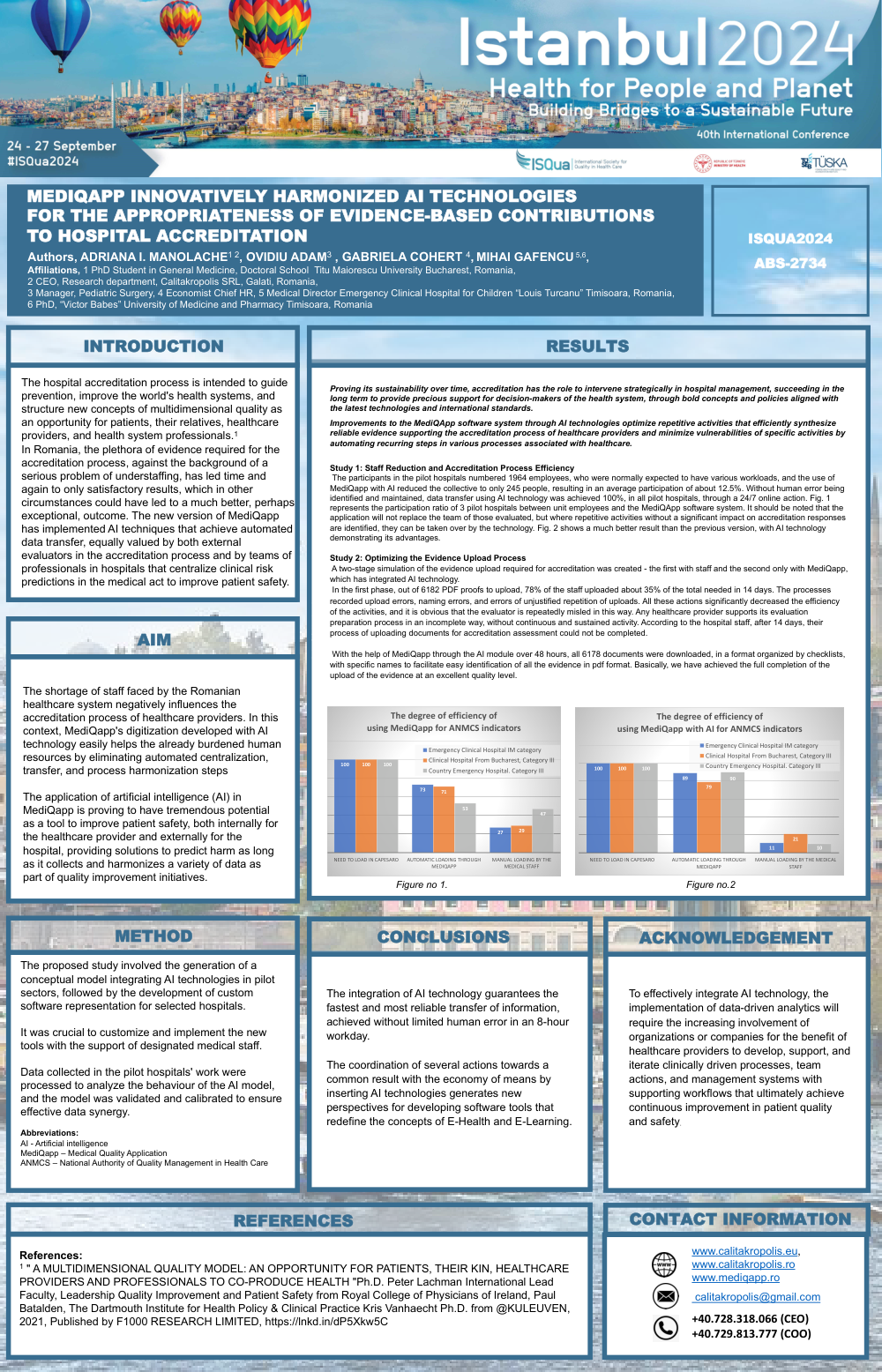
The participants in the pilot hospitals numbered 1964 employees, who were normally expected to have various workloads, and the use of MediQapp with AI reduced the collective to only 245 people, resulting in an average participation of about 12.5%. Without human error being identified and maintained, data transfer using AI technology was achieved 100%, in all pilot hospitals, through a 24/7 online action. Fig 1 represents the participation ratio of 3 pilot hospitals between unit employees and the MediQApp software system. It should be noted that the application will not replace the team of those evaluated, but where repetitive activities without a significant impact on accreditation responses are identified, they can be taken over by the technology. Fig. 2 shows a much better result than the previous version, with AI technology demonstrating its advantages.
Study 2: Optimizing the Evidence Upload Process
A two-stage simulation of the evidence upload required for accreditation was created - the first with staff and the second only with MediQapp, which has integrated AI technology.
In the first phase, out of 6182 PDF proofs to upload, 78% of the staff uploaded about 35% of the total needed in 14 days. The processes recorded upload errors, naming errors, and errors of unjustified repetition of uploads. All these actions significantly decreased the efficiency of the activities, and it is obvious that the evaluator is repeatedly misled in this way. Any healthcare provider supports its evaluation preparation process in an incomplete way, without continuous and sustained activity. According to the hospital staff, after 14 days, their process of uploading documents for accreditation assessment could not be completed.
With the help of MediQapp through the AI module over 48 hours, all 6178 documents were downloaded, in a format organized by checklists, with specific names to facilitate easy identification of all the evidence in pdf format. Basically, we have achieved the full completion of the upload of the evidence at an excellent quality level.
Conclusion:
The integration of AI technology guarantees the fastest and most reliable transfer of information, achieved without limited human error in an 8-hour workday.
The coordination of several actions towards a common result with the economy of means by inserting AI technologies generates new perspectives for developing software tools that redefine the concepts of E-Health and E-Learning.
To effectively integrate AI technology, the implementation of data-driven analytics will require the increasing involvement of organizations or companies for the benefit of healthcare providers to develop, support, and iterate clinically driven processes, team actions, and management systems with supporting workflows that ultimately achieve continuous improvement in patient quality and safety.
References:
1 " A MULTIDIMENSIONAL QUALITY MODEL: AN OPPORTUNITY FOR PATIENTS, THEIR KIN, HEALTHCARE PROVIDERS AND PROFESSIONALS TO CO-PRODUCE HEALTH "Ph.D. Peter Lachman International Lead Faculty, Leadership Quality Improvement and Patient Safety from Royal College of Physicians of Ireland, Paul Batalden, The Dartmouth Institute for Health Policy & Clinical Practice Kris Vanhaecht Ph.D. from @KULEUVEN, 2021, Published by F1000 RESEARCH LIMITED, https://lnkd.in/dP5Xkw5C
Conflict of interest: The authors declare no conflicts of interest and report no financial support from external sources for this study
Key word: AI, MediQapp, quality, safety, kin, digital, accreditation, health, management
Abbreviations:
AI - Artificial intelligence
MediQapp – Medical Quality Application
ANMCS – National Authority of Quality Management in Health Care