586 posters, 8 topics, 23 sessions, 1,077 authors, 622 institutions
ePostersLive by SciGen Technologies S.A. All rights reserved.
ISQua's 40th International Conference 2024
24th - 27th September 2024 | Istanbul, Türkiye

P526
Analysis of the Effectiveness of Using AI Information Systems to Improve Tuberculosis X-ray Screening in Mountainous Townships.
Poster Presenter
Authors
Affiliations
Part of Topic
Future of Healthcare: AI and Digital Transformation
INTRODUCTION
In Taiwan, despite national success in lowering TB incidence, Hualien County's mountainous terrain and transportation barriers impede control efforts. Xiulin Township, the largest such area, suffers an even higher rate. This project proposes an integrated AI and X-ray screening service within Hualien's mountains, leveraging technology to bridge healthcare gaps caused by inaccessibility.
AIM
In this project, our aim is to measure the following impacts after integrating AI with X-ray screening services:
(1)Reducing the time for TB risk assessment after X-ray.
(2)Increasing sputum retention rates for positive screenings.
METHOD
Using the intelligent screening service, X-ray image data and radiologist interpretation results are collected to analyze the sensitivity and specificity of the AI model. During the mobile screening period: (1)The time for the physician to confirm the image for suspected tuberculosis X-ray images. (2)Sputum collection rate of positive images, were collected and compared with the data of 2022 to analyze whether the AI information system can shorten the time from X-ray screening to physician confirmation of whether the image has a risk of tuberculosis and improve the sputum collection rate of positive images after tuberculosis screening.
RESULTS
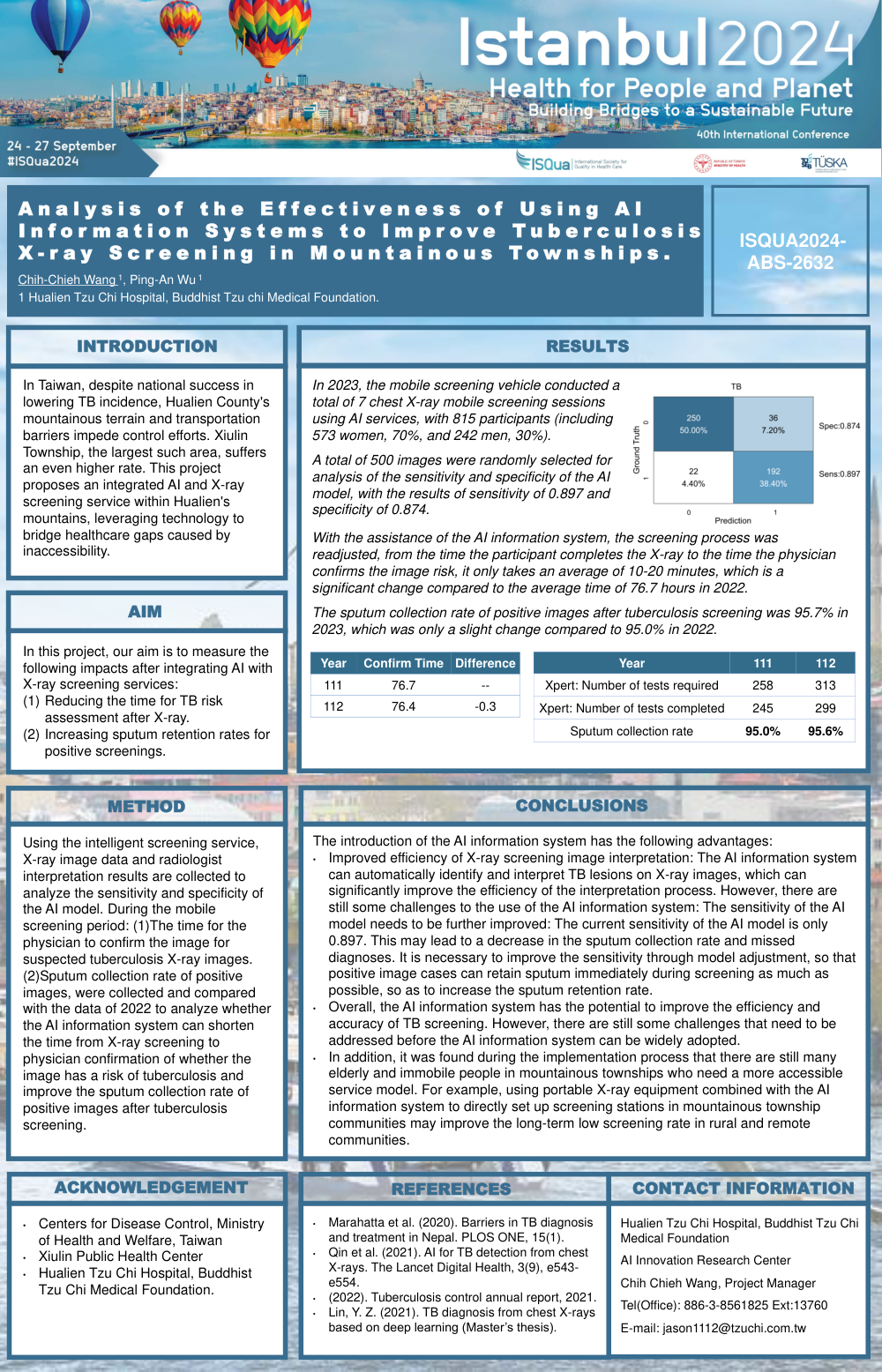
In 2023, the mobile screening vehicle conducted a total of 7 chest X-ray mobile screening sessions using AI services, with 815 participants (including 573 women, 70%, and 242 men, 30%).
A total of 500 images were randomly selected for analysis of the sensitivity and specificity of the AI model, with the results of sensitivity of 0.897 and specificity of 0.874.
With the assistance of the AI information system, the screening process was readjusted, from the time the participant completes the X-ray to the time the physician confirms the image risk, it only takes an average of 10-20 minutes, which is a significant change compared to the average time of 76.7 hours in 2022.
The sputum collection rate of positive images after tuberculosis screening was 95.7% in 2023, which was only a slight change compared to 95.0% in 2022.
CONCLUSIONS
The introduction of the AI information system has the following advantages:
- Improved efficiency of X-ray screening image interpretation: The AI information system can automatically identify and interpret TB lesions on X-ray images, which can significantly improve the efficiency of the interpretation process. However, there are still some challenges to the use of the AI information system: The sensitivity of the AI model needs to be further improved: The current sensitivity of the AI model is only 0.897. This may lead to a decrease in the sputum collection rate and missed diagnoses. It is necessary to improve the sensitivity through model adjustment, so that positive image cases can retain sputum immediately during screening as much as possible, so as to increase the sputum retention rate.
- Overall, the AI information system has the potential to improve the efficiency and accuracy of TB screening. However, there are still some challenges that need to be addressed before the AI information system can be widely adopted.
- In addition, it was found during the implementation process that there are still many elderly and immobile people in mountainous townships who need a more accessible service model. For example, using portable X-ray equipment combined with the AI information system to directly set up screening stations in mountainous township communities may improve the long-term low screening rate in rural and remote communities.