586 posters, 8 topics, 23 sessions, 1,077 authors, 622 institutions
ePostersLive by SciGen Technologies S.A. All rights reserved.
ISQua's 40th International Conference 2024
24th - 27th September 2024 | Istanbul, Türkiye

P557
Next-Gen AI in Healthcare: Transforming Antibiotic Resistance Detection with Machine Learning
Part of Topic
Future of Healthcare: AI and Digital Transformation
Introduction:In the battle against infectious diseases, the rapid emergence of antibiotic resistance, exemplified by ceftazidime-avibactam (CZA) resistance in Klebsiella pneumoniae, presents a formidable challenge to modern healthcare systems. Addressing this pressing issue, our study leverages the convergence of Matrix-Assisted Laser Desorption/Ionization Time-of-Flight Mass Spectrometry (MALDI-TOF MS) and advanced machine learning through a light gradient boosting machine (LGBM) algorithm. This innovative fusion marks a significant stride towards the digital transformation of microbial diagnostics, offering a substantial reduction in the time to detect CZA resistance, thereby bridging a critical gap in the rapid response to bacterial infections.
Aim: To accelerate the detection of CZA resistance in Klebsiella pneumoniae by integrating MALDI-TOF MS with an LGBM-based model, improving diagnostic speed and precision, and advancing AI-driven healthcare solutions.
Methods: Our investigation processed 675 Klebsiella pneumoniae specimens, applying MALDI-TOF MS for swift microbial identification, coupled with an LGBM-based model to evaluate CZA susceptibility. This integrated approach focuses on refining feature extraction and preprocessing techniques to eclipse the conventional diagnostic timeframe. By optimizing the identification workflow, we aim to enhance the efficiency and precision of detecting CZA-resistant strains, thereby propelling the integration of AI within healthcare diagnostics forward.
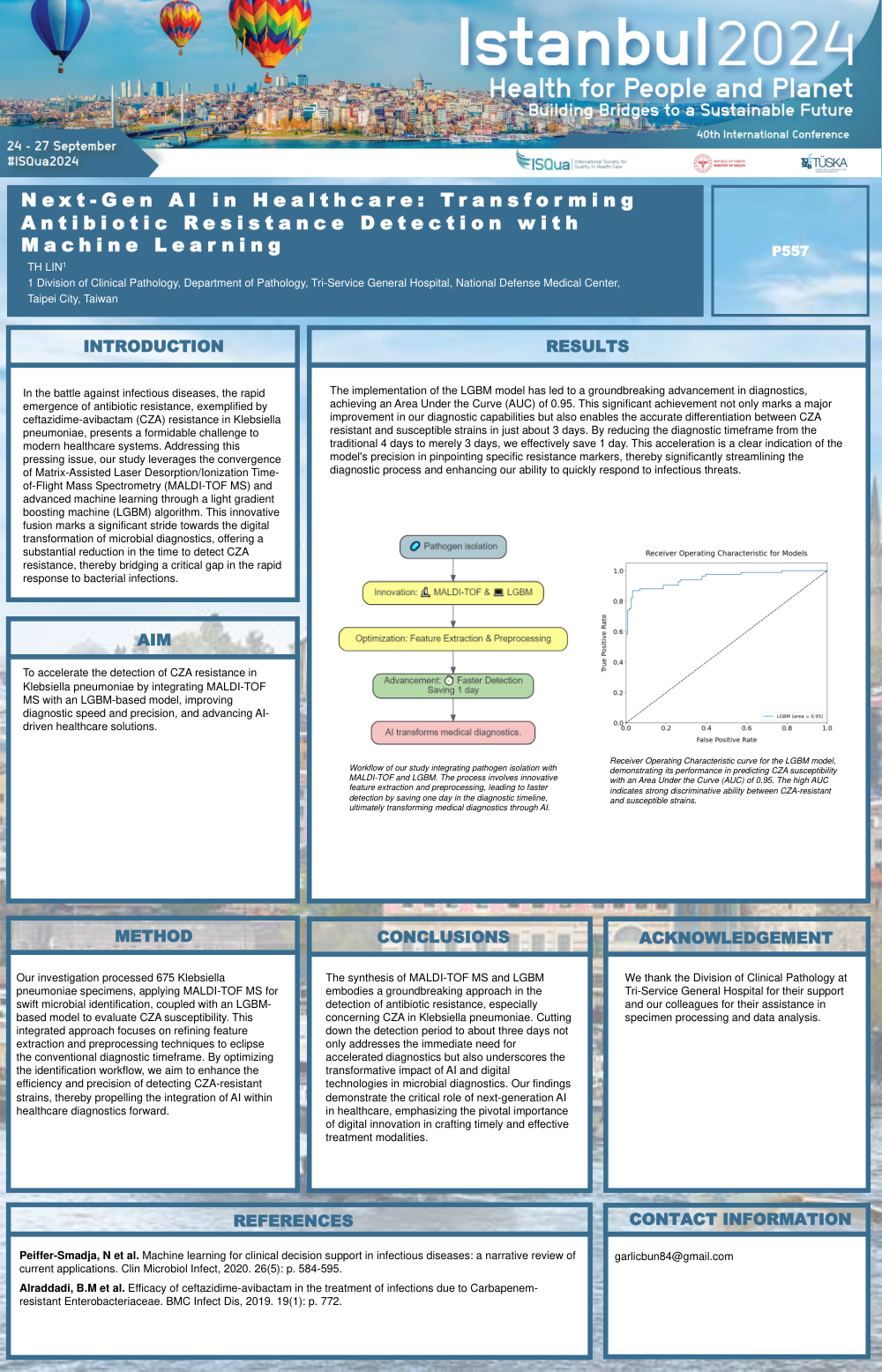
Results: The implementation of the LGBM model has led to a groundbreaking advancement in diagnostics, achieving an Area Under the Curve (AUC) of 0.95. This significant achievement not only marks a major improvement in our diagnostic capabilities but also enables the accurate differentiation between CZA resistant and susceptible strains in just about 3 days. By reducing the diagnostic timeframe from the traditional 4 days to merely 3 days, we effectively save 1 day. This acceleration is a clear indication of the model's precision in pinpointing specific resistance markers, thereby significantly streamlining the diagnostic process and enhancing our ability to quickly respond to infectious threats.
Conclusion: The synthesis of MALDI-TOF MS and LGBM embodies a groundbreaking approach in the detection of antibiotic resistance, especially concerning CZA in Klebsiella pneumoniae. Cutting down the detection period to about three days not only addresses the immediate need for accelerated diagnostics but also underscores the transformative impact of AI and digital technologies in microbial diagnostics. Our findings demonstrate the critical role of next-generation AI in healthcare, emphasizing the pivotal importance of digital innovation in crafting timely and effective treatment modalities.