586 posters, 8 topics, 23 sessions, 1,077 authors, 622 institutions
ePostersLive by SciGen Technologies S.A. All rights reserved.
ISQua's 40th International Conference 2024
24th - 27th September 2024 | Istanbul, Türkiye

P558
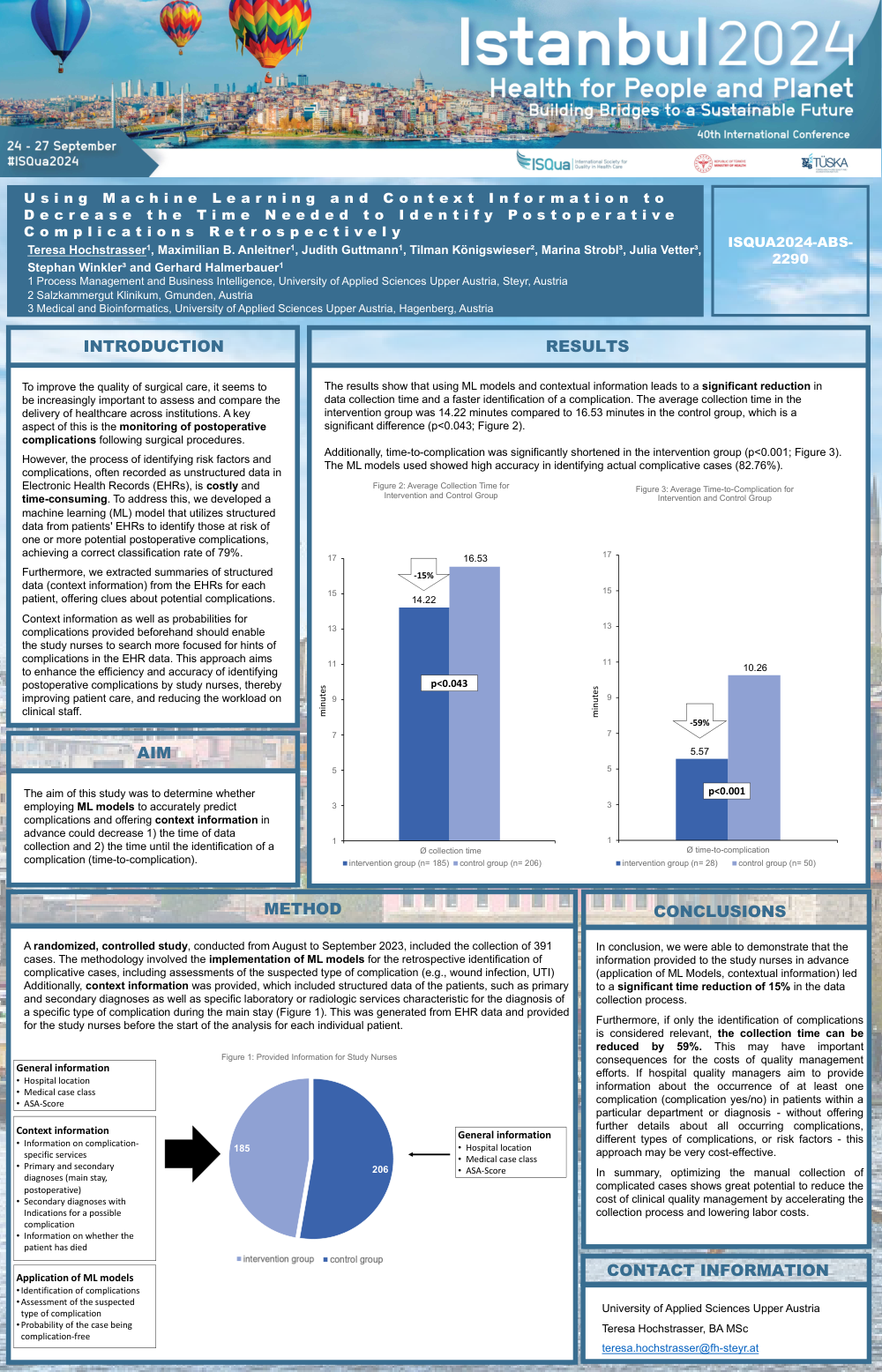
Using Machine Learning and Contextual Information to Decrease the Time Needed to Identify Postoperative Complications Retrospectively
Poster Presenter
Part of Topic
Future of Healthcare: AI and Digital Transformation
INTRODUCTION
To improve the quality of surgical care, it seems to be increasingly important to assess and compare the delivery of healthcare across institutions. A key aspect of this is the monitoring of postoperative complications following surgical procedures.
However, the process of identifying risk factors and complications, often recorded as unstructured data in Electronic Health Records (EHRs), is costly and time-consuming. To address this, we developed a machine learning (ML) model that utilizes structured data from patients' EHRs to identify those at risk of one or more potential postoperative complications, achieving a correct classification rate of 79%.
Furthermore, we extracted summaries of structured data (context information) from the EHRs for each patient, offering clues about potential complications.
Context information as well as probabilities for complications provided beforehand should enable the study nurses to search more focused for hints of complications in the EHR data. This approach aims to enhance the efficiency and accuracy of identifying postoperative complications by study nurses, thereby improving patient care, and reducing the workload on clinical staff.
AIM
The aim of this study was to determine whether employing ML models to accurately predict complications and offering context information in advance could decrease 1) the time of data collection and 2) the time until the identification of a complication (time-to-complication).
METHOD
A randomized, controlled study, conducted from August to September 2023, included the collection of 391 cases. The methodology involved the implementation of ML models for the retrospective identification of complicative cases, including assessments of the suspected type of complication (e.g., wound infection, UTI) Additionally, context information was provided, which included structured data of the patients, such as primary and secondary diagnoses as well as specific laboratory or radiologic services characteristic for the diagnosis of a specific type of complication during the main stay (Figure 1). This was generated from EHR data and provided for the study nurses before the start of the analysis for each individual patient.
RESULTS
The results show that using ML models and contextual information leads to a significant reduction in data collection time and a faster identification of a complication. The average collection time in the intervention group was 14.22 minutes compared to 16.53 minutes in the control group, which is a significant difference (p<0.043; Figure 2).
Additionally, time-to-complication was significantly shortened in the intervention group (p<0.001; Figure 3). The ML models used showed high accuracy in identifying actual complicative cases (82.76%).
CONCLUSIONS
In conclusion, we were able to demonstrate that the information provided to the study nurses in advance (application of ML Models, contextual information) led to a significant time reduction of 15% in the data collection process.
Furthermore, if only the identification of complications is considered relevant, the collection time can be reduced by 59%. This may have important consequences for the costs of quality management efforts. If hospital quality managers aim to provide information about the occurrence of at least one complication (complication yes/no) in patients within a particular department or diagnosis - without offering further details about all occurring complications, different types of complications, or risk factors - this approach may be very cost-effective.
In summary, optimizing the manual collection of complicated cases shows great potential to reduce the cost of clinical quality management by accelerating the collection process and lowering labor costs.