586 posters, 8 topics, 23 sessions, 1,077 authors, 622 institutions
ePostersLive by SciGen Technologies S.A. All rights reserved.
ISQua's 40th International Conference 2024
24th - 27th September 2024 | Istanbul, Türkiye

P457
Group Models of Care for Quality of Care in fragile state
Poster Presenter
Authors
Part of Topic
Co-production - Creating a patient-centred healthcare service
Title
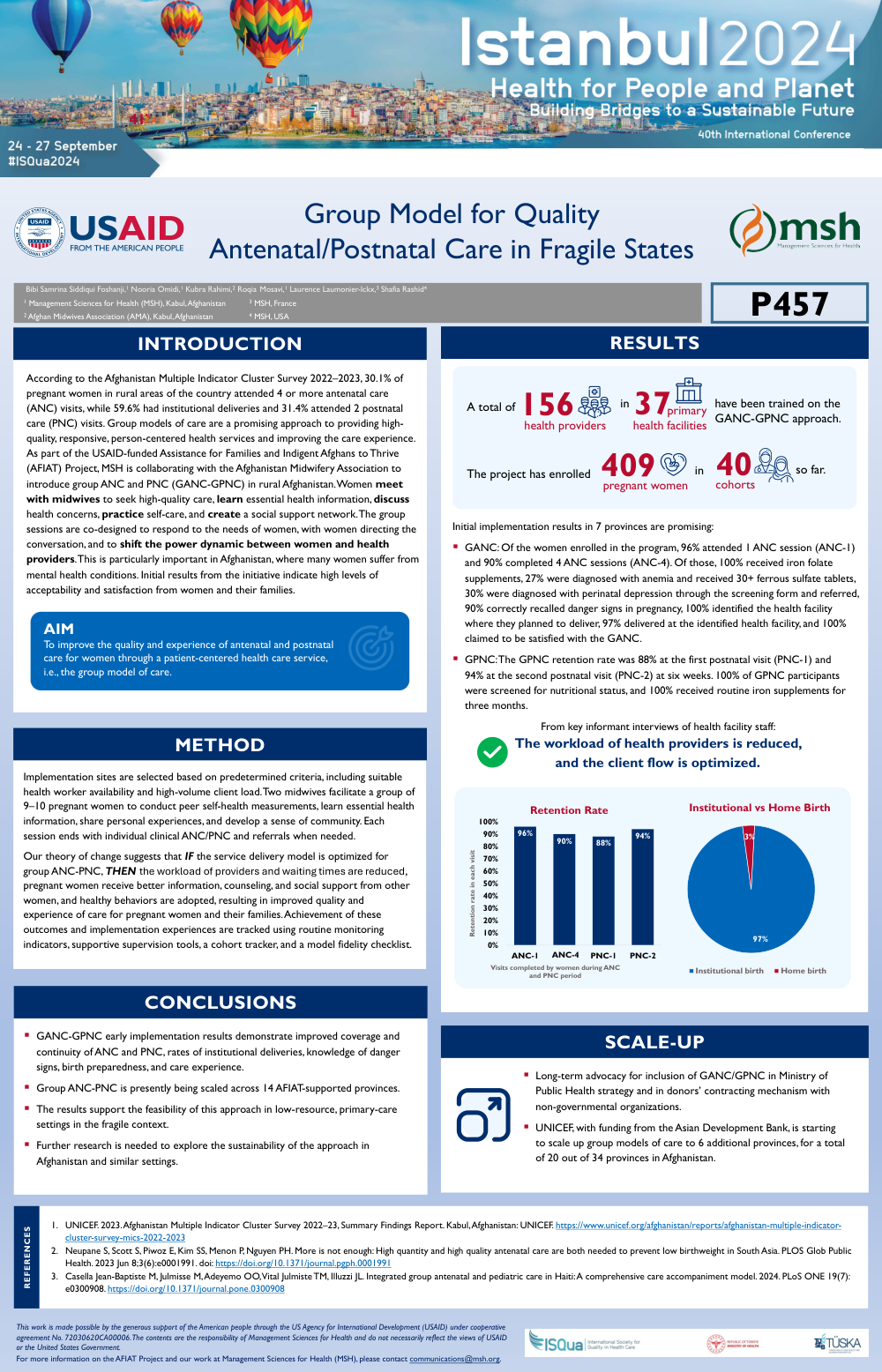
Group Model for Quality Antenatal/Postnatal Care in Fragile States
Authors
Bibi Samrina Siddiqui Foshanji,1 Nooria Omidi,1 Kubra Rahimi,2 Roqia Mosavi,1 Laurence Laumonier-Ickx,3 Shafia Rashid4
1 Management Sciences for Health (MSH), Kabul, Afghanistan 3 MSH, France
2 Afghan Midwives Association (AMA), Kabul, Afghanistan 4 MSH, USA
Introduction
According to the Afghanistan Multiple Indicator Cluster Survey 2022–2023, 30.1% of pregnant women in rural areas of the country attended 4 or more antenatal care (ANC) visits, while 59.6% had institutional deliveries and 31.4% attended 2 postnatal care (PNC) visits. Group models of care are a promising approach to providing high-quality, responsive, person-centered health services and improving the care experience. As part of the USAID-funded Assistance for Families and Indigent Afghans to Thrive (AFIAT) Project, MSH is collaborating with the Afghanistan Midwifery Association to introduce group ANC and PNC (GANC-GPNC) in rural Afghanistan. Women meet with midwives to seek high-quality care, learn essential health information, discuss health concerns, practice self-care, and create a social support network. The group sessions are co-designed to respond to the needs of women, with women directing the conversation, and to shift the power dynamic between women and health providers. This is particularly important in Afghanistan, where many women suffer from mental health conditions. Initial results from the initiative indicate high levels of acceptability and satisfaction from women and their families.
Aim
To improve the quality and experience of antenatal and postnatal care for women through a patient-centered health care service, i.e., the group model of care.
Method
Implementation sites are selected based on predetermined criteria, including suitable health worker availability and high-volume client load. Two midwives facilitate a group of 9–10 pregnant women to conduct peer self-health measurements, learn essential health information, share personal experiences, and develop a sense of community. Each session ends with individual clinical ANC/PNC and referrals when needed.
Our theory of change suggests that IF the service delivery model is optimized for group ANC-PNC, THENthe workload of providers and waiting times are reduced, pregnant women receive better information, counseling, and social support from other women, and healthy behaviors are adopted, resulting in improved quality and experience of care for pregnant women and their families. Achievement of these outcomes and implementation experiences are tracked using routine monitoring indicators, supportive supervision tools, a cohort tracker, and a model fidelity checklist.
Results
Initial implementation results in 7 provinces are promising:
94% at the second postnatal visit (PNC-2) at six weeks. 100% of GPNC participants were screened for nutritional status, and 100% received routine iron supplements for three months.
Conclusion