586 posters, 8 topics, 23 sessions, 1,077 authors, 622 institutions
ePostersLive by SciGen Technologies S.A. All rights reserved.
ISQua's 40th International Conference 2024
24th - 27th September 2024 | Istanbul, Türkiye

P549
A Preliminary Exploration of Predicting Length of Stay at a Certain Medical Center Using Machine Learning Methods
Poster Presenter
Part of Topic
Future of Healthcare: AI and Digital Transformation
P549
A Preliminary Exploration of Predicting Length of Stay at a Certain Medical Center Using Machine Learning Methods
Meng-Hsun Lee 1, 2, Ding-Hsiang Huang 2, Hung-Wen Tsai 1, Chin-Yin Huang 2
1 Department of Medical Administration, Taichung Veterans General Hospital, Taichung City, Taiwan
2 Department of Industrial Engineering and Enterprise Information, Tunghai University, Taichung City, Taiwan
INTRODUCTION
Efficient patient flow management, including bed and capacity optimization, is a critical aspect of healthcare operations. Accurate prediction of patient length of stay (LOS) facilitates proactive scheduling by clinical staff, preventing backlogs and denials for future appointments or admissions. Recent advancements in machine learning, such as Random Forest Regression and eXtreme Gradient Boosting (XGBoost) Regression, have found application in healthcare.
Established in 1982, a prominent medical center in Taiwan boasts 1,600 beds, 6,000 employees, and handles over 9,000 outpatient visits daily, along with over 6,000 inpatient visits monthly. This study aims to employ machine learning techniques to forecast patient LOS, contributing to the hospital's digital transformation and operational decision-making.
AIM
This study aims to evaluate and optimize predictive models for estimating LOS in a hospital setting using machine learning regression techniques.
The primary focus is on comparing the performance of three regression models—Random Forest, XGBoost, and Logistic Regression—across different LOS groups (≤14 days, ≤30 days, and ≤90 days).
Additionally, the study seeks to determine the impact of hyperparameter tuning on the predictive accuracy of these models, particularly in the dataset where LOS is ≤ 14 days, and to identify the most important features influencing the LOS predictions.
METHOD
The data for this study were sourced from medical records of patients discharged from January to July 2023, totaling 21,308 cases with Diagnostic Related Groups (DRG) code in the medical center. The variables included in the analysis comprised patient LOS, gender, age, department, relative weight (RW) of DRG code, principal diagnosis, secondary diagnoses, and procedure codes. The study compared patient LOS predictions by selecting the best model and tuning its hyperparameters to minimize the Mean Absolute Error (MAE). Logistic Regression (as a reference method), Random Forest Regression, and XGBoost (eXtreme Gradient Boosting) Regression models were employed.
Under each regression model, the datasets were further divided into 3 groups for comparison: LOS ≤ 14 days (consistent with the definition for quality indicators of patient readmission), LOS ≤ 30 days, and LOS ≤ 90 days (two definitions of overstay). The predictive performance, measured by MAE, was assessed using ANOVA tests and Scheffe post-hoc tests. Graphical representation and statistical analysis were conducted using Visual Studio Code (version 1.85) to write Python codes.
RESULTS
1.The ANOVA test results for the MAE among the 3 regression models and 3 LOS groups showed a significant difference, with an F-value of 143.131 and p < 0.001.
2.Among 3 regression models, analyzing the dataset where LOS ≤ 14 days yielded a smaller MAE, with a statistically significant difference compared to LOS ≤ 30 and LOS ≤ 90 days, in Scheffe post-hoc tests.
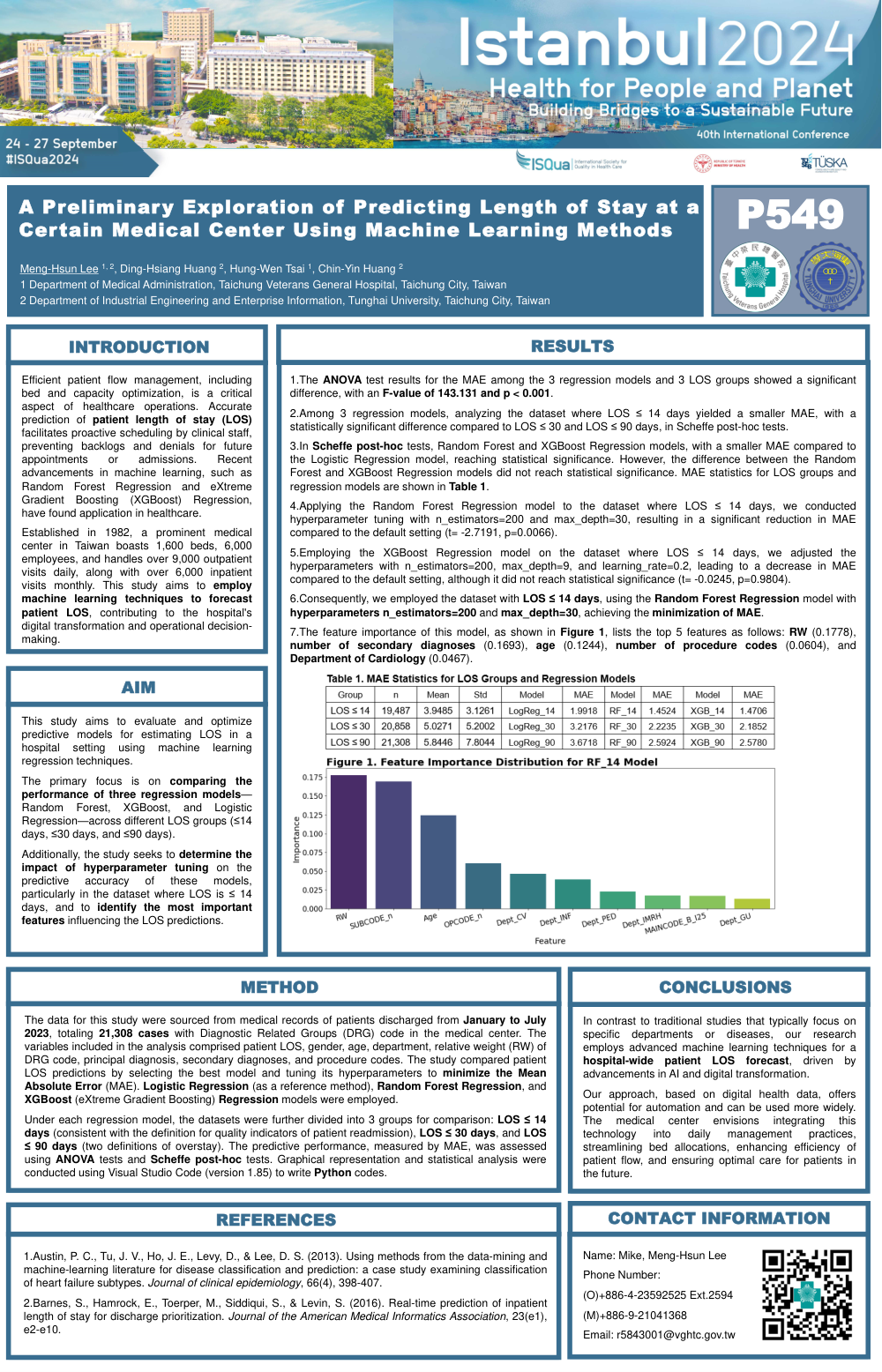
3.In Scheffe post-hoc tests, Random Forest and XGBoost Regression models, with a smaller MAE compared to the Logistic Regression model, reaching statistical significance. However, the difference between the Random Forest and XGBoost Regression models did not reach statistical significance. MAE statistics for LOS groups and regression models are shown in Table 1.
4.Applying the Random Forest Regression model to the dataset where LOS ≤ 14 days, we conducted hyperparameter tuning with n_estimators=200 and max_depth=30, resulting in a significant reduction in MAE compared to the default setting (t= -2.7191, p=0.0066).
5.Employing the XGBoost Regression model on the dataset where LOS ≤ 14 days, we adjusted the hyperparameters with n_estimators=200, max_depth=9, and learning_rate=0.2, leading to a decrease in MAE compared to the default setting, although it did not reach statistical significance (t= -0.0245, p=0.9804).
6.Consequently, we employed the dataset with LOS ≤ 14 days, using the Random Forest Regression model with hyperparameters n_estimators=200 and max_depth=30, achieving the minimization of MAE.
7.The feature importance of this model, as shown in Figure 1, lists the top 5 features as follows: RW (0.1778), number of secondary diagnoses (0.1693), age (0.1244), number of procedure codes (0.0604), and Department of Cardiology (0.0467).
CONCLUSIONS
In contrast to traditional studies that typically focus on specific departments or diseases, our research employs advanced machine learning techniques for a hospital-wide patient LOS forecast, driven by advancements in AI and digital transformation.
Our approach, based on digital health data, offers potential for automation and can be used more widely. The medical center envisions integrating this technology into daily management practices, streamlining bed allocations, enhancing efficiency of patient flow, and ensuring optimal care for patients in the future.
REFERENCES
1.Austin, P. C., Tu, J. V., Ho, J. E., Levy, D., & Lee, D. S. (2013). Using methods from the data-mining and machine-learning literature for disease classification and prediction: a case study examining classification of heart failure subtypes. Journal of clinical epidemiology, 66(4), 398-407.
2.Barnes, S., Hamrock, E., Toerper, M., Siddiqui, S., & Levin, S. (2016). Real-time prediction of inpatient length of stay for discharge prioritization. Journal of the American Medical Informatics Association, 23(e1), e2-e10.
CONTACT INFORMATION
Name: Mike, Meng-Hsun Lee
Phone Number:
(O)+886-4-23592525 Ext.2594
(M)+886-9-21041368
Email: r5843001@vghtc.gov.tw