586 posters, 8 topics, 23 sessions, 1,077 authors, 622 institutions
ePostersLive by SciGen Technologies S.A. All rights reserved.
ISQua's 40th International Conference 2024
24th - 27th September 2024 | Istanbul, Türkiye

P565
Pioneering Smart Healthcare: Empirical Exploration of Digital Innovation in Telemedicine
Poster Presenter
Part of Topic
Future of Healthcare: AI and Digital Transformation
Title: Pioneering Smart Healthcare: Empirical Exploration of Digital Innovation in Telemedicine
Introduction:
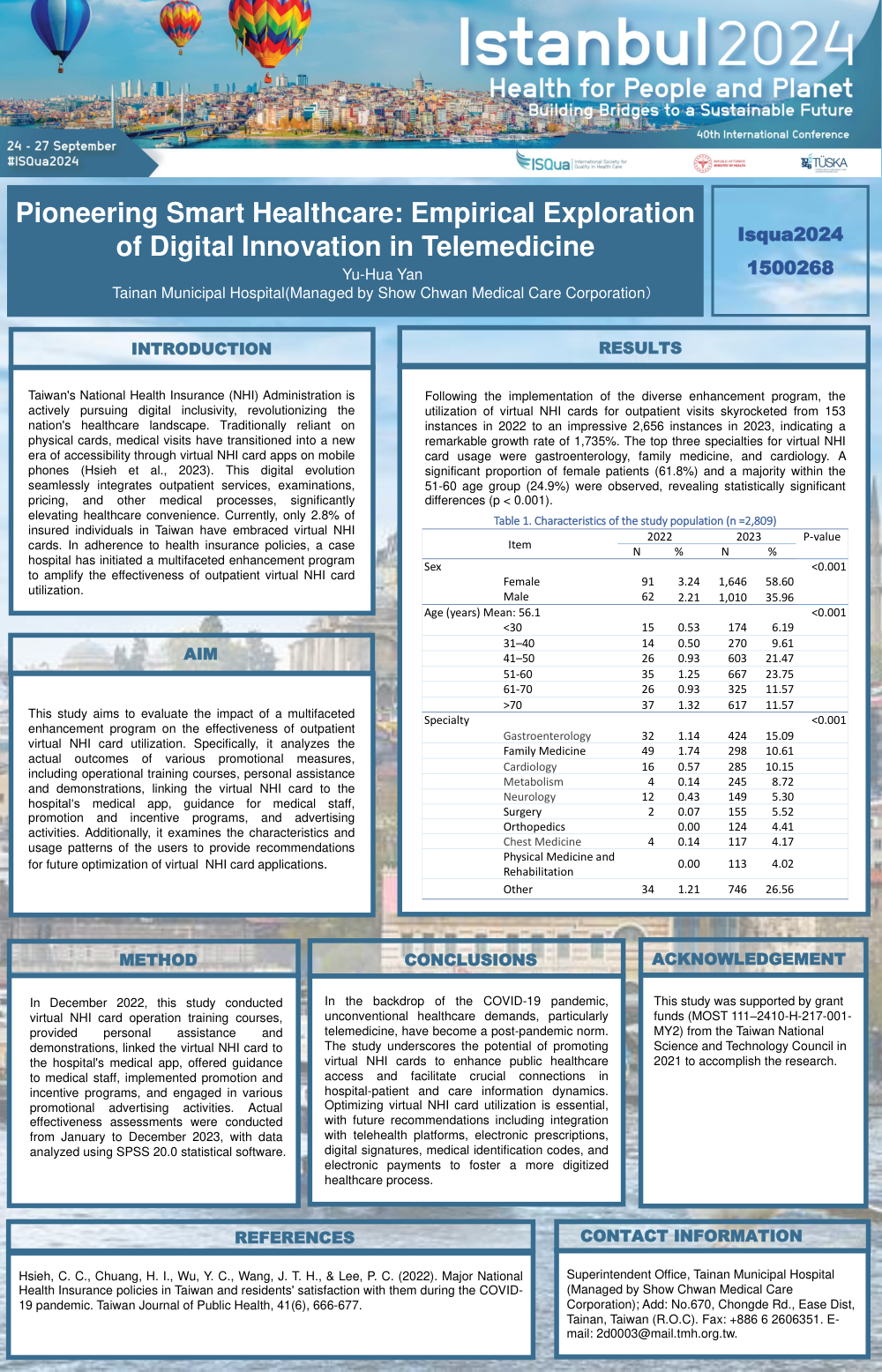
Taiwan's National Health Insurance (NHI) Administration is actively pursuing digital inclusivity, revolutionizing the nation's healthcare landscape. Traditionally reliant on physical cards, medical visits have transitioned into a new era of accessibility through virtual NHI card apps on mobile phones (Hsieh et al., 2023). This digital evolution seamlessly integrates outpatient services, examinations, pricing, and other medical processes, significantly elevating healthcare convenience. Currently, only 2.8% of insured individuals in Taiwan have embraced virtual NHI cards. In adherence to health insurance policies, a case hospital has initiated a multifaceted enhancement program to amplify the effectiveness of outpatient virtual NHI card utilization.
Methods:
In December 2022, this study conducted virtual NHI card operation training courses, provided personal assistance and demonstrations, linked the virtual NHI card to the hospital's medical app, offered guidance to medical staff, implemented promotion and incentive programs, and engaged in various promotional advertising activities. Actual effectiveness assessments were conducted from January to December 2023, with data analyzed using SPSS 20.0 statistical software.
Results:
Following the implementation of the diverse enhancement program, the utilization of virtual NHI cards for outpatient visits skyrocketed from 153 instances in 2022 to an impressive 2,656 instances in 2023, indicating a remarkable growth rate of 1,735%. The top three specialties for virtual NHI card usage were gastroenterology, family medicine, and cardiology. A significant proportion of female patients (61.8%) and a majority within the 51-60 age group (24.9%) were observed, revealing statistically significant differences (p < 0.001).
Conclusion:
In the backdrop of the COVID-19 pandemic, unconventional healthcare demands, particularly telemedicine, have become a post-pandemic norm. The study underscores the potential of promoting virtual NHI cards to enhance public healthcare access and facilitate crucial connections in hospital-patient and care information dynamics. Optimizing virtual NHI card utilization is essential, with future recommendations including integration with telehealth platforms, electronic prescriptions, digital signatures, medical identification codes, and electronic payments to foster a more digitized healthcare process.