586 posters, 8 topics, 23 sessions, 1,077 authors, 622 institutions
ePostersLive by SciGen Technologies S.A. All rights reserved.
ISQua's 40th International Conference 2024
24th - 27th September 2024 | Istanbul, Türkiye

P541
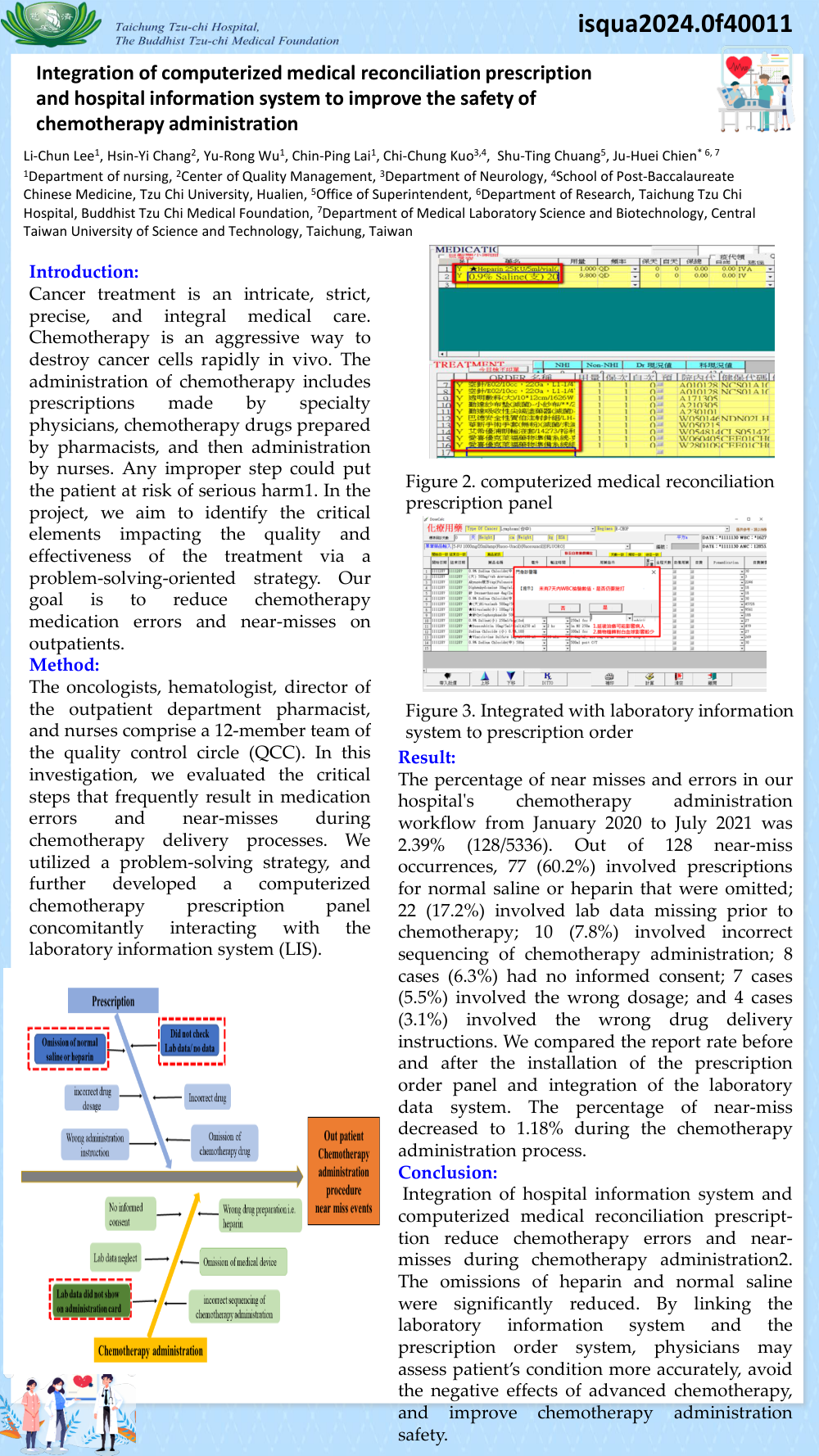
Integration of computerized medical reconciliation prescription and hospital information system to improve the safety of chemotherapy administration
Poster Presenter
Authors
Li-Chun Lee, Hsin-Yi Chang, Yu-Rong Wu, Chin-Ping Lai, Chi-Chung Kuo, Shu-Ting Chuang, Ju-Huei Chien
Affiliations
Department of nursing,Taichung Tzu Chi Hospital, Buddhist Tzu Chi Medical Foundation, Center of Quality Management,Taichung Tzu Chi Hospital, Buddhist Tzu Chi Medical Foundation, Office of Superintendent, Taichung Tzu Chi Hospital, Buddhist Tzu Chi Medical Foundation, Department of Research, Taichung Tzu Chi Hospital, Buddhist Tzu Chi Medical Foundation, Department of Neurology,Taichung Tzu Chi Hospital, Buddhist Tzu Chi Medical Foundation
Part of Topic
Future of Healthcare: AI and Digital Transformation
Integration of computerized medical reconciliation prescription and hospital information system to improve the safety of chemotherapy administration
Li-Chun Li, Yu-Rong Wu, Hsin-Yi Chang, Chin-Ping Lai, Chi-Chung Kuo, Shu-Ting Chuang, Ju-Huei Chien
Introduction: Cancer treatment is an intricate, strict, precise, and integral medical care. Chemotherapy is an aggressive way to destroy cancer cells rapidly in vivo. The administration of chemotherapy includes prescriptions made by specialty physicians, chemotherapy drugs prepared by pharmacists, and then administration by nurses. Any improper step could put the patient at risk of serious harm. In the project, we aim to identify the critical elements impacting the quality and effectiveness of the treatment via a problem-solving-oriented strategy. Our goal is to reduce chemotherapy medication errors and near-misses on outpatients.
Methods: The oncologists, hematologist, director of the outpatient department pharmacist, and nurses comprise a 12-member team of the quality control circle (QCC). In this investigation, we evaluated the critical steps that frequently result in medication errors and near-misses during chemotherapy delivery processes. We utilized a problem-solving strategy, and further developed a computerized chemotherapy prescription panel concomitantly interacting with the laboratory information system (LIS).
Results: The percentage of near misses and errors in our hospital's chemotherapy administration workflow from January 2020 to July 2021 was 2.39% (128/5336). Out of 128 near-miss occurrences, 77 (60.2%) involved prescriptions for normal saline or heparin that were omitted; 22 (17.2%) involved lab data missing prior to chemotherapy; 10 (7.8%) involved incorrect sequencing of chemotherapy administration; 8 cases (6.3%) had no informed consent; 7 cases (5.5%) involved the wrong dosage; and 4 cases (3.1%) involved the wrong drug delivery instructions. We compared the report rate before and after the installation of the prescription order panel and integration of the laboratory data system. The percentage of near-miss decreased to 1.18% during the chemotherapy administration process.
Conclusion: Integration of hospital information system and computerized medical reconciliation prescription reduce chemotherapy errors and near-misses during chemotherapy administration. The omissions of heparin and normal saline were significantly reduced. By linking the laboratory information system and the prescription order system, physicians may assess patient’s condition more accurately, avoid the negative effects of advanced chemotherapy, and improve chemotherapy administration safety.