586 posters, 8 topics, 23 sessions, 1,077 authors, 622 institutions
ePostersLive by SciGen Technologies S.A. All rights reserved.
ISQua's 40th International Conference 2024
24th - 27th September 2024 | Istanbul, Türkiye

ISQUA2024-ABS-3392
AI tracking Multidisciplinary Decision Making: Enabling a regional support tool.
Poster Presenter
Authors
Dominic van Loggerenberg, Charl van Loggerenberg, Carol-Ann Benn, Tanya Volschenk
Affiliations
BREAST CARE CENTER OF EXCELLENCE MILPARK, Netcare Breast Care Centre of Excellence, Milpark Hospital, 10 Guild Road, South Africa, MB.BCh (Wits) FCEM (SA) MBA (Wits) Dip.PEC (SA) DBM (DMS) Head of Emergency Medicine for Life Healthcare, MB.BCh (Wits) FCS (SA) Department of Immunology, Faculty of Health Sciences, University of Pretoria
Part of Topic
Future of Healthcare: AI and Digital Transformation
AI Tracking Multidisciplinary Decision Making: Enabling A Regional Support Tool.
-
Dominic Van Loggerenberg, Netcare Breast Care Centre of Excellence, Milpark Hospital, 10 Guild Road, South Africa
-
Dr Charl van Loggerenberg, MB.BCh (Wits) FCEM (SA) MBA (Wits) Dip.PEC (SA) DBM (DMS) Head of Emergency Medicine for Life Healthcare
-
Prof Carol-Ann Benn, MB.BCh (Wits) FCS (SA) Department of Immunology, Faculty of Health Sciences, University of Pretoria
-
Tanya Volschenk, Netcare Breast Care Centre of Excellence, Milpark Hospital, 10 Guild Road, South Africa
Background
The integration of AI in Healthcare allows for a unique opportunity to replicate advanced decision-making systems that are not limited by local resources and regional constraints. Within the LMI(Low-Middle Income) environment of South Africa, Multi-Disciplinary care is recognised as the gold standard. However, this service is not easily available to all patients. AI-driven decision-making tools help bridge this gap.
Methods
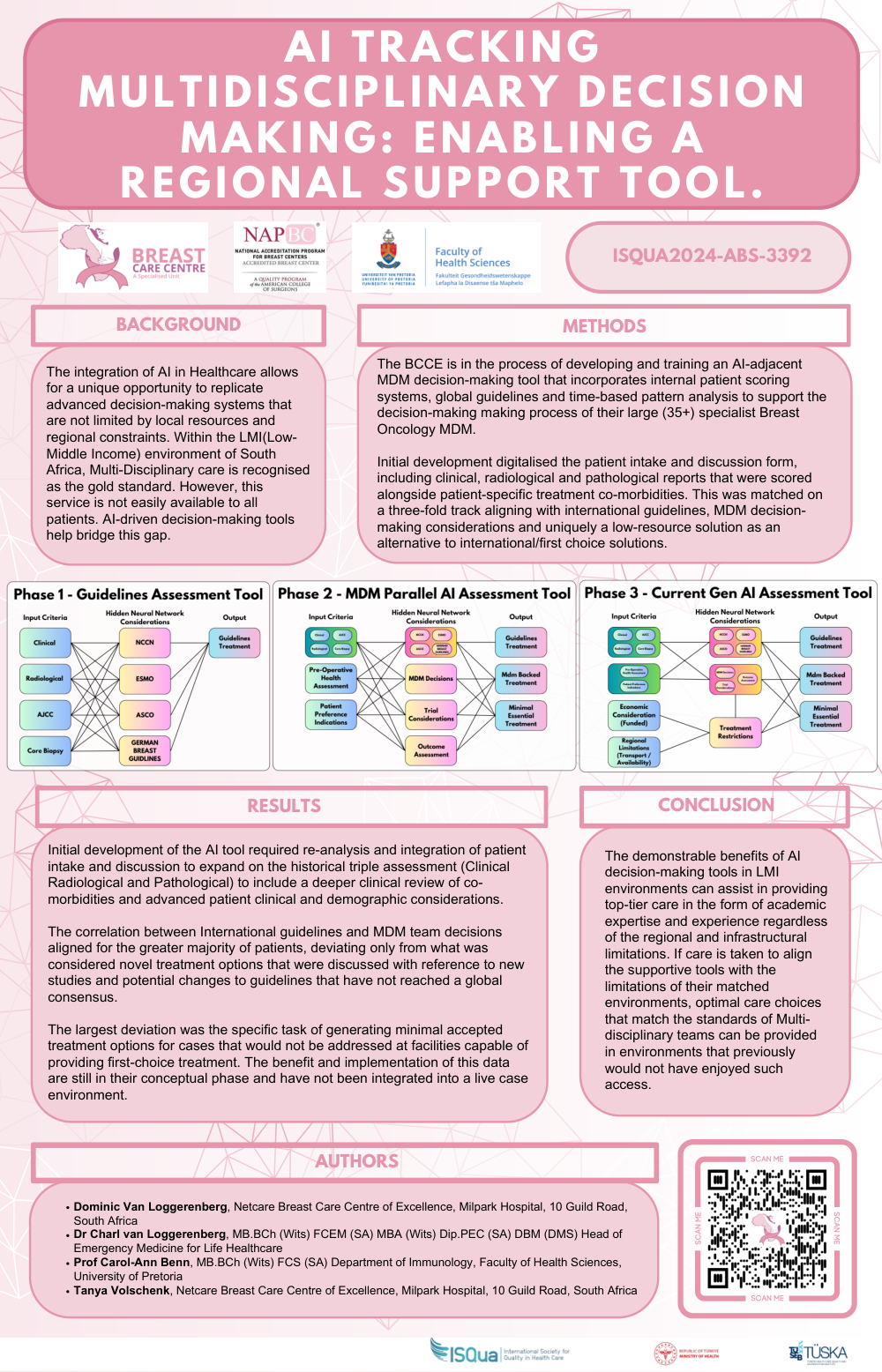
The BCCE is in the process of developing and training an AI-adjacent MDM decision-making tool that incorporates internal patient scoring systems, global guidelines and time-based pattern analysis to support the decision-making making process of their large (35+) specialist Breast Oncology MDM.
Initial development digitalised the patient intake and discussion form, including clinical, radiological and pathological reports that were scored alongside patient-specific treatment co-morbidities. This was matched on a three-fold track aligning with international guidelines, MDM decision-making considerations and uniquely a low-resource solution as an alternative to international/first choice solutions.
Results
The initial development of the AI tool required re-analysis and integration of patient intake and discussion to expand on the historical triple assessment (Clinical Radiological and Pathological) and include a deeper clinical review of co-morbidities and advanced patient clinical and demographic considerations.
The correlation between International guidelines and MDM team decisions aligned for the greater majority of patients, deviating only from what was considered novel treatment options that were discussed with reference to new studies and potential changes to guidelines that have not reached a global consensus.
The largest deviation was the specific task of generating minimal accepted treatment options for cases that would not be addressed at facilities capable of providing first-choice treatment. The benefit and implementation of this data are still in their conceptual phase and have not been integrated into a live case environment.
Conclusion
The demonstrable benefits of AI decision-making tools in LMI environments can assist in providing top-tier care in the form of academic expertise and experience regardless of the regional and infrastructural limitations. If care is taken to align the supportive tools with the limitations of their matched environments, optimal care choices that match the standards of Multi-disciplinary teams can be provided in environments that previously would not have enjoyed such access.