586 posters, 8 topics, 23 sessions, 1,077 authors, 622 institutions
ePostersLive by SciGen Technologies S.A. All rights reserved.
ISQua's 40th International Conference 2024
24th - 27th September 2024 | Istanbul, Türkiye

ISQUA2024-ABS-3228
The Patient centered Care Team: Effect on Patient reported Health-related Quality of Life.
Poster Presenter
Part of Topic
Co-production - Creating a patient-centred healthcare service
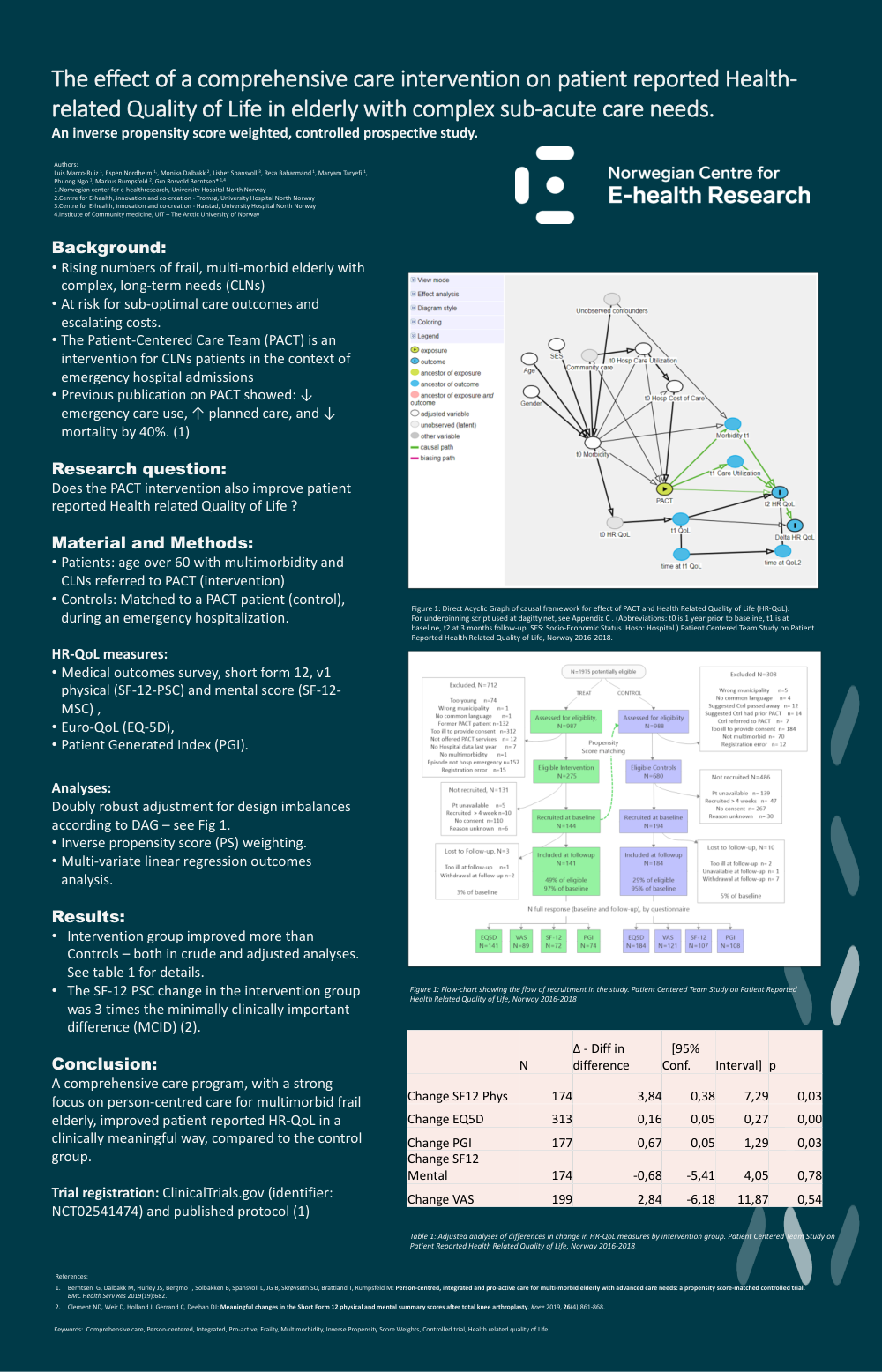
The effect of a comprehensive care intervention on patient reported Health-related Quality of Life in elderly with complex sub-acute care needs.
An inverse propensity score weighted, controlled prospective study.
Authors:
Luis Marco-Ruiz 1, Espen Nordheim 1,, Monika Dalbakk 2, Lisbet Spansvoll 3, Reza Baharmand 1, Maryam Taryefi 1, Phuong Ngo 1, Markus Rumpsfeld 2, Gro Rosvold Berntsen* 1,4
- Norwegian center for e-healthresearch, University Hospital North Norway
- Centre for E-health, innovation and co-creation - Tromsø, University Hospital North Norway
- Centre for E-health, innovation and co-creation - Harstad, University Hospital North Norway
- Institute of Community medicine, UiT – The Arctic University of Norway
Background:
- Rising numbers of frail, multi-morbid elderly with complex, long-term needs (CLNs)
- At risk for sub-optimal care outcomes and escalating costs.
- The Patient-Centered Care Team (PACT) is an intervention for CLNs patients in the context of emergency hospital admissions
- Previous publication on PACT showed: ↓ emergency care use, ↑ planned care, and ↓ mortality by 40%. (1)
Research question:
Does the PACT intervention also improve patient reported Health related Quality of Life ?
Material and Methods:
- Patients: age over 60 with multimorbidity and CLNs referred to PACT (intervention)
- Controls: Matched to a PACT patient (control), during an emergency hospitalization.
HR-QoL measures:
- Medical outcomes survey, short form 12, v1 physical (SF-12-PSC) and mental score (SF-12-MSC) ,
- Euro-QoL (EQ-5D),
- Patient Generated Index (PGI).
Analyses:
Doubly robust adjustment for design imbalances according to DAG – see Fig 1.
- Inverse propensity score (PS) weighting.
- Multi-variate linear regression outcomes analysis.
Results:
- Intervention group improved more than Controls – both in crude and adjusted analyses. See table 1 for details.
- The SF-12 PSC change in the intervention group was 3 times the minimally clinically important difference (MCID) (2).
Conclusion:
A comprehensive care program, with a strong focus on person-centred care for multimorbid frail elderly, improved patient reported HR-QoL in a clinically meaningful way, compared to the control group.
Trial registration: ClinicalTrials.gov (identifier: NCT02541474) and published protocol (1)
References:
1. Berntsen G, Dalbakk M, Hurley JS, Bergmo T, Solbakken B, Spansvoll L, JG B, Skrøvseth SO, Brattland T, Rumpsfeld M: Person-centred, integrated and pro-active care for multi-morbid elderly with advanced care needs: a propensity score-matched controlled trial. BMC Health Serv Res 2019(19):682.
2. Clement ND, Weir D, Holland J, Gerrand C, Deehan DJ: Meaningful changes in the Short Form 12 physical and mental summary scores after total knee arthroplasty. Knee 2019, 26(4):861-868.
Keywords: Comprehensive care, Person-centered, Integrated, Pro-active, Frailty, Multimorbidity, Inverse Propensity Score Weights, Controlled trial, Health related quality of Life