586 posters, 8 topics, 23 sessions, 1,077 authors, 622 institutions
ePostersLive by SciGen Technologies S.A. All rights reserved.
ISQua's 40th International Conference 2024
24th - 27th September 2024 | Istanbul, Türkiye

ISQUA2024-ABS-3001
Co-production and implementation of a handbook for the primary healthcare centers quality documentation
Poster Presenter
Part of Topic
Co-production - Creating a patient-centred healthcare service
Co-production and implementation of a handbook for the primary healthcare centres quality documentation
W. ALLOUCHE 1, H.GHANNOUCHI1, S.ESSAAFI1, S.MAJOUL1,D.BOURAS1, A.LASSOUED1, C.HAMOUDA1, 2 and Prof A.NOUIRA, Dr S.BOUDAWARA
1 Instance Nationale de l'Evaluation et de l'Accreditation en Santé (INEAS), Tunisia
2 Faculté de Médecine de Tunis (FMT), Tunisia
Introduction :
Primary health care is a whole-of-society approach to effectively organize and strengthen national health systems to bring services for health and wellbeing closer to communities1. This purpose is a big challenge for the Tunisian health system. With about 21762 Primary healthcare, it chooses to rely on the accreditation of Primary healthcare facilities. After elaborating the Primary healthcare standards, The Tunisian authority for accreditation (INEAS), the need of specific supporting tools emerged from the healthcare facilities.
Objectives:
The aims of this paper are:
Methods:
The handbook for the primary healthcare centers was developed in a collaborative method. A member of the accreditation department coordinated the process. Two seniors healthcare experts elaborated the handbook first draft .
The accreditation department team provided a first reading. Then the handbook draft was submitted to multidisciplinary health professionals (22) for comments and suggestions according to a reading grid. The experts collected the feedbacks, which were used to adjust the handbook draft.
A validation meeting involving the two experts, the accreditation department team, multidisciplinary healthcare professionals (12) and the different stakeholders (5) was held to finalize and approve the handbook final version.
By the same time, as a part of a national program aiming to promote the primary healthcare,11 primary healthcare centers where selected to get a specialized assistance, from senior experts. The target was to accredit those facilities.
The handbook was used as a main support tool. We conducted Two different surveys to evaluate the utility, relevance of the handbook for each center professionals and for each expert. And to study its impact on the facility accreditation plan. To collect the data from the centers, each one’s team get the survey, one week after a meeting to get general agreement of the answers to submit. Then in the two surveys(dedicated to facilities and the other to experts), the overall data were evaluated and analyzed.
Results:
The handbook was edited then published at the INEAS web site. https://www.ineas.tn/sites/default/files//rapport-publication/manuel_procedures_csb_et_structures_de_sante.pdf
It was composed from 17 procedures and 9 instructions (As detailed on the table below)3.
Supporting documents appeared in the order of appearance in the INEAS primary health care accreditation standards to facilitate their exploit.
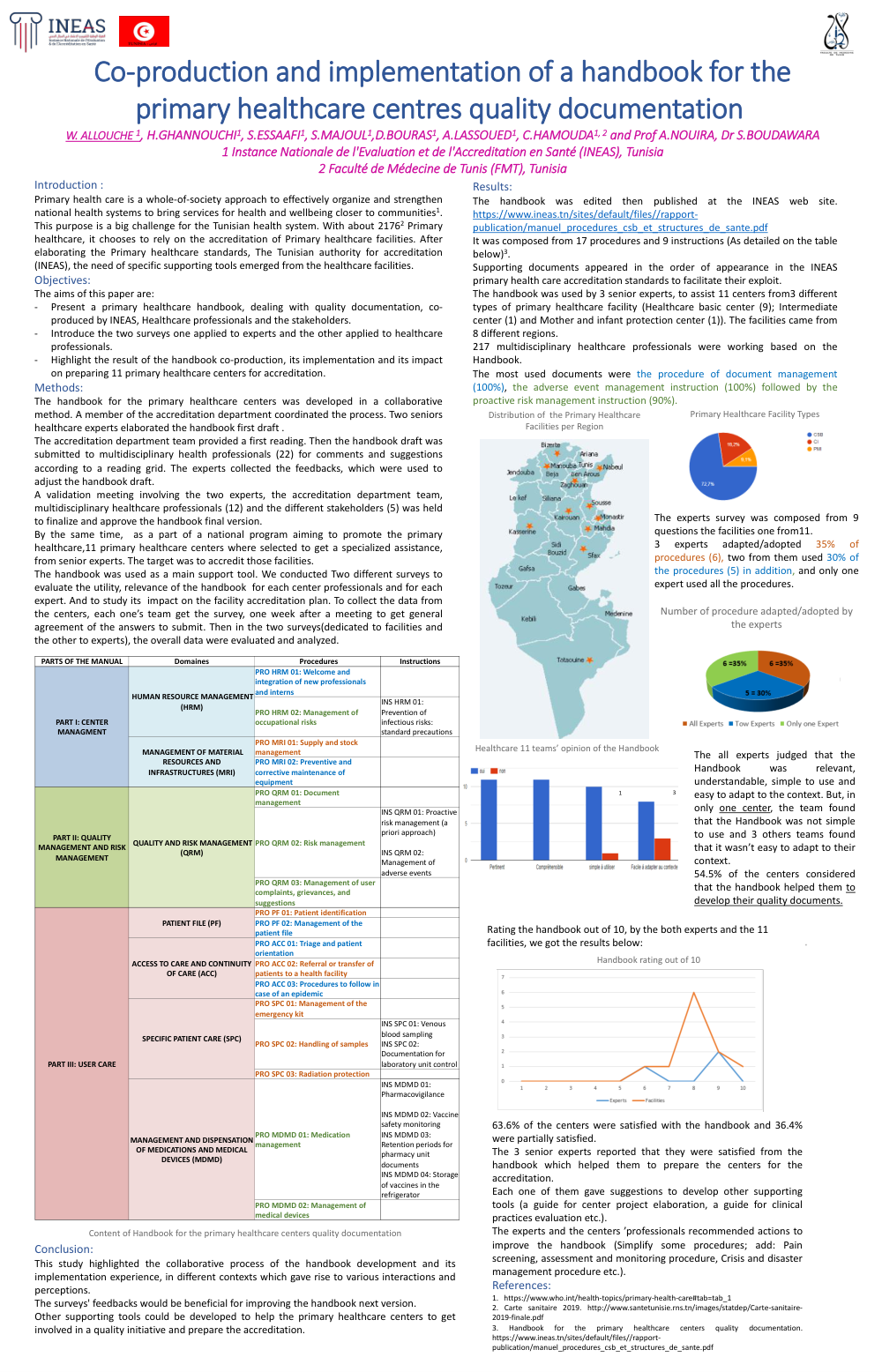
The handbook was used by 3 senior experts, to assist 11 centers from3 different types of primary healthcare facility (Healthcare basic center (9); Intermediate center (1) and Mother and infant protection center (1)). The facilities came from 8 different regions.
217 multidisciplinary healthcare professionals were working based on the Handbook.
The most used documents were the procedure of document management (100%), the adverse event management instruction (100%) followed by the proactive risk management instruction (90%).
The experts survey was composed from 9 questions the facilities one from11.
3 experts adapted/adopted same 35% of procedures (6), two from them used 30% procedures (5) in addition and only one expert used all the procedures.
The all experts judged that the Handbook was relevant, understandable, simple to use and easy to adapt to the context. But, in only one center, the team found that the Handbook was not simple to use and 3 others teams found that it wasn’t easy to adapt to their context.
54.5% of the centers considered that the handbook helped them to develop their quality documents.
Rating the handbook out of 10, by the both experts and the 11 facilities, we got the results below:
63.6% of the centers were satisfied with the handbook and 36.4% were partially satisfied.
The 3 senior experts reported that they were satisfied from the handbook which helped them to prepare the centers for the accreditation.
Each one of them gave suggestions to develop other supporting tools (a guide for center project elaboration, a guide for clinical practices evaluation etc.).
The experts and the centers ’professionals recommended actions to improve the handbook (Simplify some procedures; add: Pain screening, assessment and monitoring procedure, Crisis and disaster management procedure etc.).
References:
1. https://www.who.int/health-topics/primary-health-care#tab=tab_1
2. Carte sanitaire 2019. http://www.santetunisie.rns.tn/images/statdep/Carte-sanitaire-2019-finale.pdf
3. Handbook for the primary healthcare centers quality documentation. https://www.ineas.tn/sites/default/files//rapport-publication/manuel_procedures_csb_et_structures_de_sante.pdf