586 posters, 8 topics, 23 sessions, 1,077 authors, 622 institutions
ePostersLive by SciGen Technologies S.A. All rights reserved.
ISQua's 40th International Conference 2024
24th - 27th September 2024 | Istanbul, Türkiye

ISQUA2024-ABS-2667
Digital Health Transformation: “What and How to Achieve Success?”
Poster Presenter
Authors
Rr Tutik Sri Hariyati, Azis Sheikh, Hanny Handiyani, Tuti Afriani, Andi Amalia Wildani, Djoni Darmadjaja
Affiliations
Faculty of Nursing Universitas Indonesia, Faculty of Nursing, Universitas Indonesia, The University of Edinburgh, Edinburg, United Kingdom, 4IsQua Board, Dublin, Ireland, KARS, Jakarta Indonesia
Part of Topic
Future of Healthcare: AI and Digital Transformation
Digital Health Transformation: “What and How to Achieve Success?”
Rr Tutik Sri Hariyati* 1, 2, Azis Sheikh3, 4, Hanny Handiyani,1 Tuti Afriani, 1, Andi Amalia Wildani,1 dr. Djoni Dharmajaja2, 4
1Faculty of Nursing Universitas Indonesia, Depok, 2KARS, Jakarta, Indonesia, 3 The University of Edinburgh, Edinburg, United Kingdom, 4IsQua Board, Dublin, Ireland
1.Introduction
Digital health transformation has emerged as a pivotal force reshaping the Indonesian health sector, with profound implications for quality of care and patient safety. Transformation is very useful since health services-related information is open for people and helps them to avoid disparities in the standards of health services provided and helps them avoid gaps in the standard of health services provided. Many efforts have been made to make the digital health transformation a success, including the creation of a digital ecosystem, which the team has helped accelerate society's adoption of the disruptions influenced by the digitalization transformation.
Keyword:
Digital Health Transformation, Electronic Health Records, Quality of Care
2. Method
This research aims to analyse assistance in accelerating the implementation of electronic medical records and data integration of "SATU SEHAT Indonesia." The design used was descriptive qualitative through Focus Group Discussions with eleven participants from the team working group that formed by the government to help implement digital health transformation. Other participants are users and leaders of organizations involved in EMR implementation. The FGD was conducted in the meeting online room and was held for about 60 minutes. All information from the participants were recorded by tape recording. All data in this study have been verified and reached saturation at the end of the interview. The FGD ended when all questions were answered, and all participants submitted their information. Transcripts were read twice to catch any writing error, then the data were organised, extracted to find meaningful using thematic approach.
3. Result
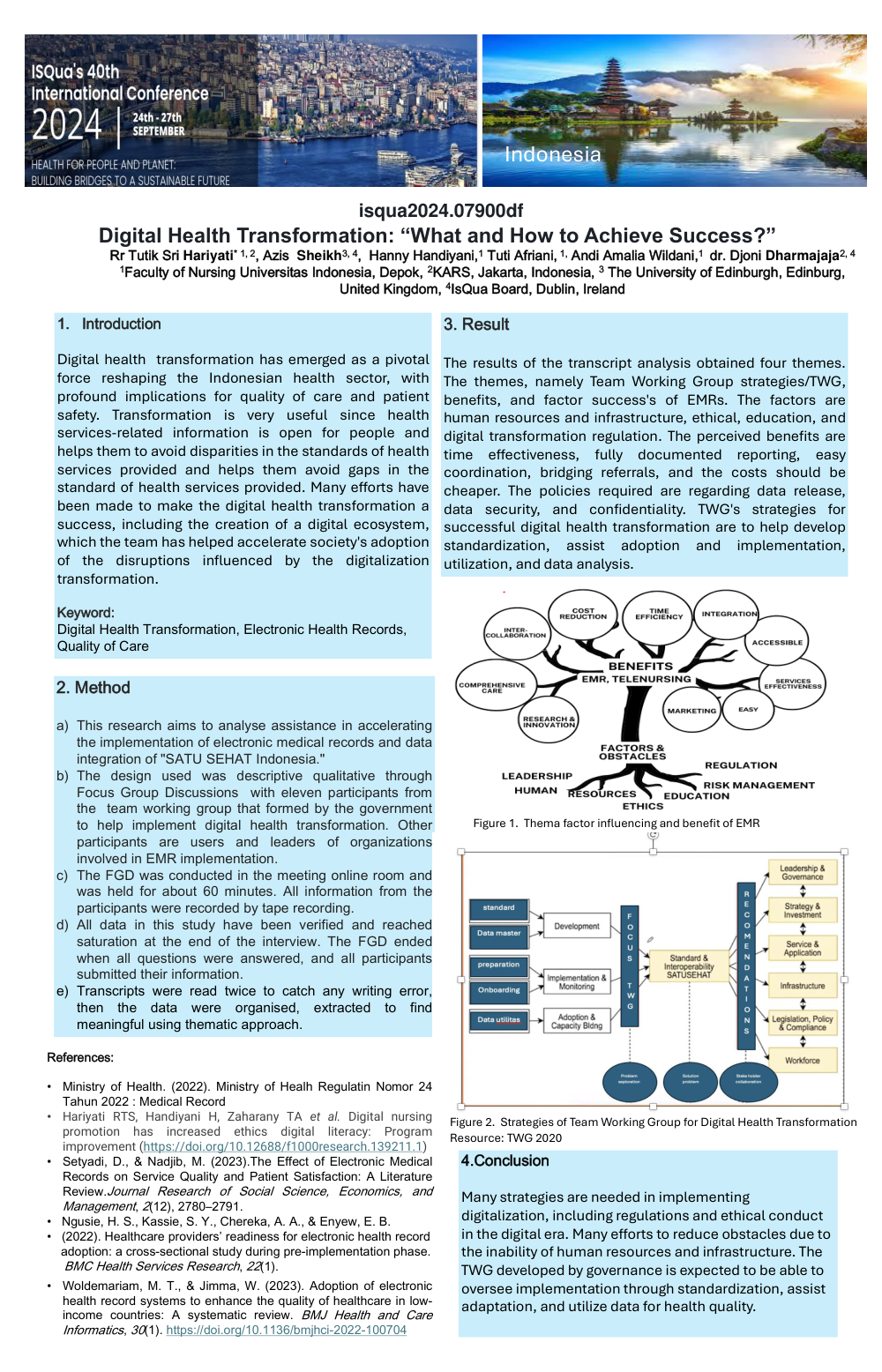
The results of the transcript analysis obtained four themes. The themes, namely Team Working Group strategies/TWG, benefits, and factor success's of EMRs. The factors are human resources and infrastructure, ethical, education, and digital transformation regulation. The perceived benefits are time effectiveness, fully documented reporting, easy coordination, bridging referrals, and the costs should be cheaper. The policies required are regarding data release, data security, and confidentiality. TWG's strategies for successful digital health transformation are to help develop standardization, assist adoption and implementation, utilization, and data analysis.
4.Conclusion
Many strategies are needed in implementing digitalization, including regulations and ethical conduct in the digital era. Many efforts to reduce obstacles due to the inability of human resources and infrastructure. The TWG developed by governance is expected to be able to oversee implementation through standardization, assist adaptation, and utilize data for health quality.
References:
Ministry of Health. (2022). Ministry of Healh Regulatin Nomor 24 Tahun 2022 : Medical Record
Hariyati RTS, Handiyani H, Zaharany TA et al. Digital nursing promotion has increased ethics digital literacy: Program improvement (https://doi.org/10.12688/f1000research.139211.1)
Setyadi, D., & Nadjib, M. (2023).The Effect of Electronic Medical Records on Service Quality and Patient Satisfaction: A Literature Review.Journal Research of Social Science, Economics, and Management, 2(12), 2780–2791.
Ngusie, H. S., Kassie, S. Y., Chereka, A. A., & Enyew, E. B. (2022). Healthcare providers’ readiness for electronic health record adoption: a cross-sectional study during pre-implementation phase. BMC Health Services Research, 22(1).
Woldemariam, M. T., & Jimma, W. (2023). Adoption of electronic health record systems to enhance the quality of healthcare in low-income countries: A systematic review. BMJ Health and Care Informatics, 30(1). https://doi.org/10.1136/bmjhci-2022-100704