586 posters, 8 topics, 23 sessions, 1,077 authors, 622 institutions
ePostersLive by SciGen Technologies S.A. All rights reserved.
ISQua's 40th International Conference 2024
24th - 27th September 2024 | Istanbul, Türkiye

ISQUA2024-ABS-2387
Prioritising electronic health record optimisation to reduce technology-related prescribing errors and improve patient safety: results from two tertiary paediatric hospitals
Poster Presenter
Authors
Magda Z Raban, Alison Merchant, Erin Fitzpatrick, Md Bayzidur Rahman, Ling Li, Johanna I Westbrook
Affiliations
Part of Topic
Future of Healthcare: AI and Digital Transformation
Prioritising electronic health record optimisation to reduce technology-related prescribing errors and improve patient safety: results from two tertiary paediatric hospitals
Raban MZ, Merchant A, Fitzpatrick E, Rahman B, Li L, Westbrook JI
Australian Institute of Health Innovation, Macquarie University, Sydney Australia
Background: Technology-related errors (TREs) occur from the design, functionality or use of electronic health records (EHRs). However, system managers require an effective means of prioritising EHR optimisation activities.
of prescribing errors in hospitals are technology-related, which can be mitigated through EHR optimisation.
Pareto principle: Is one approach to prioritising quality improvement initiatives. It identifies the causes contributing to 80% of the effects, i.e. the vital few. Targeting the vital few will deliver the largest quality and safety gains.
Objective: To identify priority areas for EHR optimisation to reduce technology-related prescribing errors at two paediatric hospitals using quality improvement methods.
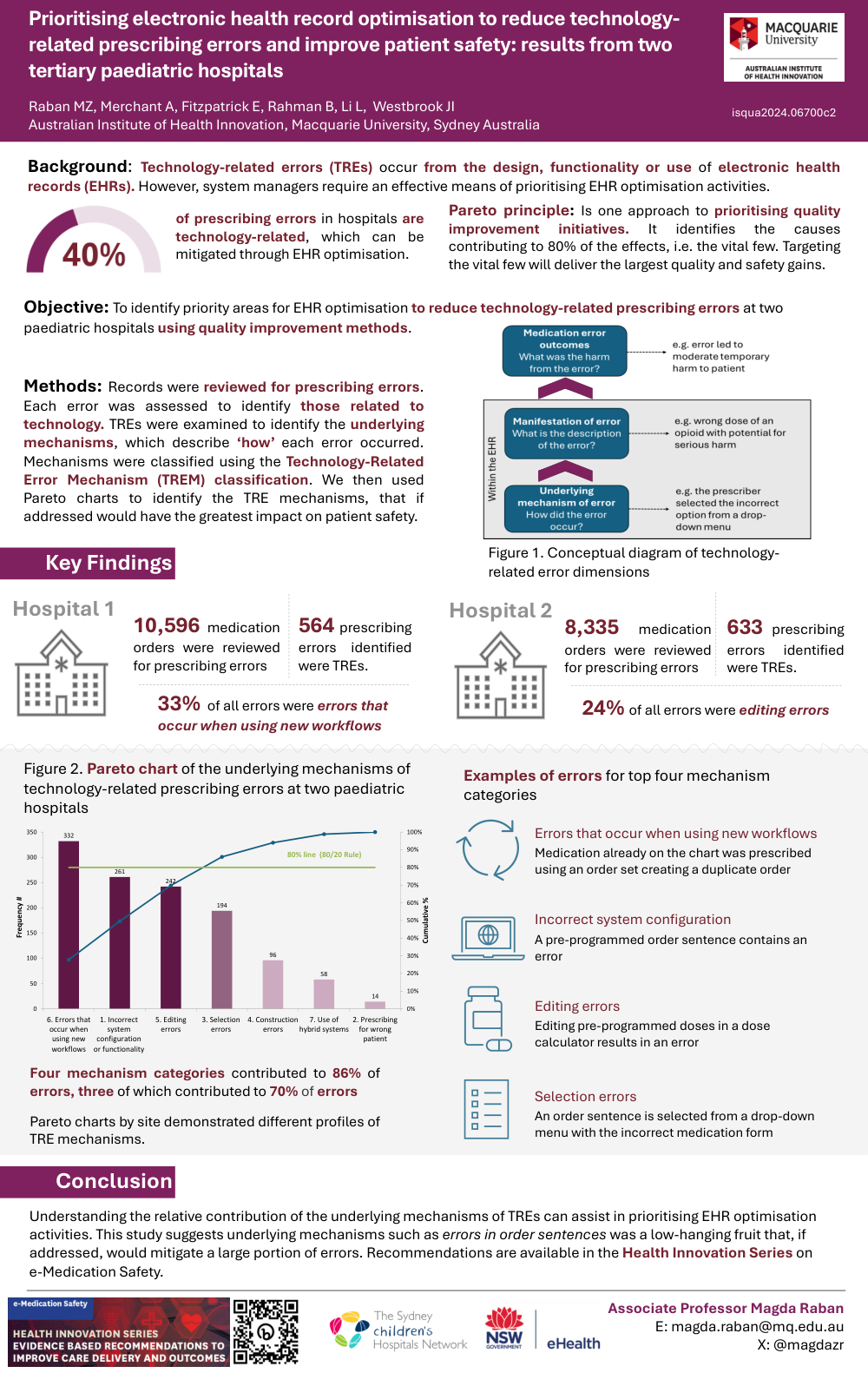
Methods: Records were reviewed for prescribing errors. Each error was assessed to identify those related to technology. TREs were examined to identify the underlying mechanisms, which describe ‘how’ each error occurred. Mechanisms were classified using the Technology-Related Error Mechanism (TREM) classification. We then used Pareto charts to identify the TRE mechanisms, that if addressed would have the greatest impact on patient safety.
Key Findings
Four mechanism categories contributed to 86% of errors, three of which contributed to 70% of errors
Pareto charts by site demonstrated different profiles of TRE mechanisms.
Conclusion
Understanding the relative contribution of the underlying mechanisms of TREs can assist in prioritising EHR optimisation activities. This study suggests underlying mechanisms such as errors in order sentences was a low-hanging fruit that, if addressed, would mitigate a large portion of errors. Recommendations are available in the Health Innovation Series on e-Medication Safety.