586 posters, 8 topics, 23 sessions, 1,077 authors, 622 institutions
ePostersLive by SciGen Technologies S.A. All rights reserved.
ISQua's 40th International Conference 2024
24th - 27th September 2024 | Istanbul, Türkiye

ISQUA2024-ABS-2370
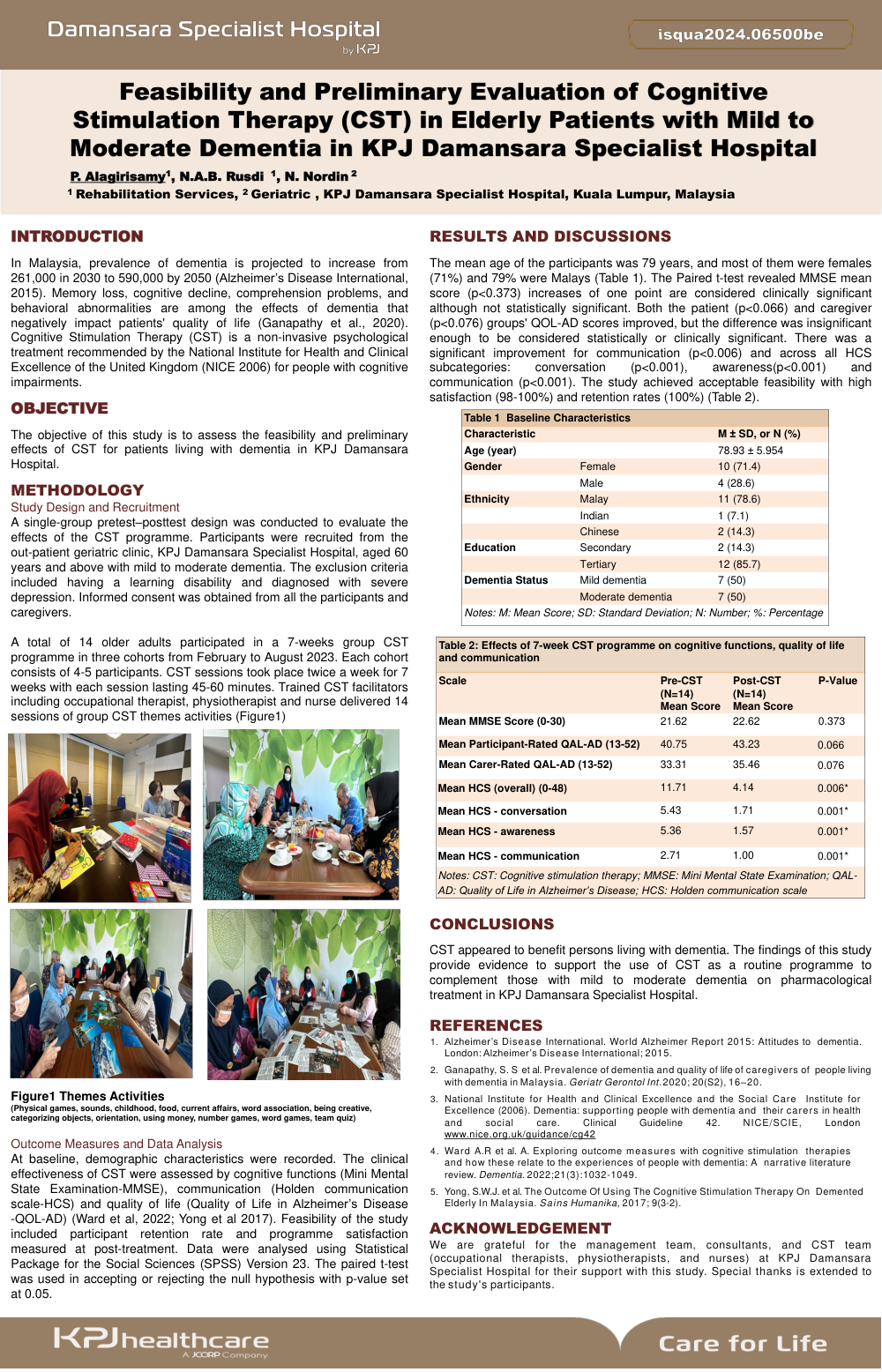
Feasibility and Preliminary Evaluation of Cognitive Stimulation Therapy (CST) in Elderly Patients with Mild to Moderate Dementia in KPJ Damansara Specialist Hospital
Poster Presenter
Authors
Affiliations
Part of Topic
Co-production - Creating a patient-centred healthcare service
Feasibility and Preliminary Evaluation of Cognitive Stimulation Therapy (CST) in Elderly Patients with Mild to Moderate Dementia in KPJ Damansara Specialist Hospital
P. Alagirisamy1, N.A.B. Rusdi 1, N. Nordin 2
1 Rehabilitation Services, 2 Geriatric , KPJ Damansara Specialist Hospital, Kuala Lumpur, Malaysia
Introduction
In Malaysia, prevalence of dementia is projected to increase from 261,000 in 2030 to 590,000 by 2050 (Alzheimer’s Disease International, 2015). Memory loss, cognitive decline, comprehension problems, and behavioral abnormalities are among the effects of dementia that negatively impact patients' quality of life (Ganapathy et al., 2020). Cognitive Stimulation Therapy (CST) is a non-invasive psychological treatment recommended by the National Institute for Health and Clinical Excellence of the United Kingdom (NICE 2006) for people with cognitive impairments.
Objective
The objective of this study is to assess the feasibility and preliminary effects of CST for patients living with dementia in KPJ Damansara Hospital.
Methodology
Study Design and Recruitment
A single-group pretest–posttest design was conducted to evaluate the effects of the CST programme. Participants were recruited from the out-patient geriatric clinic, KPJ Damansara Specialist Hospital, aged 60 years and obove with mild to moderate dementia. The exclusion criteria included having a learning disability and diagnosed with severe depression. Informed consent was obtained from all the participants and caregivers.
A total of 14 older adults participated in a 7-weeks group CST programme in three cohorts from February to August 2023. Each cohort consists of 4-5 participants. CST sessions took place twice a week for 7 weeks with each session lasting 45-60 minutes. Trained CST facilitators including occupational therapist, physiotherapist and nurse delivered 14 sessions of group CST themes activities (Figure1)
Outcome Measures and Data Analysis
At baseline, demographic characteristics were recorded. The clinical effectiveness of CST were assessed by cognitive functions (Mini Mental State Examination-MMSE), communication (Holden communication scale-HCS) and quality of life (Quality of Life in Alzheimer’s Disease -QOL-AD) (Ward et al, 2022; Yong et al 2017). Feasibility of the study included participant retention rate and programme satisfaction measured at post-treatment. Data were analysed using Statistical Package for the Social Sciences (SPSS) Version 23. The paired t-test was used in accepting or rejecting the null hypothesis with p-value set at 0.05.
Results
The mean age of the participants was 79 years, and most of them were females (71%) and 79% were Malays (Table 1). The Paired t-test revealed MMSE mean score (p<0.373) increases of one point are considered clinically significant although not statistically significant. Both the patient (p<0.066) and caregiver (p<0.076) groups' QOL-AD scores improved, but the difference was insignificant enough to be considered statistically or clinically significant. There was a significant improvement for communication (p<0.006) and across all HCS subcategories: conversation (p<0.001), awareness(p<0.001) and communication (p<0.001). The study achieved acceptable feasibility with high satisfaction (98-100%) and retention rates (100%) (Table 2).
Conclusions
CST appeared to benefit persons living with dementia. The findings of this study provide evidence to support the use of CST as a routine program to complement those with mild to moderate dementia on pharmacological treatment in KPJ Damansara Specialist Hospital.