708 posters, 8 topics, 16 sessions, 1,190 authors, 600 institutions
ePostersLive by SciGen Technologies S.A. All rights reserved.
ISQua's 39th International Conference 2023
August 27 - 30, 2023 | Seoul, Republic of Korea

ISQUA2023-ABS-1800
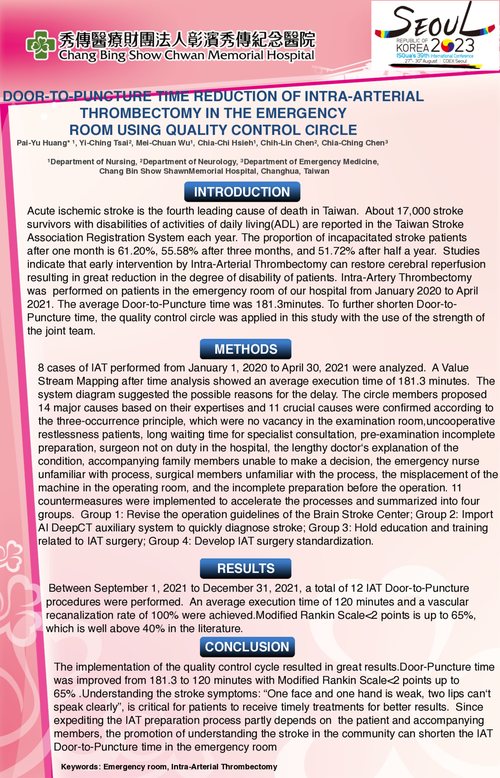
DOOR-TO-PUNCTURE TIME REDUCTION OF INTRA-ARTERIAL THROMBECTOMY IN THE EMERGENCY ROOM USING QUALITY CONTROL CIRCLE
Poster Presenter
Authors
Affiliations
Part of Topic
Patient Safety & Quality Improvement
DOOR-TO-PUNCTURE TIME REDUCTION OF INTRA-ARTERIAL THROMBECTOMY IN THE EMERGENCY
ROOM USING QUALITY CONTROL CIRCLE
Introduction
Acute ischemic stroke is the fourth leading cause of death in Taiwan. About 17,000 stroke survivors with disabilities of activities of daily living(ADL) are reported in the Taiwan Stroke Association Registration System each year. The proportion of incapacitated stroke patients after one month is 61.20%, 55.58% after three months, and 51.72% after half a year. Studies indicate that early intervention by Intra-Arterial Thrombectomy can restore cerebral reperfusion resulting in great reduction in the degree of disability of patients. Intra-Artery Thrombectomy was performed on patients in the emergency room of our hospital from January 2020 to April 2021. The average Door-to-Puncture time was 181.3minutes. To further shorten Door-to-Puncture time, the quality control circle was applied in this study with the use of the strength of the joint team.
Methods
8 cases of IAT performed from January 1, 2020 to April 30, 2021 were analyzed. A Value Stream Mapping after time analysis showed an average execution time of 181.3 minutes. The system diagram suggested the possible reasons for the delay. The circle members proposed 14 major causes based on their expertises and 11 crucial causes were confirmed according to the three-occurrence principle, which were no vacancy in the examination room,uncooperative restlessness patients, long waiting time for specialist consultation, pre-examination incomplete preparation, surgeon not on duty in the hospital, the lengthy doctor‘s explanation of the condition, accompanying family members unable to make a decision, the emergency nurse unfamiliar with process, surgical members unfamiliar with the process, the misplacement of the machine in the operating room, and the incomplete preparation before the operation. 11 countermeasures were implemented to accelerate the processes and summarized into four groups. Group 1: Revise the operation guidelines of the Brain Stroke Center; Group 2: Import AI DeepCT auxiliary system to quickly diagnose stroke; Group 3: Hold education and training related to IAT surgery; Group 4: Develop IAT surgery standardization.
Results
Between September 1, 2021 to December 31, 2021, a total of 12 IAT Door-to-Puncture procedures were performed. An average execution time of 120 minutes and a vascular recanalization rate of 100% were achieved.Modified Rankin Scale<2 points is up to 65%, which is well above 40% in the literature.
Conclusion
The implementation of the quality control cycle resulted in great results.Door-Puncture time was improved from 181.3 to 120 minutes with Modified Rankin Scale<2 points up to 65% .Understanding the stroke symptoms: “One face and one hand is weak, two lips can‘t speak clearly”, is critical for patients to receive timely treatments for better results. Since expediting the IAT preparation process partly depends on the patient and accompanying members, the promotion of understanding the stroke in the community can shorten the IAT Door-to-Puncture time in the emergency room.