708 posters, 8 topics, 16 sessions, 1,190 authors, 600 institutions
ePostersLive by SciGen Technologies S.A. All rights reserved.
ISQua's 39th International Conference 2023
August 27 - 30, 2023 | Seoul, Republic of Korea

ISQUA2023-ABS-1060
UTILIZING FAILURE MODES AND EFFECTS ANALYSIS TO PROMOTE MEDICAL QUALITY AND PATIENT SAFETY BY IMPROVING THE PLANNING PROCESS IN RADIOTHERAPY
Part of Topic
Patient Safety & Quality Improvement
【Purpose】
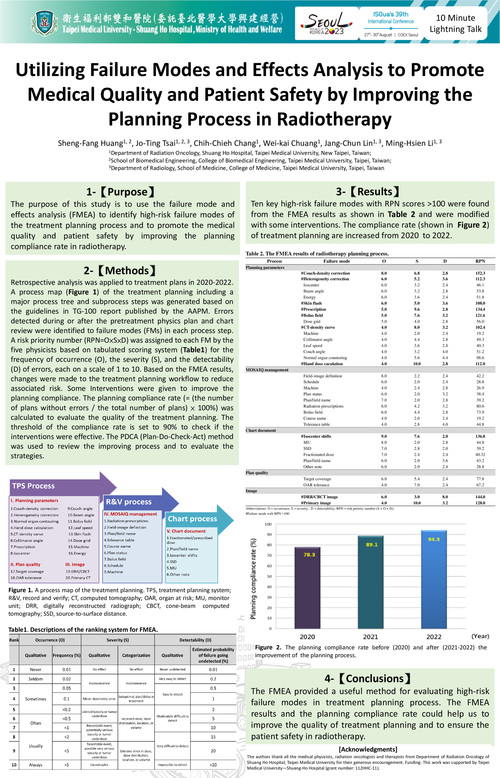
The purpose of this study is to use the failure mode and effects analysis (FMEA) to identify high-risk failure modes of the treatment planning process and to promote the medical quality and patient safety by improving the planning compliance rate in radiotherapy.
【Methods】
Retrospective analysis was applied to treatment plans in 2020-2022. A process map (Figure 1) of the treatment planning including a major process tree and subprocess steps was generated based on the guidelines in TG-100 report published by the AAPM. Errors detected during or after the pretreatment physics plan and chart review were identified to failure modes (FMs) in each process step. A risk priority number (RPN=O×S×D) was assigned to each FM by the five physicists based on tabulated scoring system (Table1) for the frequency of occurrence (O), the severity (S), and the detectability (D) of errors, each on a scale of 1 to 10. Based on the FMEA results, changes were made to the treatment planning workflow to reduce associated risk. Some Interventions were given to improve the planning compliance. The planning compliance rate (= (the number of plans without errors / the total number of plans) × 100%) was calculated to evaluate the quality of the treatment planning. The threshold of the compliance rate is set to 90% to check if the interventions were effective. The PDCA (Plan-Do-Check-Act) method was used to review the improving process and to evaluate the strategies.
【Results】
Ten key high‐risk failure modes with RPN scores >100 were found from the FMEA results as shown in Table 2 and were modified with some interventions. The compliance rate (shown in Figure 2) of treatment planning are increased from 2020 to 2022.
【Conclusions】
The FMEA provided a useful method for evaluating high-risk failure modes in treatment planning process. The FMEA results and the planning compliance rate could help us to improve the quality of treatment planning and to ensure the patient safety in radiotherapy.
Keywords: FMEA, planning, quality, patient safety, radiotherapy