708 posters, 8 topics, 16 sessions, 1,190 authors, 600 institutions
ePostersLive by SciGen Technologies S.A. All rights reserved.
ISQua's 39th International Conference 2023
August 27 - 30, 2023 | Seoul, Republic of Korea

ISQUA2023-ABS-1122
EFFECTIVENESS OF THE HUDDLE RUN MEETINGS IN IMPROVING THE PATIENT SAFETY CULTURE AMONG CLINICAL TEAM MEMBERS
Poster Presenter
Authors
Affiliations
Part of Topic
Patient Safety & Quality Improvement
Background
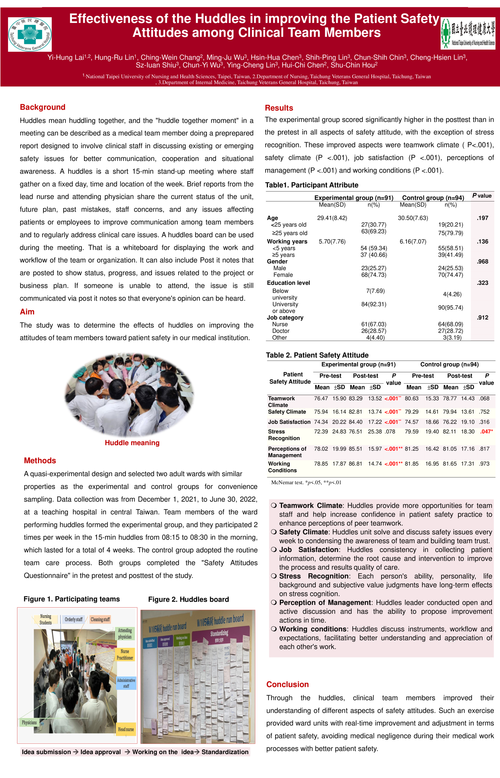
Huddles mean huddling together, and the "huddle together moment" in a meeting can be described as a medical team member doing a preprepared report designed to involve clinical staff in discussing existing or emerging safety issues for better communication, cooperation and situational awareness. A huddles is a short 15-min stand-up meeting where staff gather on a fixed day, time and location of the week. Brief reports from the lead nurse and attending physician share the current status of the unit, future plan, past mistakes, staff concerns, and any issues affecting patients or employees to improve communication among team members and to regularly address clinical care issues. A huddles board can be used during the meeting. That is a whiteboard for displaying the work and workflow of the team or organization. It can also include Post it notes that are posted to show status, progress, and issues related to the project or business plan. If someone is unable to attend, the issue is still communicated via post it notes so that everyone's opinion can be heard.
Aim
The study was to determine the effects of huddles on improving the attitudes of team members toward patient safety in our medical institution.
Methods
A quasi-experimental design and selected two adult wards with similar properties as the experimental and control groups for convenience sampling. Data collection was from December 1, 2021, to June 30, 2022, at a teaching hospital in central Taiwan. Team members of the ward performing huddles formed the experimental group, and they participated 2 times per week in the 15-min huddles from 08:15 to 08:30 in the morning, which lasted for a total of 4 weeks. The control group adopted the routine team care process. Both groups completed the "Safety Attitudes Questionnaire" in the pretest and posttest of the study.
Results
The experimental group scored significantly higher in the posttest than in the pretest in all aspects of safety attitude, with the exception of stress recognition. These improved aspects were teamwork climate ( P<.001), safety climate (P <.001), job satisfaction (P <.001), perceptions of management (P <.001) and working conditions (P <.001).
Conclusion
Through the huddles, clinical team members improved their understanding of different aspects of safety attitudes. Such an exercise provided ward units with real-time improvement and adjustment in terms of patient safety, avoiding medical negligence during their medical work processes with better patient safety.